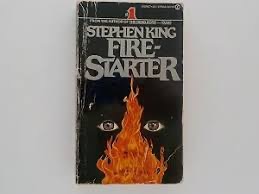
I believe that 1980’s “Firestarter” was another one of the battered paperbacks that my mom’s friend gave to me when I was 11 or so. It wasn’t one of my favorites and on re-read I think it’s a step down from the previous books I’ve written about, “The Dead Zone” and “The Long Walk.” But I definitely think there’s more depth to “Firestarter” than I picked up as a grade schooler.
The book starts out in media res, with our protagonists—8-year old Charlie McGee and her father, Andrew—broke and on the run in New York City. We soon learn that they are on the run from a shadowy government agency known as “The Shop”—a fictional agency (but one clearly modeled after the CIA). Andrew and his wife were part of a Shop-funded experiment in college, in which they were dosed with an experimental drug called “Lot 9,” which gave Andrew the limited ability to control people’s minds (though at great cost to him—each use causes him debilitating brain trauma) and his wife minor telekinetic powers. Their daughter Charlie—the titular Firestarter—is far more powerful than either of them, with the power to create fire with her mind. The Shop wants her power, to control and to study—and in the process of trying to kidnap Charlie, Shop agents tortured and killed Vicki. Andrew, we see in a flashback, foiled the abduction, and he and Charlie have been on the run ever since.
As with “The Dead Zone” and “The Long Walk,” the plot of “Firestarter” was clearly influenced by actual events in the 60s and 70s. King’s “Afterword” for the novel notes that:
[M]ost of the novel’s components are based on actual happenings, either unpleasant or inexplicable or simply fascinating. Among the unpleasant ones is the undeniable fact that the U.S. government, or agencies thereof, has indeed administered potentially dangerous drugs to unwitting subjects on more than one occasion.
While King doesn’t enumerate these experiments, a few come to mind: the Untreated Syphilis Study at Tuskegee, undertaken by the U.S. Public Health Service on black men without their consent ; and the CIA-funded MK Ultra program, in which unknowing subjects were dosed with LSD . I imagine the latter of these was primarily on King’s mind when he wrote “Firestarter,” as the U.S. Senate convened the Church Committee, which investigated various misdeeds by the CIA including MK Ultra’s LSD experiments, in 1975, just five years prior to the publication of “Firestarter.”
Although King was writing before the Unabomber’s heyday, I also thought of the Ted Kaczynski. Kaczynski was the subject of a CIA-funded experiment when he attended Harvard, which went something like this:
Each of the students was seated in front of bright lights, wired to electrodes and subjected to what [was] described as “vehement, sweeping, and personally abusive” interrogations, during which members of [the] research team would attack the student subjects’ ideals and beliefs, as gleaned from their essays. The goal was to measure how the students responded to intense psychological stress.
Even if this wasn’t on King’s mind when he wrote “Firestarter,” this definitely is consistent with the themes of the book: how unethical experimentation can result in vast destruction. In Kaczynski’s case, these experiments may have created a literal “fire starter.”
In any event, we follow Andrew and Charlie as they evade The Shop, whose agents are largely portrayed as bumbling idiots that are unsuited for other employment; at one point, a character ruminates that “if the most efficient of the Shop’s thousand or more employees had to go to work in the private sector, they would have been drawing unemployment benefits before their probationary periods were up.” Exemplifying this incompetence is a Shop agent named Orville “OJ” Jamison, a coward and bully who has nicknamed himself “The Juice” and carries a .357 Magnum that he calls “The Windsucker.” We follow OJ through fuckup after fuckup as Andrew—a penniless English professor—and the 8-year-old Charlie manage to evade a coterie of Shop agents.
The McGees are finally apprehended about halfway through the novel by the only competent employee of the Shop, a hulking, disfigured Native American veteran named John Rainbird. Rainbird brings the McGees to the Shop’s main facility in Virginia, where Andrew and Charlie are forcibly detained and studied. The Shop believes that Andrew is “tipped over” and his mind control powers are no longer operative. But Andrew is biding his time, and the rest of the book is a cat and mouse game between Andrew, who plots his and Charlie’s escape, and Rainbird, the only one at the Shop who suspects anything is amiss.
King’s ability to create captivating secondary and tertiary characters really shines through in “Firestarter.” He uses a “close third person” technique to tell the story from a variety of different characters’ perspectives. So we are not only privy to the thoughts and impressions of our protagonists, Andy and Charlie; but also the murderous Rainbird; a character known as “Cap,” who is the head of “The Shop’” and even a cheap government thug like “The Juice;” among many others. King imbues each of these characters with their own thoughts, dreams, motivations, and backstories, which really adds to the drama of this novel.
By putting the reader into the mind of various Shop operatives, King brings to mind “the banality of evil,” a concept articulated by Hanna Arendt regarding SS Lieutenant Colonel Adolf Eichmann, who handled logistics of. “The Final Solution” during his trial at Nuremburg. To quote Arendt:
I was struck by the manifest shallowness in the doer [ie Eichmann] which made it impossible to trace the uncontestable evil of his deeds to any deeper level of roots or motives. The deeds were monstrous, but the doer – at least the very effective one now on trial – was quite ordinary, commonplace, and neither demonic nor monstrous.
Arendt came to mind as I read the narration provided by various ground level Shop operatives, who just want to catch Andy and Charlie to avoid the displeasure of their bosses. Cap wants to keep Congressional funding flowing and avoid investigations that could institutionally imperil the Shop. Various Shop scientists just want the recognition that studying Charlie will get them. It’s even implied that Vicki’s murder wasn’t part of the plan, but that Shop agents surveilling the McGees’ home mistakenly interpreted Charlie attending a slumber party as the McGees going on the lam. took Charlie’s being gone overnight at a slumber party as the McGees trying to run, and Vicki’s murder just sort of happened. To quote another work of 70s-era paranois, “All The Presidents’ Men:” “These are not very bright guys, and things got out of hand.”
The exception here is the character of John Rainbird, who one could say is truly evil, as well as competent and canny. He’s the one who finally brings in the McGees; he then masquerades as a lowly orderly who mops Charlie’s room while she’s confined to the Shop headquarters and slowly worms his way into her confidence, eventually persuading her to take part in the Shop’s experiments. His reward is that he will get to “dispose” of Charlie once the Shop is done with her: he wants to stare into her eyes as he kills her, in an effort to understand the mystery of death.
He’s a deeply disquieting[1] character, one of King’s most grotesque and fascinating villains. At the same time, he comes off as almost admirable in contrast with the bumbling of the other characters in the novel, and there were times in the second half of the novel that I found myself rooting for him, even as he served as the McGees’ main foil.
Anyhow, Firestarter is a solid book. There isn’t much in the “horror” department; the book is more of a paranoid thriller that just happens to include characters who possess supernatural powers. As in “The Dead Zone,” King doesn’t really bother that much with establishing the science; he doesn’t care about the “hows” or “whys” of the McGees’ powers; at one point a scientist studying Charlie notes that she is able to generate unbelievable heat, but doesn’t burn calories in doing so, a thermodynamic impossibility. The scientist speculates that she’s “channeling” the heat from some other source. But the “hows” and “whys” are never really King’s strong point or interest. What he’s interested in is how normal men and women react when confronted with the uncanny, and that’s where his skill in characterization really shines through in both this book and in many (many, many, many) others.
You can skip the 1984 movie. Everything comes up as cheap—the sets and special effects are cheesy and detract from the movie. Tangerine Dream does the score and I’m not a fan of that either. It’s also dreadfully miscast: David Keith is a wild-eyed brute as Andy (contrary to his characterization as a thoughtful, mild-mannered professor n the novel), Drew Barrymore isn’t very good, and they cast George C Scott as Rainbird. In addition to “whitewashing” a Native American character, at this point of his career Scott was way too old and out of shape to credibly portray Rainbird, who is a frightening and seemingly invincible menace in the novel.
Next time: Speaking of King not really caring about “hows” or “whys” – Christine, in which a a 1958 Plymouth Fury becomes sentient and homicidal!
[1] And also somewhat problematic; at one point Rainbird characterizes himself to Cap as “your red n******.” I’ve previously noted King’s unfortunate penchant for the unnecessary use of racial slurs. I will note that King generally uses these racial slurs to show how villainous his villains are. But it’s really a cheap device and King is way too good to need to use it. I mean Rainbird soliloquizes about wanting to murder an 8-year old girl in cold blood! Do we really need King to throw in racial slurs to emphasize what a bad guy he is??? (Although that is a rhetorical question, the answer is: NO!!!!!!)


Leave a Reply