Category: Blog/All

  • Dorl Family Trip to Iceland Part 6 (of 9)

    Dorl Family Trip to Iceland Part 6 (of 9)

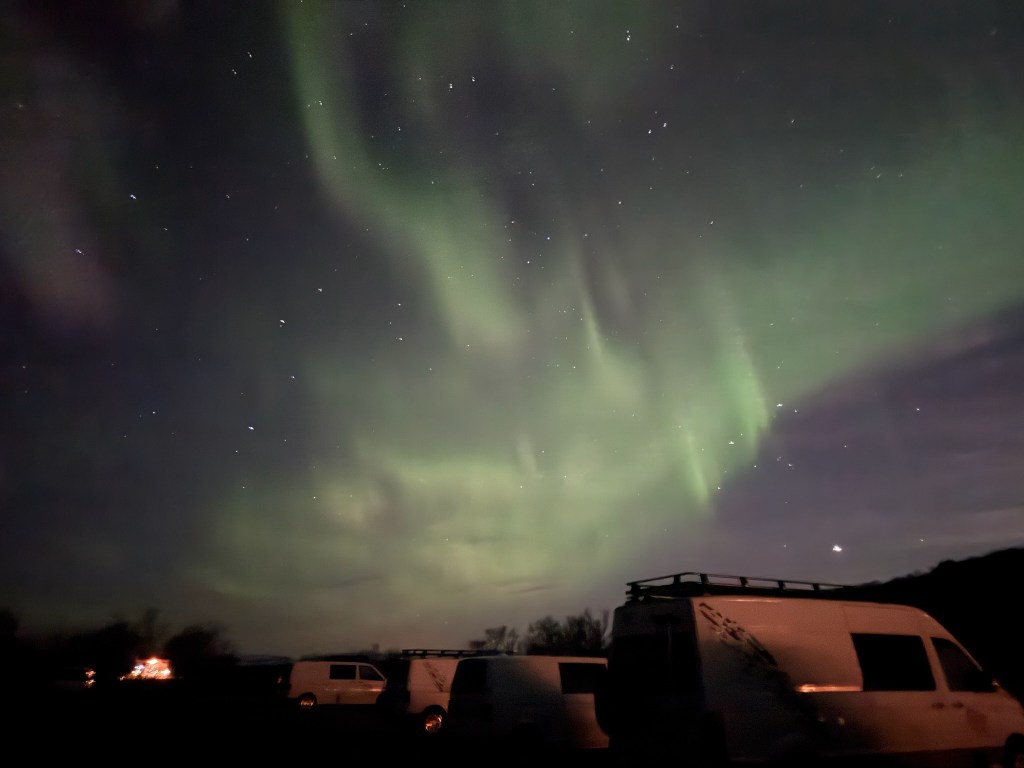
    I woke up in the middle of the night needing to pee and made my way through the darkened campground to the bathrooms. It was a clear night and I stared up at the stars, bright in the sky. I soon noticed eerie, greenish, glowing cloud-like formations in the sky and realized I was looking at the elusive Northern Lights. I stood under them, taking them in, until the chill of the night drove me back into the camper. My jostling as I climbed out of my coat and shoes woke up Kaye, who went out to use the bathroom and came back in and woke the kids to look up at the Northern Lights. 

    We all eventually went back to sleep and awakened at around 8. This campground didn’t have an enclosed kitchen (we came to realize that the campgrounds we’d stayed at the first two nights of our trip had been better equipped than we realized at the time), so we ate our breakfast in the camper van. We all were in good spirits that morning, and called each other by nicknames we’d given each other: Gwen had dubbed me “Gorilla,” and herself “Monkey,” and Billy and Gwen had jointly nicknamed Kaye “A.I. Generated Alpaca.” Despite that creative moniker, Gwen probably referred to Kaye as “sir” more often than that. I assumed Gwen was trying to get under Kaye’s skin by calling her that, but Kaye took it with aplomb the entire time. I was amused by the whole affair, and thought of “The Peanuts” and how Marcie always called Peppermint Patti “sir.” As for Billy, he went by a variety of nicknames during the trip, including “Spider” and “Capybara.” But that morning he was referring to himself as “Whale Shark” and during breakfast playfully pretended to gnaw on my arm. 

    Despite all the good vibes, though, I was constantly scolding the kids and reminding them to keep their breakfast foods over the van table as they dropped crumbs all over the place. Even worse, at one point I caught Gwen wiping her hands on the upholstery, and reminded her that this was our sleeping area in addition to our dining room. Again, I found myself wishing the campground had a dedicated kitchen area where we could’ve eaten without worrying about food getting all over our “bedroom.” 

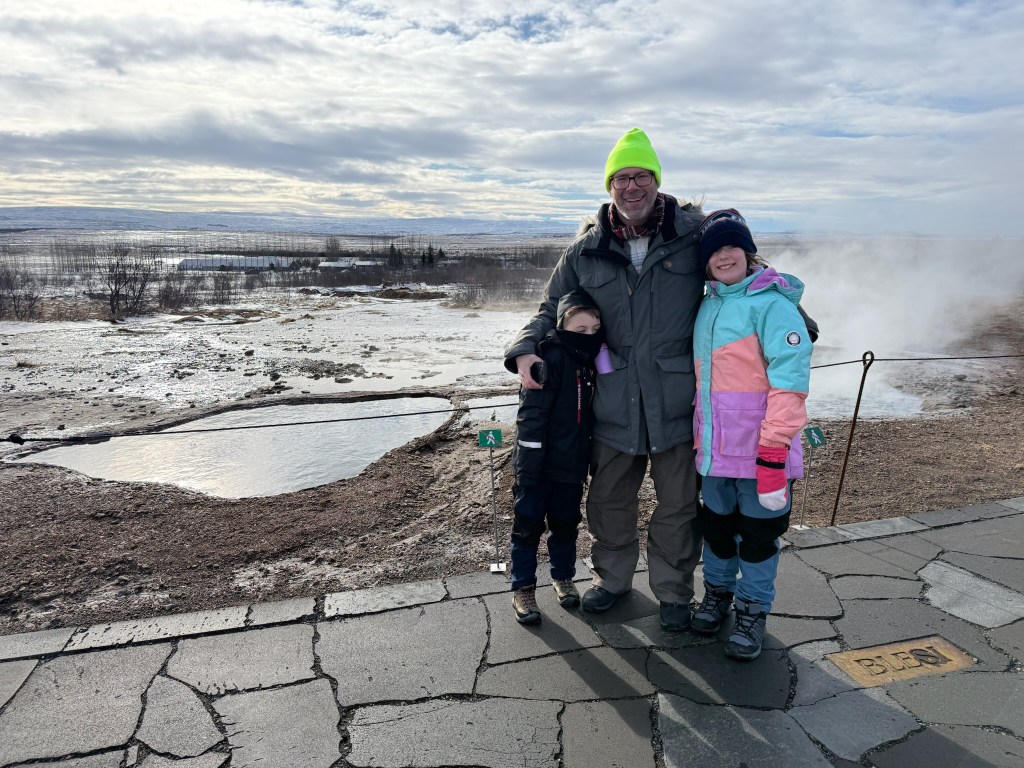
    It was a clear, sunny morning and that weather would hold all day, which let us have our most active day of the trip. I guess you could say that we “made hay while the sun was shining.” 

    Our first expedition was a hike that began inside the campground. A sign near the trailhead showed that we were about a 2-kilometer hike away from the Svartifoss waterfall. We set out at 9:30 and were rather cavalier at first, noting that the distance wasn’t that far even for the kids—we recalled doing a few 2-mile hikes when we’d visited Alaska the previous summer, and figured that the 4-kilometer round trip here (about 2.5 miles) wouldn’t be an issue. But once we started hiking, I realized that the trail was pretty steep, so I let Kaye and the kids keep walking along the trail as I returned to the camper van to grab our water bottles and my trusty bag of almonds in case we needed snacks on the way. After grabbing our provisions, I hurried up the steep trail in pursuit of Kaye and the kids, passing other hikers on the way. Soon I was very hot in the direct sunlight (I was still wearing a wool base layer, snow pants, heavy winter coat and stocking cap) and shed my stocking cap in favor of a windproof headband. 

    When I finally caught up with the rest of my family, the good vibes we’d had that morning had ebbed. The kids were dragging their feet and complaining. I tied to cheer them up by telling them that we weren’t going that much further than a walk to school and told them that we’d hiked this distance in Alaska. That didn’t go over so well and Gwen accused me of lying. Both kids were hot from the uphill climb and the strong sun, so to appease them I packed Billy’s coat in my daypack and carried Gwen’s coat under my arm. Kaye told them, “What a nice dad,” and received only blank stares in return.

    We reached a preliminary, smaller waterfall named Hindefoss. As an avowed waterfall aficionado, I really enjoyed it—spray from the waterfall had formed a sort of ice “chute” from which streamed a flow of water resembling the ablutions from a bathtub faucet, which fell into a bowl-shaped reservoir of white ice that led to a stream, from which the water continued its journey downhill. Spray from the watery downpour had coated the surrounding rock in an icy white glaze. The kids really weren’t having it, though, even as I enthusiastically spurred them up the trail to a watery collection point where the steam of water gathered before pouring out the icy chute below. 

    We continued our journey up the trail, the kids dragging their feet and complaining and groaning the entire way. Kaye and I kept trying to motivate them with, variously, encouragement, challenge, and irritation. At one point Kaye made the point that we should do as much as we could while it was clear and sunny, noting that the weather projected another blizzard that night. Gwen misheard the word “blizzard” and shrieked, “we’re going to get blisters?!??”

    Somehow we managed to keep the kids’ morale high enough that we reached the summit of the trail, where we saw in the distance another mountain completely coated in pure white snow. As we descended the trail, the grand waterfall Svartifoss came into view. It poured down past dark, hexagonal, volcanic basalt columns in a single steam, about 60 feet high. Unlike Hindefoss, the water descended in one great, broad torrent, rather than collecting and then pouring out of a faucet-like structure. Spray from the waterfall had coated some of the hexagonal basalt columns white, and like Hindefoss, accumulated watery spray had formed a bowl-like structure around its terminus. 

    The trail continued from there. Billy and Kaye decided they’d had enough and began their descent back to the camper. But Gwen’s attitude completely turned around and she joined me down a narrow, icy trail to a closer vantage point to Svartifoss. First, we stood on a narrow metal bridge that crossed the stream that connected Svartifoss and fed Hindefoss; then we went back to the trail from which we’d come, and approached the mighty Svartifoss even closer, from the banks of the river. Gwen was attentive the whole time, and listened to me when I told her to stay on the trail and to watch out for slippery spots. I called her a “can do kid,” recalling her first-grade teacher Mr. Leatherwood’s inspirational name for his class. 

    After we had enough of Svartifoss, Gwen and I hiked back toward the trailhead, and saw the terrain that had been at our backs on our way to the waterfalls: a vast plain extending all the way to the ocean, which from our vantage point was a glimmering strip flanked by rocky, mountainous ridges. As we descended the trail, back toward the camper van, she asked me for some ideas for a science fair project. I brought up some of the questions she’d asked that very day: why does hair turn gray (I joked with her that her behavior had given Kaye several new gray hairs this trip); or why do we burp (I told her maybe she could simulate the chemical reaction that causes burps for her science fair). I noted that she didn’t need any ideas from me; she was inquisitive enough on her own. 

    We reached the bottom of the trail and hit the bathrooms before heading back to the camper van. I changed out of my snow pants due to the warmth (by Iceland standards) of the day and realized that I’d worn them every waking moment since I first put them on Saturday morning. But of course, this being Iceland, I would regret my decision to take them off before too long. 

    We got the camper configured for diving (table and luggage stowed, eating benches reconfigured to seats that Billy and Gwen could buckle up into) and hit the road. The terrain was notably different here from the South Coast, where we’d been the last few days: here there was less now on the ground and we could see green, mossy roadside boulders. Kaye told me that this was more along the lines of what she expected from Iceland in late March and that a recent Instagram travel post had compared last March—green, moss-covered terrain—with this year’s ice-encrusted landscape. 

    We had lunch in the town of Kirkjubæjarklaustur (what a mouthful), close to where we camped on our second night in Iceland. We ate at a restaurant named Systrakaffi, which advertised itself with the motto: “no Wi-Fi – talk to each other.” The food was quite good, and Billy was able to get his second (and, to his chagrin, final) decaf caramel latte of the trip there. He gulped it down and declared himself part of the “clean cup club.” 

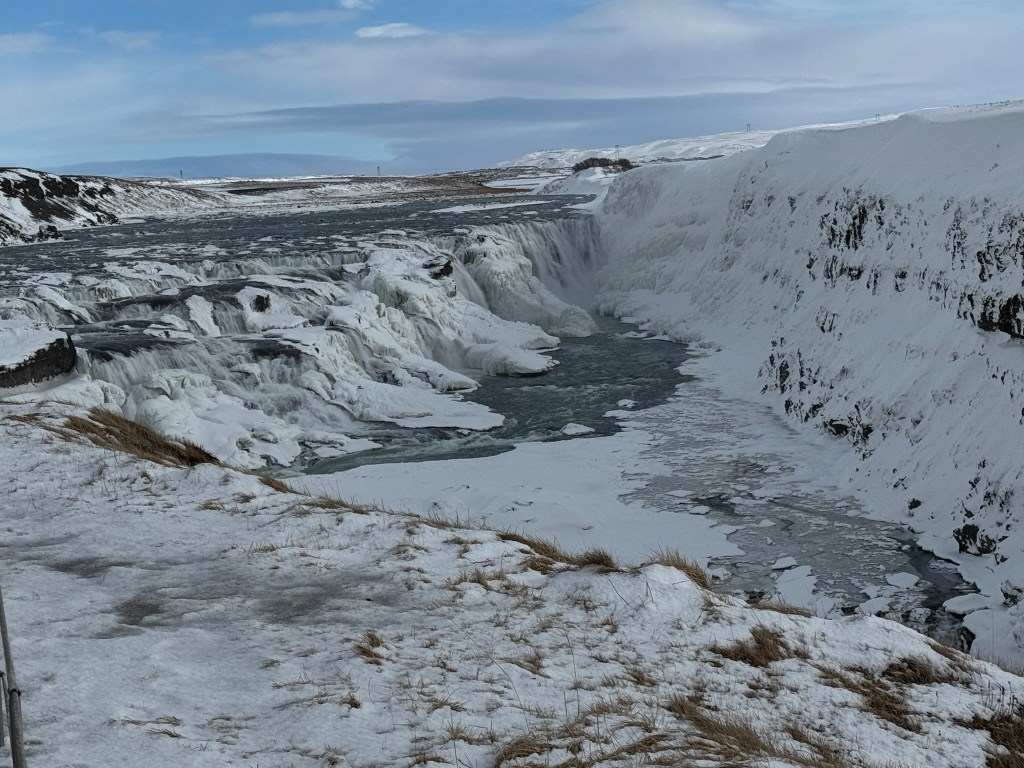
    We then made a short drive to Stjornafoss, a “secret” frozen waterfall (“secret” in that there were only a few scattered people there). It was a flat, snowy hike to the waterfall, and I found myself wishing (not for the last time that day) that I was wearing my snow pants. The waterfall lived up to its “frozen” moniker—most of it had frozen into icy white stalactites, with just a few rivulets of water rushing through the snowy, beardlike ice structures into a pool that was choked with ice floes. I found a rock to sit on and closed my eyes and tried to be “present” with the sound of flowing water, as well as the feeling of icy mist that settled with a chill on my face. But soon the kids were on me, jabbering, and I soon gave up. I hugged both of them to my body and gazed onto the waterfall with some amount of wistfulness, knowing that there was a good chance this would be my only time there. 

    We made our way back toward the car, the kids still jabbering and grab-assing and running ahead of us despite our serious talk with them, before the trip, that they needed to stay with us; and our frequent admonitions during the trip that they needed to heed our warnings and be careful. The last straw came when we were approaching a busy road that we needed to cross to get back to the camper van. Gwen, running ahead of us, tripped in a deep patch of snow and stumbled onto the shoulder of the road as a truck approached. Kaye and I both scolded her and told her she needed to start listening. The intervention had mixed results, at best. 

    Our next stop was Fjaðrárgljúfu—a deep and winding river canyon. It was only around ten miles away, but the landscape changed dramatically; on our way there we entered a lava field, with craggy and undulating fields of lava rock extending as far as the eye could see, which was marked, fittingly, “Epic Mossy Lava Field Viewpoint” on Google Maps. 

    We reached Fjaðrárgljúfu at around 2. A sign there noted that Fjaðrárgljúfu is about 100 meters deep and a little over 1 km long. The sign noted that while the bedrock—mostly palagonite—originated from the Ice Age about two million years ago, the canyon itself was only around 9,000 years ago and was formed when the river Fjaora cut through the bedrock once a glacier retreated, leaving the terrain exposed to the weathering force of the river. 

    Fjaðrárgljúfu is another major Icelandic tourist attraction owing to—as with Skogafoss—Justin Bieber featuring it in one of his music videos. Also like Skogafoss, Fjaðrárgljúfu had a massive parking lot, with dozens of cars and camper vans and many tour buses as well. 

    We started our way up the steep trail of crushed, black, volcanic rock to the top of the canyon. Billy was having none of it, complaining that his hip hurt. The poor kid drew only scorn form the rest of his family; we joked that he acted like he was about to turn 80, rather than 8. At one point we paused mid-trail so he could stretch a bit, and that seemed to help since he managed to make it with the rest of us to a scenic viewpoint, where we could see the great field of lava we’d passed on our way here, stretching out to the horizon. 

    Although the day remained clear and sunny, the winds had picked up again, carrying with them the Arctic chill of the North Atlantic. So Kaye took Billy back down to the camper as Gwen and I continued to the end of the trail. By that point, I was feeling tired and a bit vertiginous at the sheer drop to the bottom of the canyon, 100 meters below, so Gwen and I did not linger long at the end of the trail and made our way back down to the van. 

    We continued on our way, back in the direction of Reykjavik. The lava fields continued for another thirty mile or so, then eventually gave way to trees and shrubs popping out of snow. Then back to lava fields, a layer of ice and snow glazing the volcanic rock and glistening in the sun. I marveled at the way the landscape varied over just an hour’s drive. 

    We reached our next (and final) expedition of the day—Gígjagjá, or “the Yoda Cave,” inside a park known as “Viking Park.” Billy had been enthusiastic about this stop—true to its name, it was a cave, the entrance to which bears a resemblance to Yoda’s silhouetted form, if you squint at it the right way and use your imagination. But what Billy (and the rest of us) didn’t know was that it was a half hour hike across a flat, featureless, blindingly white snowy plain to get to the Yoda Cave. 

    We parked and were accosted by an American couple in their thirties asking us whether we know how to pay for parking. The woman was a blond, wearing a puffer jacket and tasseled beanie; while the man had a gravelly voice, oversized sunglasses, and the accent of a chronic weed smoker. He lit up a cigarette and asked to see the interior of our camper van. I was suspicious at first, but I soon realized he was a harmless goofball who was actually interested in our large-ish camper van. As the two of them trudged off ahead of us, Kaye told me that at first, she’d thought that I knew the guy, as he reminded her of some of my Rockford friends. That comment really made me reconsider my choice in friends. 

    We trudged through the snow to the Yoda Cave, which was muddy, damp, and a bit fetid inside, with droplets of what I assumed was condensation dripping form the top of the cave. Billy stood in the middle of the cave, arms outstretched, face turned toward the top of the cave and his mouth open wide. He was trying to catch drops of condensation in his mouth, but seemed to be getting most of the liquid down the front of his snow jacket. 

    We hiked back to the van, Billy and Kaye majorly outpacing Gwen and I. Gwen at first wondered why those two were going so much faster than us but I reminded her that we’d hiked further than them at both Fjaðrárgljúfu and Skaftafell—and uphill to boot. Like I said, that day was probably the nicest weather we had all trip, and we made the most of it. My pedometer read 25,000 steps (or about 12.5 miles, much of it uphill) for the day. 

    So it was a relief when we checked into the Hotel Selfoss at 7 pm, in the town of Selfoss—the town I’d found incredibly charming when we’d driven though just a few days earlier. The hotel had a spa there, as well as a restaurant, where we ate that night. The restaurant had an awesome view of the Ölfusá river running under the bridge we had crossed on our way away from Reykjavik, and even though the food was mediocre it was nice having real beds to sleep in that night. 

    Kaye and Billy were too tired to head over to an ice cream shop adjoining the hotel, so Gwen and I went to get ice cream for all of us. The girl behind the counter had pretty bad English but gave us a truly astounding amount of ice cream, cramming a huge amount into each of the “small” cups. We all ate our desserts, then fell asleep, exhausted after a long and active day. 

  • Dorl Family Trip To Iceland, Part 4 (of 9)

    Dorl Family Trip To Iceland, Part 4 (of 9)

    I woke at 7 AM that morning. Billy had taken the “center position” between me and Kaye and had clung to me all night, curling his small body next to mine. I was crowded and wary of rolling over onto him, so it wasn’t the greatest night’s sleep; but still, he’s such a loving boy I couldn’t fault him that much. 

    It had snowed overnight and now a fresh layer of snow covered the dangerous ice I’d almost fallen on the night before; ironically the new layer of snow made my path a little less treacherous, as the snow had sufficient “give” to create additional traction as I crossed the lot. 

    We had breakfast in the kitchen that morning. Like the bathrooms, the kitchen was undersized for the population of the campground—just three small tables that could hold four people each. We grabbed a table and had the some of the food we’d picked up at the grocery store—cereal, milk, and yogurt. I also did my best to cook some warm breakfast items using the malfunctioning castoff appliances we found in the campground kitchen; we wound up with burnt toast (the toaster didn’t automatically “pop,” which I only noticed when the smell of burnt toast filled the small kitchen) and lukewarm coffee (a defective electric kettle had a lid that wouldn’t close all the way).  

    The kitchen area also featured a topographic map of the area and highlighted the nearby Laki volcano. Again, we learned some discomfiting facts about volcanic activity in Iceland—the Laki volcano’s eruption in the 1780s let out sulfuric fumes that disrupted agriculture to such an extent that somewhere between 25 and 50 percent of Iceland’s population at the time died, as well as 75 percent of the country’s livestock. The explosion was powerful enough that it disrupted weather patterns worldwide, with some historians linking its eruption to food shortages and price spikes in Europe that led to the French Revolution. 

    After cleaning up after breakfast, I took a shower for 300 Kronen per three minutes. I was able to luxuriate with a whole six minutes, as the rest of the family decided not to use the showers there. Of course, it would be too convenient to be able to deposit all the money for a six-minute shower all at once; rather, I had to put in the money, let my allotted 3 minutes elapse, then shiver as I plugged another six 50-Kronen coins into the machine. After the shower I changed my undies and base layers despite having planned to wear that set for another day. I wasn’t sure when my next shower would be, so I figured I might as well start out as clean as possible for the next leg of our journey. 

    I took Gwen to the bathroom for one last stop before we were on our way at around 9. By that point the wind had picked up and it had begun snowing again, the wind blowing the snow horizontally across the already frozen terrain.  “Another beautiful day in Iceland” I quipped. 

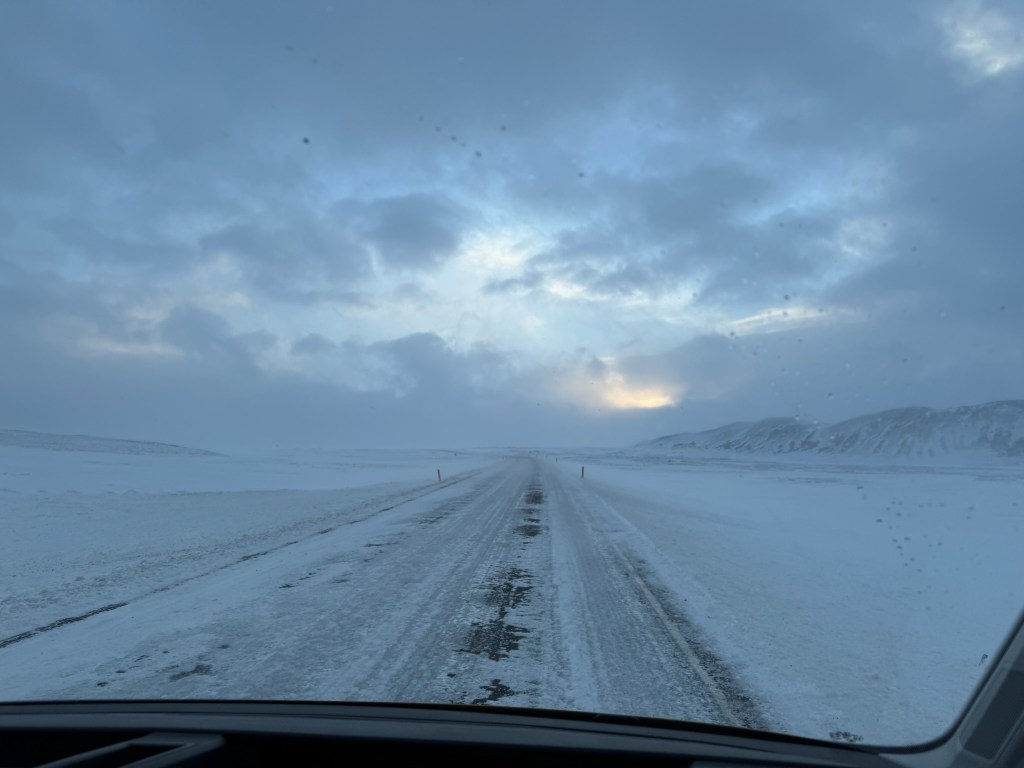
    The blowing snow only thickened as we traveled toward our next stop—Diamond Beach, where we had scheduled a noon trip to ice caves on the Jokulsarionglacier.  I stared as waves of drifting snow washed over the blacktop like steam.

    Even through the blowing snow, the beauty of the Icelandic countryside was striking. The snow let up a bit at one point and we stopped to admire Hvannadalshnúkur, Iceland’s highest mountain, standing 6900 feet above sea level. A plaque nearby noted that Hvannadalshnúkur was an active volcano and two “colossal eruptions” had occurred there in recent years. I stared at it across a vast field of bare rock as Gwen climbed a nearby structure of twisted, graffitied metal beams of unknown origin. The plaque said something about a 12-to-16-hour hike to summit the volcano that started at an abandoned farm town nearby. Gwen and I resolved that one day we would return to Iceland and do that hike. Later, I mused on that vow and remembered that my mom and I had resolved to someday return to Alaska after we’d been there together in 1997, and how that vow remained unfulfilled until her eventual death made it impossible. I wondered to myself whether Gwen’s and my vow would meet the same fate. 

    We continued our drive, through an Icelandic landscape filled with boulders, seemingly of volcanic origin, that were as big as our camper van. I found myself imagining an eruption as we passed by, huge chunks of volcanic rock blocking our path, then sealing us into a rocky cairn. I imagined living off our meager provisions until finally, desperate, I managed to dislodge one of the rocks to escape. My daydream of becoming trapped and having to subsist on our meager provisions would prove prescient. 

    The snow picked up again as we got closer to our destination of Diamond Beach—visibility was terrible as we stopped at a lookout so Billy and I could get out and pee in the fresh snow (there were no bathrooms there) as we were pelted by large snowflakes driven by the cold winds. The lookout wound up being a trailhead for the Jokulsarion Glacier (which also covers the Hvannadalshnúkur volcano we had recently admired). There was a short hike to be done there, but the weather—and our noon reservation for the ice cave tour—prevented us from doing it. On our way back to the van, I spotted a sign that stated that the glacier had retreated 8 kilometers since the 1870s. Doing some quick mental math, I realized that a century and a half ago, the glacier, now invisible from the road, would have stretched past the highway we were driving on and most likely to the sea. It was a sobering reminder of a heating world.  

    We had hoped that Gwen and Kaye could use the bathroom at that stop, but since there were no bathrooms there, we doubled back to the Fjallsárlón Frost Restaurant, which we had passed maybe ten miles back. We arrived at 11 (an hour before our appointment to tour the ice caves) and by that point the snow and wind had picked up to the point that our visibility was almost zero. We walked into the restaurant, which looked eerily abandoned as the blizzard raged outside. Eventually a waitress emerged from the kitchen and told us that due to the blizzard, the restaurant was closing at noon and had no food except for some pre-made cakes and coffee. As Kaye and Gwen used the bathroom and I paid, the waitress consulted road.is—a real-time road map of Iceland–-and pointed out vast swathes of ominous red shapes moving over an outline of the island, designating the horrible weather that blanketed our region. She said that road closures were projected (a prediction that would be proven correct later that day) and asked where we were staying that night. I told her, “In the camper” and she was like “you really shouldn’t stay in the camper tonight, you’re much better off getting a hotel. Maybe you and your wife would be OK but”—she affectionately ruffled Billy’s hair—“the kids might not be.” 

    Kaye came out of the bathroom and almost immediately got a phone call—the guide for the glacier tour canceled for the day and tentatively rescheduled it for 8 AM the next morning. Two independent Icelandic residents had now warned us that the weather was going to be terrible, so we began frantically looking for a place to stay that night, eventually choosing “The Glacier View” hotel in Hoffel, about an hour away, due to their having geothermal hot tubs on the property. We also planned to overshoot Hoffel a bit on Highway 1 and have lunch at Pakkhus restaurant in Hofn, a fishing town whose name literally means “Harbor” in Icelandic. I imagined it as a charming little seaside tourist town, but as I would soon learn, my expectations were way too high. 

    We told the kids about the change in plans and they—particularly Gwen—seemed crestfallen. She let out a disappointed groan when we told her we’d be staying in a hotel that night, and not in the camper. It became clear that the kids were really enjoying the camper van life. 

    I thanked the waitress and asked if she was from around there. She told me that she had moved there from Poland, and I remembered the host of the Lava Show had mentioned that Polish was one of the most widely spoken language in Iceland, due to immigration from that country. I told the waitress that and she seemed a little embarrassed; she said something about hoping that other Polish people were hard workers and were making a good impression on the people of Iceland (and I thought about how immigrant communities all over the world were under pressure from Nativists in their adopted countries). Kaye mentioned that we were from Chicago, with the highest number of Poles outside of Poland, and the waitress responded that all that immigration came around “The War”—which Kaye took to be a comment on the more difficult immigration environment under Trump, and that I thought was a comment on there being a well-established and longstanding immigrant community in Chicago, versus the newer community in Iceland. Our waitress told us she liked living in Iceland; that this was a busy restaurant, located just a 15-minute drive from the popular tourist attraction of Diamond Beach, and they would have up to 1000 people per day. But she said her off days were quiet, and she liked the fact that tourists who come to Iceland were there to see the natural beauty of the country, rather than to drink and party. 

    Later that day I’d see statistics online that there are approximately 20,000 Polish nationals living in Iceland, the biggest group of international residents (approximately 40% of the total immigrant population in Iceland), that they come there for wages that are up to three times as high as that in Poland, and that Polish immigrants find the culture and climate to be similar in Iceland and Poland. 

    We continued our way through the now-blinding snow, skirting close to the sea at Diamond Beach. Through my window, crashing waves were just visible through the whiteout storm. Despite the weather, I saw many cars parked in the parking lot; it seemed that despite our tour operator’s prudence, a lot of people were taking their chances. 

    As we continued to drive through unrelenting snow, Kaye—as in previous vacations in Italy and Ireland, where she transported us safely along steep and winding mountain roads—was her usual steely-eyed and sure-handed driver. After an hour and a half of whiteout conditions, we finally reached Hofn. From the numerous corrugated-metal warehouses there, I realized this was an industrial harbor town, not the charming seaside hamlet I was hoping for. We parked the car and made our way across a snow-packed snow to a restaurant named Pakkhus.

    Like the rest of the town, Pakkhus wasn’t much to look at, at least at first glance. It was perched near the harbor, tugboats docked behind it. It looked like a haphazardly built shack and later I read that the word “Pakkhus” is Icelandic for “warehouse,” and that the restaurant was originally built in 1982 for that purpose, constructed mainly from scrap wood of other houses. There were letters stenciled into that scrap wood that were still visible. In addition to the place not looking like much, we were also wary that it might be closed due to the weather and scoped out some other, similarly unpromising looking places to eat. 

    But despite our fears, inside we found a warmly lit wood interior, with Arcade Fire and other American indy rock playing. It felt like a refuge from the howling winds and ice outside. The food was as welcoming as the atmosphere—it was delicious, the best we’d had in Iceland. We ordered an Icelandic fish stew for us all to eat, and it was a perfect, hearty meal for such a cold and windy day. 

    As we ate, Billy amused us by blowing on the window next to us and then, in the resulting frost, drawing the faces of various Marvel characters (or at least crude representations thereof) and having the rest of us guess who he drew. He did Captain America, Thanos, Ant Man, Spider Man, and others and we all did miserably in guessing who he drew. We were particularly perplexed by his version of Thanos, who sported an incongruous grin. 

    After we ate, I made everyone go behind the restaurant to get photographs in the rather charmless harbor, tugboats in view – I guess it reminded me of my time in Alaskan fish towns where the wharf was full of industrial machinery. Then we headed back to the car to make our way to Hoffel, maybe 20 kilometers away.  

    It was around 1:45 now and the snow and wind were absolutely punishing, reducing visibility virtually to zero. As we dove out of town, we encountered a Toyota Hilux blocking the road. It was an ominous sign: I knew the Hilux as the notoriously durable 4×4 pickup truck favored by ISIS and other militias the world round; in fact, a war between Libya and Chad in the 80s had been known as the “Great Toyota War,” as the two countries had employed Hiluxes outfitted with heavy machine guns in the cargo beds.  We drew closer to the truck, and I saw it was manned by two massive Icelandic men. Kaye lowered her window and the man in the passenger seat told us that the highway had been closed.  Kaye explained that we had a reservation in Hoffel, and they let us through, since it wasn’t too far. 

    But distance is all relative: it took us 45 minutes to drive the 20 kilometers, (or 12 miles) to Hoffel. We had to leave the main road to get to our hotel, and if anything, the road and visibility conditions got even worse on the back roads. We finally made it at around 2:30. As we pulled in, the front door to the main building was opening and closing at seemingly random intervals, the automatic sensor apparently triggered by the heavy snow and accumulating snowdrifts—an incongruous and slightly creepy touch out of a David Lynch movie. My sense of dread mounted as we checked in and the kids cavorted about a cavernous and completely empty dining room, a la “The Shining.” The dining room had a huge picture window that faced the massive Vatnajokull glacier (which accounted for the name of the hotel—“Glacier World”), which was not visible due to the blowing snow and ice. 

    The front desk told us that they didn’t have any food, but would put on a breakfast for us the next morning. When they learned that we would be leaving early the next day for our then-planned 7 AM glacier tour, they brought us up sandwiches and fruit for our journey; they also gave us a quart of milk for free. But other than that, what we had in the van would have to suffice for our dinner, and I found myself feeling grateful for the heavy meal I ate in Hofn. 

    We wound up being the only people staying at the hotel, so they gave us a rather large—if undistinguished—room consisting of a small atrium, a kitchenette, and two bedrooms, with a connecting hallway that we used as a makeshift dining room (pushing together two small tables together to accommodate the four of us).  I deemed it clean but rather spartan and charmless, not unlike much of Iceland itself. 

    We’d picked this place in part due to its geothermal hot tubs, so once we got our luggage into the room (braving a set of ice-covered external stairs; I once again cursed the Icelandic disdain for snow and ice removal) we gathered our bathing things, donned our heaviest storm gear, and trudged through the howling snowstorm to the changing room, about a 20-meter walk through the snow. The place was separated into men’s and women’s dressing rooms, so I took Billy to strip off our heavy storm gear and don our swimsuits. Then we headed out of the changing room, and into the blizzard, to reach the outdoors geothermal pools. On our way out of the changing room, we ignored the sign that told us we needed to take a naked soapy shower before entering the pools; I guess I thought it was unnecessary since I’d showered that morning (though the road conditions made it feel like it had been far longer than just a few hours).          

    Even without being wet, it was jarring to step out into the ice and wind with just my swimsuit, flip-flops, and a towel wrapped around my shoulders. Billy had it a little better with a robe Kaye had packed for him, but his teeth immediately started chattering in the icy gale. My feet soon were also freezing as the accumulated snow and ice began to gather in the space between the soles of my feet and the flip flops, and Billy wasn’t faring much better in his crocs. We trudged through the freezing conditions and the almost-blinding snow, but I mustered enough courtesy to nod hello to a couple that was in one of the three hot tubs. They waved back and pointed me over to an empty one nearby. Billy and I shrugged off our clothes and got into the hot water, and although Billy at first groaned at the excessive heat, we were soon feeling much better being out of the winter storm that raged around us. 

    Kaye and Gwen came out a few minutes later, wet from complying with the instruction (that Billy and I had ignored) to take a shower before entering the hot tubs. Kaye complained to the couple that in the neighboring hot tub that the shower only provided cold water; the couple sort of shrugged at that, and their complete indifference to cold convinced me they were Iceland natives. Then Kaye and Gwen joined us in the hot tub, and we did our best to enjoy it while looking out at a frozen landscape that stretched out to a pair of twin ridges far in the distance. The Vatnajökull glacier sat between those ridges, and despite its almost unfathomable size (at 2,973 square miles, it covers 8% of the land mass of Iceland), for now all we could really see was the haze of the stormy sky, blowing sleet, and the steam coming off our hot tub. 

    I tried to relax in the hot water as the storm raged around us, but soon my hair was coated in freezing precipitation and my ears were pounding from the cold and flying ice. I looked over with envy at our “neighbors” in the other hot tub, who seemed completely inured to the winter storm, at least in part because of the winter beanies they were wearing in the hot tub. Gwen, Billy, and Kaye all were wearing beanies as well, but their hats were soon also soaking with both rain and water from the tub. I tried to use the steaming hot water to thaw my hair, which by now had frozen into an icy mass. That would provide me with some temporary relief, but at the unpleasant cost of leaving my hair even more saturated with water, which then soon froze into an even more solid mass—a vicious cycle. To make matters worse, as we moved about the tub (particularly the kids, who were still burning off energy after being cooped up in the car all day) the waves generated by our bodies sloshed over our towels and robes, which were also being pelted by snow, rendering them completely soaked within minutes of us entering the water. 

    Soon the wind, already howling around us, picked up even more, sending painful torrents of freezing snow slashing into my face with the sensation of little razors striking me. The kids wailed as the same snow struck them and I abruptly said, “OK, we’re going in.” I strode out of the water and futilely draped my now-soaked towel across my shoulders, which only made me colder, and handed Billy his soaked robe as he emerged, teeth chattering, from the hot tub. We donned our sandals—now full of snow—and hobbled over to the men’s locker room as Gwen and Kaye when the other way. I gave a polite wave goodbye to our fellow hot tub enthusiasts, who were undisturbed by the weather and seemed amused at our plight. 

    We went back to our room, hung up our soaking towels and swimsuits and hats to dry in the shower, and didn’t leave the room the rest of the night. We had a makeshift dinner of cereal, bread with Nutella, cookies, and three pieces of leftover pizza from the night before, which Kaye reheated in a frying pan she found in the kitchenette. As we ate our pieced-together meal, the cold winds raged outside with an eerie whistling sound. All that was missing was the sound of howling wolves in the background. 

    Everyone was on edge after the harrowing events of the day. While watching a movie, an errant kick from Gwen sent a water glass off a side table and it shattered, leading Kaye to scold her; then Billy accidentally locked himself into the bathroom, which again left Kaye yelling at him angrily. I asked Kaye to stop yelling at people (a request to which she replied with an icy glare) but a few minutes later the kids were roughhousing on one of the beds to the point where Billy would have fallen off onto his head if I hadn’t caught him, which led me to yell at both of them to leave their hands to themselves. 

    After a long and trying day, we sorted ourselves into our usual pairs—me sleeping with Gwen (who is a total “Daddy’s Girl” and whose restless sleep tends to irritate Kaye), Kaye sleeping with Billy—with the intent of getting up at 6 AM to head to the ice cave tour the next morning. 

  • Dorl Family Trip to Iceland – Part 3 (of 9)

    Dorl Family Trip to Iceland – Part 3 (of 9)

    Part 1 Part 2

    When we woke the next morning at 8:30, there was about an inch of a fresh snow on the ground, and the snow kept coming down hard as Billy and I made our way to the hostel associated with the campground for their “buffet.” After our “dinner” of crackers and cookies, my stomach rumbled at the prospect of eggs, sausage, French toast, home fries, etc. 

    But once Billy and I got there, we were sorely disappointed at the array. No omelet bar, waffle iron, or anything of the like. Just a variety of breads, slices of cheese, ham (which was out of stock), and cereal and milk—and to add insult to injury, all the cow’s milk was gone, leaving only soy milk. Kaye and Gwen soon joined us and I made the best of it—a bowl of muesli with soy milk, then two open faced ham (once it got replenished) cheese and cucumber/tomato sandwiches, followed by a bowl of granola with cow’s milk (again replenished), washed down with two glasses of apple juice and a cup of coffee. The grand total for the four of us was $55, which seemed pretty steep considering that even my gluttonous repast couldn’t have cost more than a buck, but then I realized I was thinking in USA terms, not in terms of a quasi-Arctic island where pretty much all the food needs to be shipped in. 

    After breakfast, the kids played foosball in the common area of the hostel. I looked around at the other people staying at the hostel and I noticed how young everyone looked. I wondered to myself, thinking back to my own hostel days, whether I’d ever looked that young. But then I realized that the crowd appeared to be high schoolers on some sort of retreat, judging by a matronly looking chaperone who looked over them. 

    After Gwen and Billy’s epic game of foosball (Billy won) we headed to the bathrooms to get ready for a long day ahead of us.  I knew we’d be outside a lot that day, so given the heavy snowfall I put on a merino wool base layer and my new pair of snow pants over a rust-colored wool shirt. Now I felt like a real Icelander!

    And of course, Iceland weather being what it is, by the time I got out of the bathroom, fully clad in my snow gear, the snowy weather had given way and it was suddenly clear and sunny. Ah, Iceland. 

    We reconfigured the van and were ready to go at around 10:30. On our way out, Kaye sideswiped one of enormous concrete planter boxes that marked the boundaries between parking spots in the camping area, but thankfully there was no damage to the van (we got the maximum insurance coverage anyways). As we made our way toward downtown Reykjavik, the kids played an annoying Burger King jingle called “Whopper Whopper” over and over again on the IPad Spotify and—despite (or perhaps because of) Kaye’s and my protests—sang the first two lines of that song over and over again throughout the rest of the day. That jingle is now permanently burned—or should I say scarred, or seared—into my brain, so I’ll reproduce it here: 

    Whopper Whopper Whopper Whopper 

    Junior, Double, Triple Whopper! 

    As the kids slowly drove us insane with the Whopper song, we drove past Reykjavik harbor, which offered stunning views of the North Atlantic Ocean and high mountains in the background. There were people strolling past the frigid waters and going for runs and I realized it was a lazy Sunday morning for the people of Reykjavik.

    We parked in a seemingly trendy neighborhood full of high-end shops and restaurants and bars. As Kaye and I fruitlessly tried to figure out how to pay for parking, the kids kicked loose piles of snow (midtown Reykjavik, just like everywhere else in Iceland we’d been, seemed to eschew any sort of snow or ice removal) into a stream of melt off running down the gutters and happily sang, “slush factory!” 

    We sought refuge in a small souvenir shop called Little Proud Puffin to try to figure out the inscrutable parking app (again, like any other big city in the world) and eventually gave up, but not before Gwen got herself a little ceramic whale and Billy a little Puffin charm for the back of his backpack. I’d wanted to get a picture of the two of them with a giant statue of a puffin in the store—its namesake I suppose—but the shop had filled up with tourists by that point. I surveyed the merchandise, much of it fixated on Iceland’s purported Viking past: t-shirts with tacky legends like, “Too Many Idiots, Not Enough Axes,” or “A True Viking Fears Only Odin and His Wife.” 

    We made our way from the gift shop to a little thoroughfare called “Rainbow Road,” which had been painted the colors of the rainbow one Pride Week and then left that way after people liked it. Everyone was a little disappointed in the Rainbow Road—Kaye because it only took up a block; the kids because it was just a road and not some sort of levitating rainbow bridge as in the “Thor” movies. 

    We headed to Bakabaka then, a well-regarded local bakery. Again, we noted the Icelandic indifference to snow removal: a reluctance bordering on contempt. The steps up to the bakery, crowded with well-heeled looking Icelanders and tourists, were covered in ice, and I envisioned myself slipping and breaking my neck on them. As we entered, there were separate lines for take-out versus in-store service. Kate had originally planned on getting pastries to go, but remembering the stress I felt in the camper at falling crumbs—this is where we would be sleeping for much of the next week—I insisted we eat at the cafe. “The more time we can spend outside the camper, the better” I said, and Kaye agreed. 

    The pastries wound up being as good as advertised. Gwen and I had both had cinnamon rolls, Billy had an apple Danish, and Kaye had a Chocolate croissant. Three of us also had coffee—Billy included. He had his favorite, which he would request at every restaurant we went into –a decaf caramel latte, which he slurped with relish. But it was too hot for him to finish in its entirety so we put the rest of it in a to-go cup and wound up taking it back to the camper (where it would come to a somewhat disastrous end, as we shall see).  

    After we finished up at Bakabaka, we piled back up into the camper and headed out of Reykjavik a little before noon. There wasn’t much in terms of suburbs; one minute we were in city sprawl and the next in vast white, snow-covered terrain, flat land for leagues and leagues, with craggy mountains in the background. Soon we reached the terrain we’d see for most of the rest of the day: vast swathes of snow-covered volcanic rock stretching to white-dusted mountains in the distance. 

    We also saw a surprising number of livestock in the snowy, cold conditions—mostly horses, often gathered around a bale of hay, but sometimes groups of cows and sheep, huddled together for warmth. We also saw many farms storing scores of hay bales, shrink-wrapped in plastic to protect it against the constant snow. At one point I saw two riders galloping on horses across the snow-covered expanses. 

    Also looking aback at my photo reel, this was when I would start taking seemingly endless series of landscape shots, trying to capture the majesty of the Icelandic terrain. I know from experience from prior trips to overwhelmingly beautiful places—Alaska, the Amalfi Coast, Montana –that I rarely look back on the landscape shots. But I just get so awed by the natural beauty of these landscapes (and particularly the mountains, I realize as I look back at that list of places) that I want to capture them for posterity, though I’ve found it impossible to truly convey the natural beauty of the mountain, with its endlessly fascinating gradations of color, light, and sedimentary design.

    The first major city we crossed was Selfoss. It looked like a charming little city, over the Ölfusá river. But we weren’t stopping there and I regretted it (though later in the voyage we’d spend an extended amount of time there.) A little past Selfoss, we got passed by an over aggressive tour bus, which cut us off and caused Kaye to have to brake hard. We heard a shriek of dismay from the back; it turned out that the remainder of Billy’s caramel latte had tumbled to the floor of the camper van and spilled all over. Kaye pulled over the camper at the next stop and wiped up the mess the best she could. We resolved to grab paper towels and/or Swiffer pads at the next time we hit the grocery store, as the backseat was bound to get gross with our constant eating and congregating in a space that was going to have to serve as our bedroom as well. 

    We hit our next destination, Gluggafoss waterfall, at about 1:45. There was one other car parked there (in contrast to some waterfalls we would see later in our trip, which were jam packed) but there was nobody else in sight. There was heavy snow there and the wind, always an issue throughout our trip, was whipping snow almost sideways. The “trail” (such as it was) had been rendered indiscernible by knee-deep accumulation. Not for the last time this trip, I was very happy I was wearing snow pants.

    Poor Billy was also wearing snow pants, but was also wearing his low-top Keens and soon found his shoes full of snow, which would be an issue for the next day or so as we tried to dry out his shoes. Gwen’s boots hadn’t been tucked properly into her snow pants, and her boots too were soaking wet by the time we got back to the camper. Kate, mother of the year, stuffed towels into both children’s sodden shoes, and let Gwen wear a very nice pair of designer snow boots I’d gotten her for Christmas for most of the rest of the trip. I was startled that Gwen had grown to such a stature that she could comfortably wear her mother’s shoes.

    The waterfall itself was amazing—about 170 feet high in total, with two main drops: the first around 140 feet into a narrow recess, then another for a further 28 feet, with the water then flowing into a small stream. The weather had been cold enough that much of the waterfall had frozen, so the “main” flow erupted in a shower-like spray from frozen stalactites; while the lower part was diverted into five or so streams, erupting from pristine snow-capped ice. 

    Waterfalls have long been a source of comfort to me; an old friend once posited that they emit “positive ions” that are intrinsically calming to the brain. I looked that theory up once and it appears to be pseudoscience, but regardless of the “positive ions” theory, to me there is something calming about the steady roar of a waterfall and the feeling of fine droplets of its waters sprayed onto the face. I closed my eyes and attempted to be “present” with it, to let my consciousness become one with the timeless rush of water….

    But of course, I was traveling with the kids—who, having grown bored at decorating a snowman someone had left near the waterfall, now were complaining about their wet feet—and Kaye, who had a seemingly second-by-second itinerary and was urging us to get a move-on. I sighed in irritation, but realized that Kaye had planned this trip, and that her efforts allowed me to play the “philosopher” and think such hokum about “positive ions” and becoming one with nature. So I reluctantly left the waterfall and hiked back through the snow drifts to the camper van. 

    And of course, no sooner than we got loaded into the van and were driving off, the sun came out. 

    Our next stop came at around 3:15 at another waterfall, this one called the Seljalandfoss. If anything, it was even more impressive than Gluggafoss, around 197 feet tall, part of the Sljalands River with an origin in the volcano glacier Eyjafjallajokull. But whereas our last waterfall had only a single car parked there, and not a single other human in sight, this one had a huge parking lot packed with vehicles, including several huge tour buses. I joked with Kaye that this was the most people we’d seen in Iceland. I was wondering at the time what accounted for the disparity in visitors between the two waterfalls we’d been to that day, but later looked it up and the Seljalandfoss has had a significant part in pop culture, forming a backdrop to an episode of “The Amazing Race” and had been featured (along with a few other Icelandic landmarks we would eventually visit) in a Justin Bieber music video. 

    Despite the crowds, Seljalandfoss was truly remarkable. Whereas the Gluggafoss is broken up into several drops and multiple streams, this one was A single torrent of water from a source towering over us. Although Seljalandfoss, like Gluggafoss, was a bit dammed by frozen estuaries, the flow was immense and impressive. 

    We made our way along a trail leading to the waterfall, taking pictures along the way. There was a small trail leading behind the waterfall that was, sadly, closed at the time. I could see that it was closed for good reason, though; between the sun—warm enough to melt the top layer of packed snow and ice that coated the ground—and the scads of tourists tamping down the fresh snow into a glossy, packed surface, the trails had become very slippery. At one point I lost my footing and fell to the ground and I was not the only person—there were portions of the trail that were so slippery that people just dropped down to their butts and slid down, including one foolish tourist (who appeared to be from Japan or Korea) wearing a leather miniskirt and fashionable high-heeled leather boots who was comically contorting herself in an effort to slide down on her butt without getting frostbite on the backs of her thighs. 

    We stayed for about a half hour, and then left so we could make it to “The Lava Show” in our next stop, Vik. True to Iceland, the weather began to turn just as we left. On our way back to the van, dark clouds moved in, obscuring the sun and turning the sky an ominous dark grey. A light sleet began whipping into us as we approached the van, and I was happy we left when we did. 

    We drove across the Icelandic terrain, destination Vik. We passed farms, the Holtsos lagoon, separated from the Atlantic by only a thin strip of sand, and Skogafoss, a massive 200-foot waterfall that was visible from the main highway. I again wondered why there wasn’t the same mass of tourists for Skogafoss as for Seljalandfoss and realized that the answer is probably “Justin Bieber.” 

    We reached Vik then—120 miles away from Reykjavik, and the location of the Lava Show as well as our planned dinner at Black Crust Pizza (which I was very much looking forward to after the morning’s light fare). As we entered the city, we saw a lonely church perched up over the town. We learned later that it was the designated evacuation meeting point for a potential flash flood that would happen if the nearby volcano of Katla were to ever erupt and send a tidal wave of melted glacier water from the Mýrdalsjökull glacier (which lies directly over Katla) to inundate the town. Apparently, this had happened with rather disconcerting frequency, with the last torrential flood occurring in 1918. Some other disconcerting facts we learned about Vik is that Katla was long overdue for an eruption, and that if the volcano were to blow, we would have a whopping 15-minute warning to get out of the way of onrushing flood waters. 

    We parked, piled out of the camper and went into the small bar/restaurant attached to the Lava Show. The kids were starving by this point, and I smuggled my trusty bag of almonds into the room where the show would be staged. As I furtively took the bag of almonds out of my snow pants, the kids asked whether we were allowed to have food in the show, and Kate and I taught them the old adage, “Better to ask for forgiveness than permission.” 

    The Lava Show soon began; as a prelude, we watched a short video about Iceland’s volcanic activity, and we learned the aforementioned disconcerting facts about volcano floodwater that was overdue to obliterate the town. Then the main event began: the host activated a stone smelter that poured a stream of lava down a chute. The bright orange flow made the room noticeably hotter—the guide mentioned that in its hottest form, it was over 1,000 degrees Celsius (or 2,000 degrees Fahrenheit)—and made sizzling noises as it slowly rolled down the chute. The host then used a giant pair of tongs to “stretch” lengths of lava, which glowed hot orange in the darkened room. He let the lava cool a bit to a stony crust with the bright orange lava still visible underneath, and then cut a cross section to demonstrate how hot lava can still be hundreds of degrees even when it appears to have cooled. It was a fun show. 

    After that we ate dinner at Black Crust Pizza, where the food was quite excellent, and then went to Black Beach, a beach of black volcanic sand overlaid by snow and ice. We were lured over by a striking, four-crowned rock formation we could see from the parking lot of the Lava Show. But by the time we got to the beach, dense, low-hanging clouds had rolled in and obscured the rock formation, which was now almost indiscernible against the darkening sky. I looked out at the sea, where huge waves from the North Atlantic were crashing into the craggy black coast. Kaye warned the kids to stay far away from the incoming tide, as this was an area where the infamous “Sneaker waves” would sweep a frightening number of tourists out to their icy deaths in the North Atlantic every year. Despite the danger, we saw a man walking alone and making his way out a small estuary of rock that protruded into the ocean. I watched in horror as huge waves crashed into the narrow bridge of rock he traversed; but fortunately, he was not knocked down into the icy depths. 

    We piled back into the van and went on to Kirkjubæjarklaustur, about another hour’s drive, where our campground was. On our way we passed more incredibly beautiful scenery – cliffs and ridges and towering rock formations that seemed to have been carved out of the landscape by the elements. At one point we passed a small pond and I saw dozens of white swans peacefully floating around, seemingly immune to the cold and wind.

    We made it to our campground at around 8, as the light was failing for the day. As we checked in, the attendant at the gate asked how many of us there were—Kaye told him 2 adults and 2 children, and Gwen shouted from the back, “and three stuffies.” We learned that it would cost us 300 Icelandic Kroner for a three-minute shower, and I cursed myself for not showering that morning, but we sighed and paid the attendant for four showers. In exchange, we got 24 50-Kronen coins, which would allow each of us to have a 3-minute shower. 

    We set up the van to camp for the night and trekked across the dangerously icy parking lot (I almost wiped out several times) to play a few games of “Uno” and have a pre-bedtime snack in a small kitchen area, with tables, chairs, and a sink. We all hit the ludicrously undersized co-ed bathroom—a total of four toilets, four sinks, and two showers for a large parking lot holding at least a half dozen camper vans; they were also expected to suffice for about a dozen small cabins that were on the site. But we managed to go to the bathroom and brush our teeth, and we all were soon fast asleep after a very busy and eventful day in Iceland. 

  • Dorl Family Trip to Iceland (Part 2 of 9)

    Dorl Family Trip to Iceland (Part 2 of 9)

    Part 1

    Our flight took off on Friday, March 20, at around 8:45 and was about a 6-hour flight, meaning we’d be landing at 2:45 AM our time (but Iceland is about 5 hours ahead in time zone, so we landed at 7 AM local time). Gwen mostly slept beside me; I probably caught a couple hours of sleep before landing in… 

    ICELAND! The descent was instructive as to the nature of the country; out of my window, I saw a snowy, mountainous landscape with a few sparse, thin ribbons of light—highways cutting through the darkened landscape—and a smattering of modest, barracks-like buildings. I thought what a contrast this approach was, with its scant evidence of human habitation, with the vast orange grid that one sees on the descent into the Chicagoland area.

    Another “Welcome to Iceland” moment came when the crew warned us about the slippery stairs to get off the plane; rather than exiting the plane into a gate, instead we would be climbing down a steep and narrow set of airstairs that were covered in snow. This was our first lesson of an ongoing curriculum in Icelandic culture: snow and ice removal is a foreign concept to Icelanders, again in contrast with Chicago, where the city’s delayed response to the legendary blizzard of 1979 famously ended the political career of then-Mayor Michael Bilandic. 

    We managed to safely descend the icy stairway, then took a small bus across the snowy tarmac to the airport and retrieved our luggage. Kaye and I stopped at the ATM to grab local currency—20,000 Icelandic Kronen, the equivalent of about $170. I would eventually get passably good at multiplying any Icelandic price by .0085—the going exchange rate for an American dollar—to see what things cost (I generally didn’t like the answer, particularly when it came to food, as I would learn in just a few minutes). Kaye noted we’d probably be able to use our cards for everything. She wound up being correct—I didn’t use local currency until day five or so—but I quipped that we might need cash for things like bribing the cops. 

    We waited in the arrivals lounge for around 45 minutes while waiting for our bus to Happy Campers, the company from which we were renting our sleeper van. We ate croissants from the overpriced cafeteria, where the price of food proved to be a major shock—it cost something like $25 for a tiny cup of coffee, two croissants, and an apple. We waited then, eating our small breakfast, and watching people hauling their equipment out of the airport. We saw a lot of people toting skis, but one guy was loading up his golf clubs. That seemed strange given the snowy, windy weather that was notable just 45 minutes into our trip, but I looked it up later and apparently there is amazing golf in Iceland. I noted that to Kaye and she said, “but it’s snowing” and I remarked, “He must be an optimist.” 

    We finally found our Happy Campers rep and were loaded up into a minivan with another two couples to head to the rental place—Billy had to sit in Kaye’s lap due to a lack of space in the van. We had our first (but definitely not our last) experience with the infamously mutable Icelandic weather on the way; when we started out from the airport, it was overcast but relatively placid. Five minutes into the drive, we began getting pelted with an ice squall, hail suddenly pounding on the top of the van. We arrived at the rental place and upon opening the van door, we were greeted by a gust of wind and icy precipitation howling into the van. Billy was alarmed and shot out of the van screeching, and soon fell into a snowbank adjoining the parking lot. 

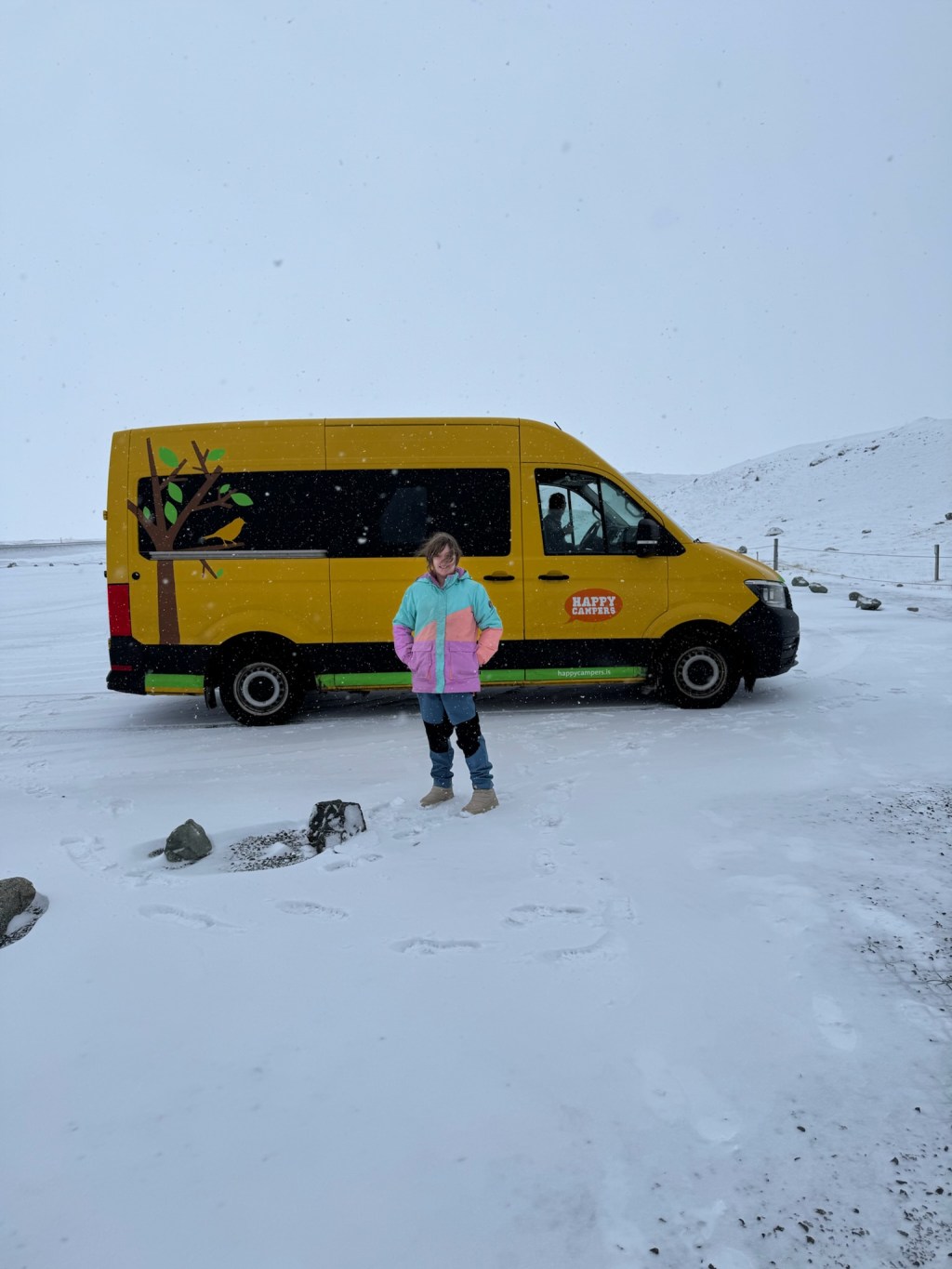
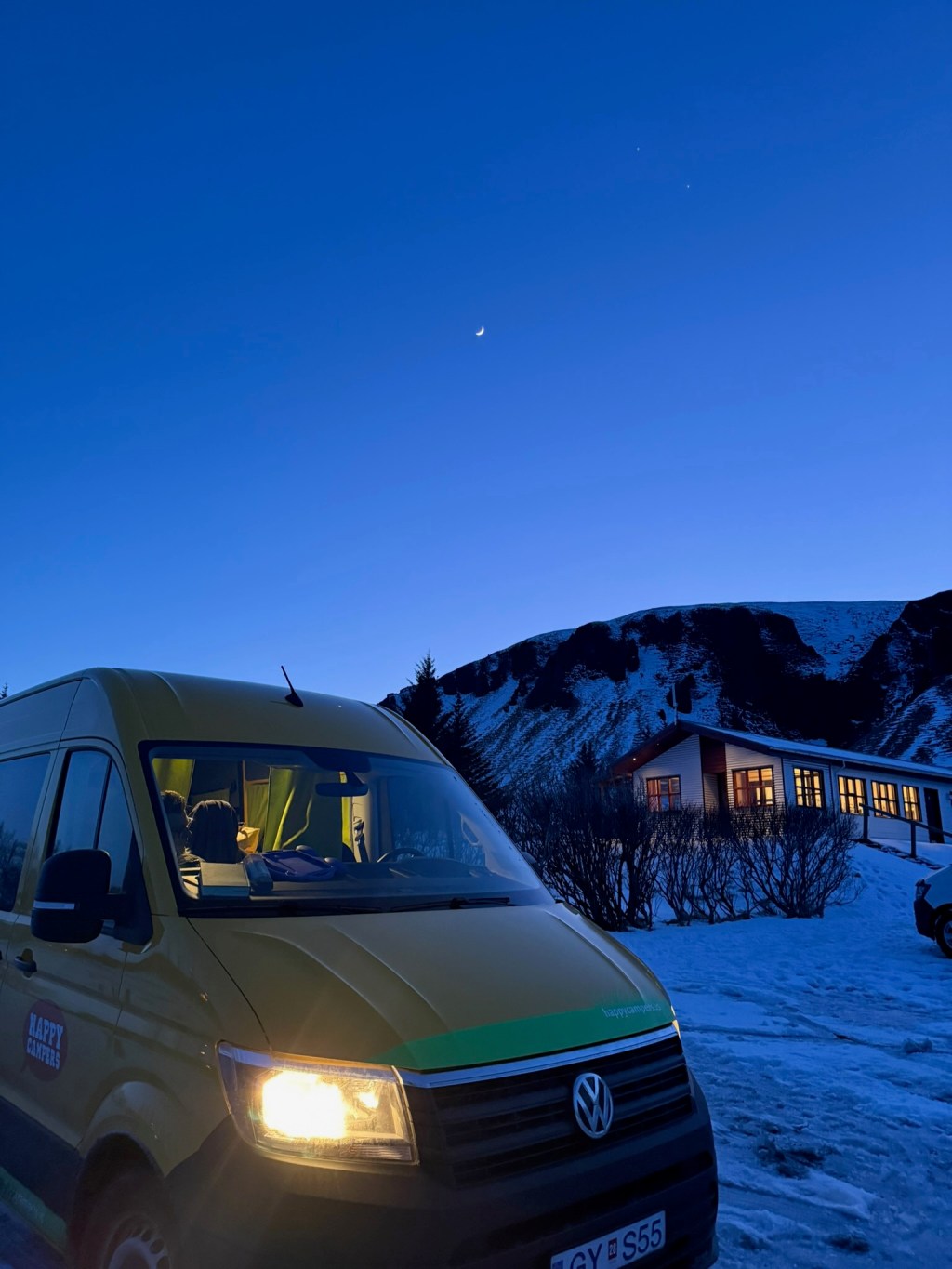
    We loaded up our camper van—the “Happy 3,” model, the largest, which supposedly sat and slept 5 (though it wound up being pretty tight sleeping for just the four us, including two children).  It was painted a cheery yellow and green, and was massive—maybe 8 feet high, 18 feet long, and 6 feet across. The guy at the Happy Trails walked us through its features, which included many charging outlets (which throughout our trip would be kept busy charging our vast array of electronic gadgets); a fillable water tank that supplied a running faucet of potable water; a large propane tank that would keep the van heated and allow us to cook on a small range top stove; and a refrigerated drawer. All this was powered by a massive battery that was charged by the van’s engine. He also demonstrated how the back section could be switched over from passenger seats, to benches and a small table for meals and recreation, and then to a two-tiered sleeping arrangement. Gwen claimed the “top bunk” for herself and at first, I thought about joining her, but there wound up being maybe four feet of space from the upper sleeping surface to the top of the van, which was just too claustrophobic for me. But it was a perfect space for Gwen, who loved nestling herself up there with her three stuffies and then dangling her hand down for me to hold as she fell asleep.

    We loaded our gear into the van and hit the road toward the Blue Lagoon, a luxury hotel and spa built on top of a geothermal vent. Iceland, as we learned, is situated astride two continental plates, the only island to have that distinction and which accounts for all the volcanic and geothermal activity on the island. And the way to Blue Lagoon showed ample evidence of that activity—the landscape was stunning, littered with craggy volcanic rock (which Kaye noted was left over from an eruption that occurred just a few years ago) covered by a thin layer of snow. Beyond the fields of stone were ice-streaked plateaus in the distance. The snowstorm that had pelted us earlier had given way to a grey cloudy sky, the sun a pale distant disk behind the shroud of clouds. 

    About 45 minutes into the drive, we began to approach the Blue Lagoon, its proximity tipped off by a pungent, sulfuric smell. It was a familiar smell to me from the summer—over 30 years prior—when I worked at Yellowstone National Park, stationed near the geothermic Mammoth Hot Springs, which had an almost identical smell. Gwen, though, had a different explanation for the stench.  “I know why it smells like farts back here,” she announced. She waited a beat, then said, “Because I just farted.” Billy made a disgusted groan and I thought to myself there is a good reason Gwen always calls herself “Mini Daddy.”

    We had bought access to the thermal pools here, so we checked in, donned our bathing suits in separate boys’ and girls’ locker rooms (pretty plush), then headed into the Blue Lagoon. The attendant there had given water wings to Billy as we entered the pool, but he immediately and dismissively peeled them off and threw them to the side of the pool. Not long after that, the attendant tracked us down and told us Billy had to wear them as long as he was in the pool, and he begrudgingly complied for the rest of our time there.  

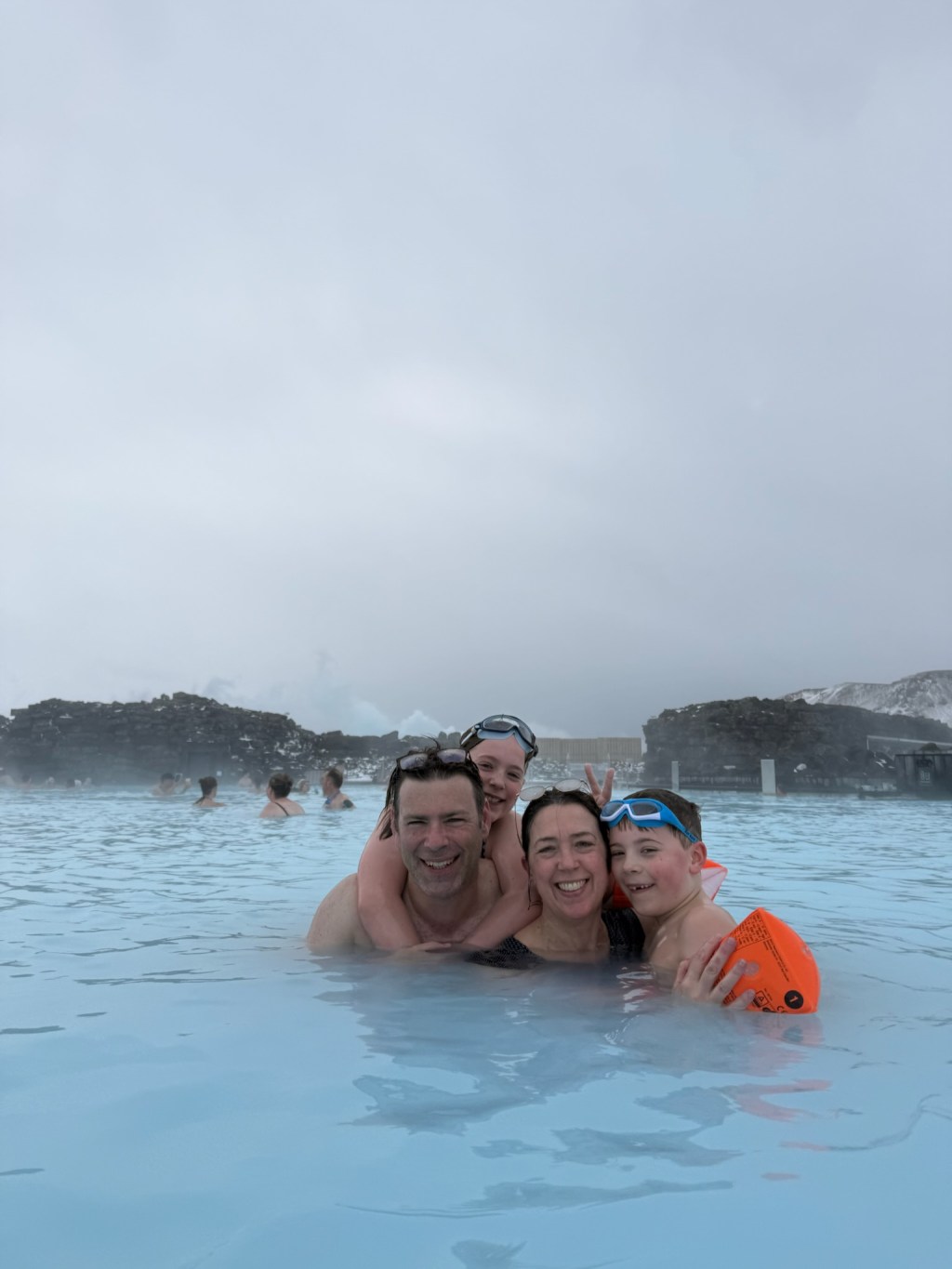
    The Blue Lagoon was a hallucinatory experience. It is about 10,000 square meters, cut up into various coves, channels, tunnels, and watery cul de sacs. The water was a vivid, almost unreal deep blue from the silica content in the water. The water’s average temperature was 98-104°F—in jarring contrast to the 30-ish degree air temperature, which was windy and at times carrying biting flakes of precipitation—and wafts of commingled steam and arctic winds slipped over the surface. The same temperature contrast between the hot water and the cold air also fogged up my glasses, giving me the choice of trying to navigate with fogged-over glasses, or my almost equally foggy myopia. Making things even trippier, everyone who paid for admission was given a complimentary mud mask, so masks of garish white bobbed above the surface of the steaming, deep blue water. 

    We all floated about, Kaye and I getting our complimentary masks then rinsing off with clean spring water. Billy was a little out of sorts, complaining every time we’d hit a patch of overly hot water and wanting to leave, but we cajoled him into staying until we’d gotten our complimentary beverages (given the cost of entrance, though, the word “complimentary” deserves to be in scare quotes). Then we made our way back to the entrance, went inside, and changed back into our dry clothes. 

    We had lunch there at the Lava restaurant, a chic, upscale place, with a giant picture window facing the lagoon and an accent wall of made of volcanic rock. The kids both ordered the “lava chicken,” excited due to a quip in “The Minecraft Movie,” where Jack Black’s character is the proprietor of a restaurant serving up chickens cooked in hot lava, and sings a catchy jingle that starts “la-la-la lava, ch-ch-ch chicken!” The kids both happily sang that song as we waited for our food and I noted that we all were in relatively good spirits despite our long flight and lack of sleep.

    But again, I was struck by the price of food here – our meal was around $255, for two kids’ meals, a steak and cup of lobster soup for me, and a cod dish and glass of wine for Kaye. Yes, this was a high-end touristy hotel restaurant but still—ye gods. The blow was softened by a bit when Kaye consulted her Rick Steves handbook and saw that tips are neither customary nor expected in Iceland. I quipped, “you mean they pay a living wage here? How barbaric.” On our way out, Kaye took a detour to the bathroom, and I took the kids to a gift shop where again I was struck by the prices here—$100 wool hats and scarves, and wool sweaters I didn’t even look at. 

    We loaded back into the camper van and did a quick stop at a Kronan supermarket. We would learn over the course of our stay in Iceland that Kronan is a pretty ubiquitous chain of supermarkets. We got cereals, chips, yogurts, etc.—light stuff that could be eaten for breakfasts and snacks on the way. We’d decided against doing any serious cooking inside the van, due to concerns about cleanliness and smells in a space where we would be living and sleeping for a week. 

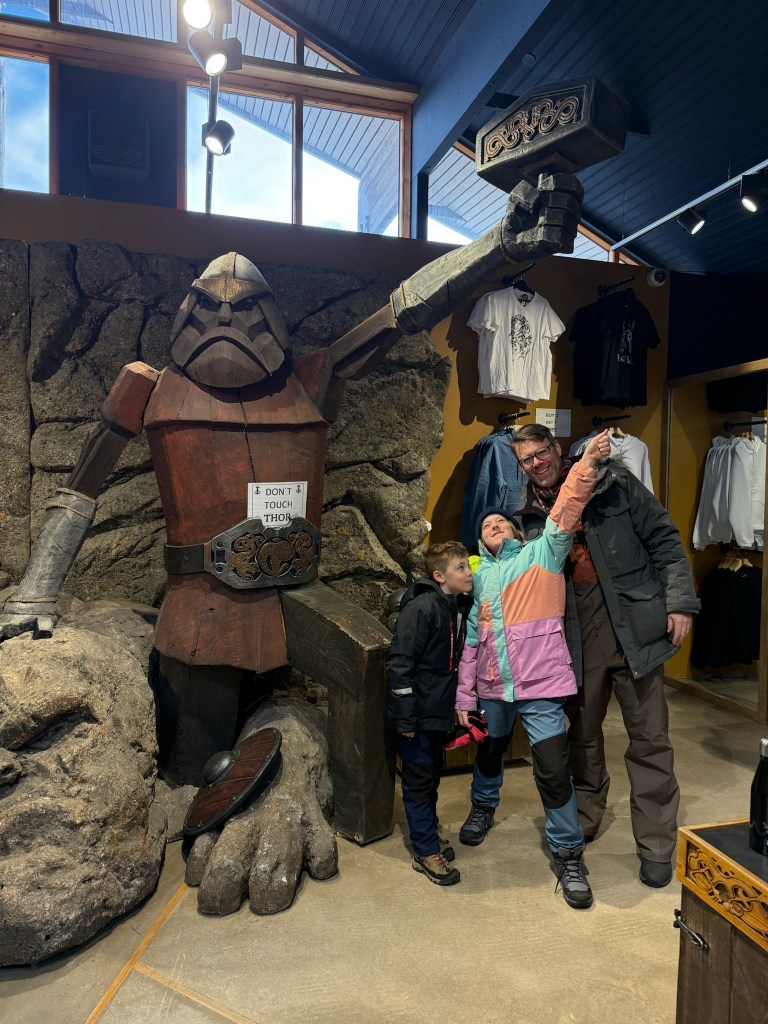
    We headed into Reykjavik, on our way to our first campground, when I impulsively looked up “Thor’s Power Gym,” a Reykjavik weightlifting gym owned by Hafthor Bjornson, a world-famous strongman who played a hulking, sociopathic knight known as “The Mountain” on the television show “Game of Thrones.” It just happened that the exit to the gym was coming up as I looked on my Google Maps, and Kaye humored me by going five minutes out of our way so I could take a gander. Billy, who had been complaining of being tired, immediately perked up when he saw the place, and Kaye took pictures of the kids and I posing under the sign to the gym, as well as next to an assortment of ludicrously heavy lifting stones (known as “Atlas Stones”) that were arranged outside the gym, going up to 280 KG (or roughly 600 pounds).

    We all went inside and saw a few refrigerator-sized Icelandic guys lifting weights; a small room just off the gym was a combination store and museum devoted to Hafthor’s achievements. I gawked at innumerable medals, trophies, Lucite plaques, etc. on display commemorating his long (and continuing) reign as the world’s strongest man. I bought t-shirts for the kids and I, then excitedly took pictures of all the accolades in the shop before getting a picture of the kids—both hitting double bicep poses and scowling menacingly for the camera—standing next to a life-sized cutout of the 6’8” 400-pound Hafthor.

    We continued into Reykjavik, through the typical sprawl of 21st Century metropolises: we saw Icelandic franchises of some of America’s worst fast-food restaurants—Subway, Dominos and KFC franchises, which we would see all over Iceland—and Asian car dealerships—Toyota, Honda, Subaru. We came to another destination I’d clamored for, the Árbær Open Air Museum, which reconstructed a turn-of-the century Icelandic town. The real draw for me there were some Atlas stones they had there that ranged from 180 to 600 pounds; according to legend, they would be used to test the strength of prospective sailors to decide what tasks they’d perform on fishing vessels. In anticipation of lifting the Árbær stones, I’d worked on stone lifting with my weightlifting coach in Chicago and had managed to lift 180-, 210-, and 240-pound stones from the ground to a shoulder-level shelf. I’d even brought my weightlifting belt to help me out and avoid injury. But unfortunately, all the smaller stones were frozen into the ground, and only the largest one—600 pounds—was free of ice. I gave the big one a shot and managed to budge it a bit, but I knew that any attempt to actually get it off the ground would almost certainly leave me grievously injured, so I quit while I was ahead. 

    As I engaged in this fool’s errand, the kids were having a blast on a nearby playground where all the equipment was made of wood. We let them burn off some steam on the playground, then looked inside some of the structures at the open-air museum. One was an old church that later served as a gymnasium and it featured artifacts from both building’s former incarnations: an old stain glass window, as well as a pommel horse, boxing gloves, and other sporting equipment. 

    Another building recounted the history of consumer activity on Iceland. It was interesting to learn that the barter system existed on Iceland until the beginning of the 20th Century. But despite this rather primitive economy, the country wound up developing along the same lines as the rest of Western Europe, with a large jump in living conditions after WW2, when Iceland formally became an independent republic and also benefitted from the Marshall Plan. One sign noted that Iceland’s strategic location in the North Atlantic motivated the US to spend more money there per capita—$2 per resident (though admittedly the population even now is under half a million)—than any other country. 

    The snow had picked up again while we were at the museum, so we headed to our campsite at Dalur Hostel, not far from Reykjavik’s city center. By the time we got there, there was a thick layer of snow on the ground. Undaunted, we converted the back of the camper into an eating space and ate crackers and mini donuts for dinner (we were all still pretty full from our expensive lunch at Lava) and played Uno. Then we configured the back of the camper for sleeping; it was a little awkward with all our stuff, but it would get easier with practice. We hit the campground’s communal bathrooms to brush our teeth, then settled in for the night’s sleep. Kaye began reading “A Series of Unfortunate Events” to the kids, but I quickly fell asleep by 8:30. I was awakened at 10, when Billy had to go to the bathroom, so I clambered into my boots and sweatshirt and winter hat and brought him to the foul-smelling communal men’s room then back to the van. 

    Then Gwen woke up crying the middle of the night. At some point that night she’d lost track of her beloved “monkey blanky” (which she’d had since she was an infant) and was crying disconsolately. Kaye was irritated as Gwen continued to cry for almost an hour; Kaye scolded her that she was far too old to need a blanket to fall asleep. Kaye wasn’t wrong, but I felt a little more sympathy for Gwen, whose body was 6 hours behind the local time and was sleeping for the first time in a van. 

    Even after Gwen eventually fell back asleep, I slept fitfully the rest of the night, crowded into the lower area (recall, only 6 feet across) with 2 other people. More than once, I woke up with my arm asleep, cut off from blood by my constrained sleeping position, and kept tossing and turning (although the van really did keep warm from the propane heater, and I was covered by multiple warm blankets). But eventually I managed to string together a few hours of sleep.

  • How The Fuck Did We Get To This Point? Reading Robert Paxton’s “The Anatomy of Fascism” in the Age of Trump

    How The Fuck Did We Get To This Point? Reading Robert Paxton’s “The Anatomy of Fascism” in the Age of Trump

    How the fuck did we get here? I’m sure I’m not the only one who has thought this as masked fascist goons terrorize my city, tear gassing Halloween parades and schoolyards, crashing their cars into civilians then dragging them out of their cars to take them God knows where, and literally “disappearing” people from their families and lawyers. And that’s just the tip of the iceberg, as an unaccountable executive arrogates more and more power from supposedly coequal branches of government, bombs or intimidates more or less every other country in the Americas, sinks our economy with misguided notions of autarky, and corruptly pockets bribes, all while a steady 37% of the country continues to accept that he will “Make America Great Again.”

    In hopes of understanding how exactly in the fuck we got here, I turned to Robert Paxton’s “The Anatomy of Fascism.” Before publishing this book in 2004, Paxton wrote a well-regarded history of Vichy France that bucked the conventional wisdom that it was a reluctant hostage and instead portrayed it as an enthusiastic supporter of Nazi Germany.

    I first came across Paxton’s name on my favorite political blog, Lawyers Guns and Money, which often cites Paxton’s definition of fascism in various posts about the Trump administration’s latest depredations. The definition is a mouthful, but is also extremely useful:

    Fascism may be defined as a form of political behavior marked by obsessive preoccupation with community decline, humiliation, or victimhood, and by compensatory cults of unity, energy, and purity, in which a mass-based party of committed nationalist militants, working in uneasy but effective collaboration with traditional elites, abandones democratic liberties and pursues with redemptive violence and without ethical or legal restorations goals of internal cleansing and external expansion.

    I’m too lazy to link to news articles that demonstrate, in my opinion, that Trumpism checks all of those boxes, but the aforementioned Lawyers Guns and Money does a good job of that.

    Paxton really “shows his work” in “The Anatomy of Fascism,” coming to this definition only at the very end of the book, after his exhaustive breakdown of fascism into different phases: “Creating Fascist Movements,” “Taking Root,” “Getting Power,” “Exercising Power,” and the long term prospects of fascist states, which are overwhelmingly negative.

    Not surprisingly, Paxton mostly focuses on Fascist Italy and Nazi Germany in his history. Paxton points out that the ravages of the First World War and its aftermath of runaway inflation were what created the “political space” for fascism to take root. The existing “liberal” (in the classical sense) democracies in those countries were simply incapable of dealing with the almost unimaginable aftermath of World War I. In addition, Italy and Germany were both “young” democracies at this point, and Hitler and Mussolini were able to harness the disappointment and resentment of the dispossessed in a way that more traditional “conservatives” of that era–who were mostly from the aristocratic classes–were unable to do.

    Paxton emphasizes over and over that it was the particular sociopolitical conditions of post World War I Europe that created the conditions for fascism: mass impoverishment, devastation that is almost unimaginable to modern Americans, the absolute decimation of an entire generation of young men, and an inability to absorb the survivors into the workforce.

    At this point in the book, I found myself wondering; how did the American polity fall prey to a nakedly authoritarian con-man rapist like Trump? I’ve seen many on the left blame the Great Recession and the debacles of war in Iraq and Afghanistan; but those explanations just don’t seem to explain what is happening in our country. As bad as the Great Recession was, the American political system didn’t “fail;” in fact the recovery was fairly quick In comparison with the Great Depression, and the labor markets were never anywhere near as disrupted as in the 20s and 30s (particularly in a Germany that was also paying reparations under the Treaty of Versailles). I thought the same about the so-called “Global War on Terror;” sure, it was heinous, and sure, we were led into the war in Iraq by mendacious lies by the Bush Administration and an overly-credulous mass media. But the number of Americans whose lives were destroyed by the Global War on Terror is nothing–and I mean NOTHING–like the wholesale slaughter of World War I.1

    But near the end of the book, Paxton turns to more modern European and American fascist movements, which at the time of publication (the relatively halcyon days of 2004) were only in their nascent forms and hadn’t gained any appreciable power. Paxton cooly assesses the socioeconomic changes that led the way to a resurgence of the European ultranationalist far right in the early 2000s:

    I don’t know about you, but that laundry list of post-World War II socioeconomic factors sounds awfully familiar to what has happened to the American political economy in the past 20 or 30 years.

    Early on in the book, Paxton emphasizes the fact that Fascism is a mass-based movement that harnesses popular energy, and in doing so takes on the symbols of whatever culture it is taking root in. So, he notes, resurgent fascism isn’t necessarily going to look like what we’re familiar with through popular culture: black shirts, armbands with swastikas, goose stepping, and the like. Paxton–again, writing in 2004–notes the following regarding a then-hypothetical American fascism:

    Again, I don’t know about you, but this seems awfully prescient.

    Another thing that struck me about Trump’s rise to power as I read this book is the fact that while Hitler and Mussolini came to power in parliamentary systems, Trump attained power through a vastly different political system. I came to believe that Trump actually had an easier time assuming authoritarian power over the country due to the fact that the United States has a “winner take all” electoral system that essentially guarantees that there will be a two-party system. Once Trump gained a large enough mass following, the elites of the Republican Party began to accede to his demands– recall that Paxton identifes fasicsm as entailing “uneasy but effective collaboration with traditional elites”–to the point where even the Senators whose lives were threatened during Trump’s January 6 attempted coup2 would not move to convict him in his second impeachment trial.

    Another factor of the American political system that differs from 1930s Germany and Italy and that seems to have really empowered Trump is that the United States has a presidential system, with the Constitution granting a great deal of power to an executive. Our presidential system can, in the euphemistic terms of an intro to political science workshop, “present[] challenges to democracy.” I’ll fucking say.

    The book doesn’t give much of a silver lining for nations that are taken over by fascist movements. Paxton argues persuasively that fascist dictators such as Mussolini and Hitler, far from being omnipotent autocrats, relied on mass-based energies to come to power, and continued to rely on the enthusiasm of their base to maintain that power. This, Paxton argues, led to constant escalations of both internal repression and outward expansion, which only ceased once those nations collapsed.

    Unfortunately, this feels in line with our current dilemma, as Trump has continued to up the ante since he began his second administration–increasingly militant and violent State actions via the National Guard, ICE, and Customs and Border Protection in “Blue” cities, coupled with plans for a hot war in South America, along with bluster about annexing Canada and Greenland. I hazard to guess that Trump’s violence and unhinged rhetoric will only increase as his prospects in the next midterm elections continue to sink. He’s already (illegally) attempting to outlaw mail-in voting, preparing a “rapid reaction” military force, and vowing to deploy “observers” to blue-state elections while threatening military action in South America and Nigeria.

    Given the bleak outlook of this book, I found myself often asking myself–in my characteristic way of denying obvious facts that are right in front of my face–Is this REALLY fascism? But whatever denial I had was pretty much wiped away when I did a little research for this blog post and found that Robert Paxton–you know, the foremost researcher and theorist of fascist movements and the guy who wrote this book–has himself labeled Trump a “fascist.” QED I suppose. And maybe RIP.

    Anyhow, by the end of the book I found myself simultaneously depressed and alarmed. Alarmed by the fact that I’m convinced that using the word “fascist” for the current administration is not an overstatement, and that a study of previous fascist states gives us a pretty good indication that things are going to get way fucking worse. Depressed by the fact that Trump could have been stopped at many points, but the political elites of this country found it too expedient to cover their eyes and pretend that a fascist takeover of our country was not happening. As I mentioned above, I think the primary culprit is a mendacious and power-hungry Republican Party, which wouldn’t even denounce Trump even after he tried to get some of its leading political actors fucking lynched on January 6. But another major “sliding doors” moment in my estimation was the Biden Administration’s–and more particularly former Attorney General Merrick Garland’s–slow-walking the prosecution of Trump for January 6. But in this case failure has many fathers (and mothers–I’m looking at you Marjorie Taylor Greene, Katie Miller, Usha Vance, etc., etc., etc.).

    So why read this at all? Paxton gives us a sort of raison d’être for the book near the end:

    Welp, we were warned. And the people who mattered didn’t take heed. And now we all will face the consequences.

    To paraphrase the late, great Hunter S. Thompson, who had a few thoughts about fascism, “Buy the ticket, take the ride.” If Paxton is right, we’d all better buckle up.

    1. I certainly don’t mean to dismiss the suffering of the Afghanistanis, Iraqis, or Americans who died or were physically and/or mentally maimed in those wars. But in terms of societal disruption, total U.S. casualties in both the Iraq and Afghanistan wars combined, over the course of a decade, totaled around 50,000 killed or wounded, according to Wikipedia. Compare that to the over TWO MILLION German soldiers killed (I’m not even counting the number that were wounded) in World War I, with a far lower population. The two wars just aren’t comparable. ↩︎
    2. Technically January 6 wasn’t a coup, it was an attempted autogolpe, but same idea. ↩︎
  • Spirits – a horror story (the finale)

    Spirits – a horror story (the finale)

    As Halloween approached again, I learned the hard way that the old cliché you hear about the one-year anniversary of a loved one’s death being hard is dead-fucking-on. I’d be out grocery shopping or running errands and for brief instants I could swear I could see him. Someone would catch my eye and something about them – the set of their mouth as they perused a menu; or their gait; or a turn of phrase, like “a couple three” – would remind me of my father so strongly that for a dizzying moment I felt the uncanny sense that he was somehow there. When I got a letter from the Cremation Society a few weeks before Halloween telling me that “the anniversary of a death can stir up many emotions all over again and may come when you least expect them,” I thought to myself “no fucking shit,” and threw the thing in the trash. 

    (more…)
  • Horror Fiction Book Review – “Tender is the Flesh,” by Augustina Bazterrica

    Horror Fiction Book Review – “Tender is the Flesh,” by Augustina Bazterrica

    This book is some sick shit. It’s possibly the most fucked-up book I’ve ever read…..And I mean that in the best way possible.

    (more…)
  • Horror Fiction Book Review – “Burnt Offerings” by Robert Marasco

    Horror Fiction Book Review – “Burnt Offerings” by Robert Marasco

    “Burnt Offerings” by Robert Marasco is a 1974 haunted house novel that supposedly influenced Stephen King’s 1977 horror classic “The Shining.” I haven’t seen ay first hand verification by King himself that Marasco was an influence, but for what it’s worth, he lists “Burnt Offerings” in the Appendix to his non-fiction book about the post-World War Two horror genre, “Dance Macabre” (which is a must-read for any horror fan). He even asterisked “Burnt Offerings” in his Appendix, which denotes that he believed it to be “particularly important” to the genre.

    (more…)
  • Spirits – a horror story (Part four of five)

    Spirits – a horror story (Part four of five)

    Before I called 911, Eli and I went through what we would tell the police. It was an accident. Grandpa tripped and fell. Daddy tried to help. They questioned me and Eli separately, but whatever the boy had seen, he told them the right thing. He was a good boy.

    I put him to bed, then went into the bathroom and looked at myself in the mirror. I vowed to prove my father wrong, to be a better father to Eli than my father had been to me. That Eli would never become like him. Like me. Alcoholism had plagued my family from time immemorial, like some ancient curse. But it would stop here. 

    (more…)
  • Horror Fiction Book Review – “The Final Girl Support Group,” by Grady Hendrix

    Horror Fiction Book Review – “The Final Girl Support Group,” by Grady Hendrix

    I read and thorougly enjoyed “Paperbacks from Hell” and “My Best Friend’s Exorcism” by Grady Hendrix a few years back, so decided that I’d read his most recent book, 2021’s “The Final Girl Support Group” this Halloween. I was not disappointed.

    (more…)