Our flight took off on Friday, March 20, at around 8:45 and was about a 6-hour flight, meaning we’d be landing at 2:45 AM our time (but Iceland is about 5 hours ahead in time zone, so we landed at 7 AM local time). Gwen mostly slept beside me; I probably caught a couple hours of sleep before landing in…
ICELAND! The descent was instructive as to the nature of the country; out of my window, I saw a snowy, mountainous landscape with a few sparse, thin ribbons of light—highways cutting through the darkened landscape—and a smattering of modest, barracks-like buildings. I thought what a contrast this approach was, with its scant evidence of human habitation, with the vast orange grid that one sees on the descent into the Chicagoland area.
Another “Welcome to Iceland” moment came when the crew warned us about the slippery stairs to get off the plane; rather than exiting the plane into a gate, instead we would be climbing down a steep and narrow set of airstairs that were covered in snow. This was our first lesson of an ongoing curriculum in Icelandic culture: snow and ice removal is a foreign concept to Icelanders, again in contrast with Chicago, where the city’s delayed response to the legendary blizzard of 1979 famously ended the political career of then-Mayor Michael Bilandic.
We managed to safely descend the icy stairway, then took a small bus across the snowy tarmac to the airport and retrieved our luggage. Kaye and I stopped at the ATM to grab local currency—20,000 Icelandic Kronen, the equivalent of about $170. I would eventually get passably good at multiplying any Icelandic price by .0085—the going exchange rate for an American dollar—to see what things cost (I generally didn’t like the answer, particularly when it came to food, as I would learn in just a few minutes). Kaye noted we’d probably be able to use our cards for everything. She wound up being correct—I didn’t use local currency until day five or so—but I quipped that we might need cash for things like bribing the cops.
We waited in the arrivals lounge for around 45 minutes while waiting for our bus to Happy Campers, the company from which we were renting our sleeper van. We ate croissants from the overpriced cafeteria, where the price of food proved to be a major shock—it cost something like $25 for a tiny cup of coffee, two croissants, and an apple. We waited then, eating our small breakfast, and watching people hauling their equipment out of the airport. We saw a lot of people toting skis, but one guy was loading up his golf clubs. That seemed strange given the snowy, windy weather that was notable just 45 minutes into our trip, but I looked it up later and apparently there is amazing golf in Iceland. I noted that to Kaye and she said, “but it’s snowing” and I remarked, “He must be an optimist.”
We finally found our Happy Campers rep and were loaded up into a minivan with another two couples to head to the rental place—Billy had to sit in Kaye’s lap due to a lack of space in the van. We had our first (but definitely not our last) experience with the infamously mutable Icelandic weather on the way; when we started out from the airport, it was overcast but relatively placid. Five minutes into the drive, we began getting pelted with an ice squall, hail suddenly pounding on the top of the van. We arrived at the rental place and upon opening the van door, we were greeted by a gust of wind and icy precipitation howling into the van. Billy was alarmed and shot out of the van screeching, and soon fell into a snowbank adjoining the parking lot.
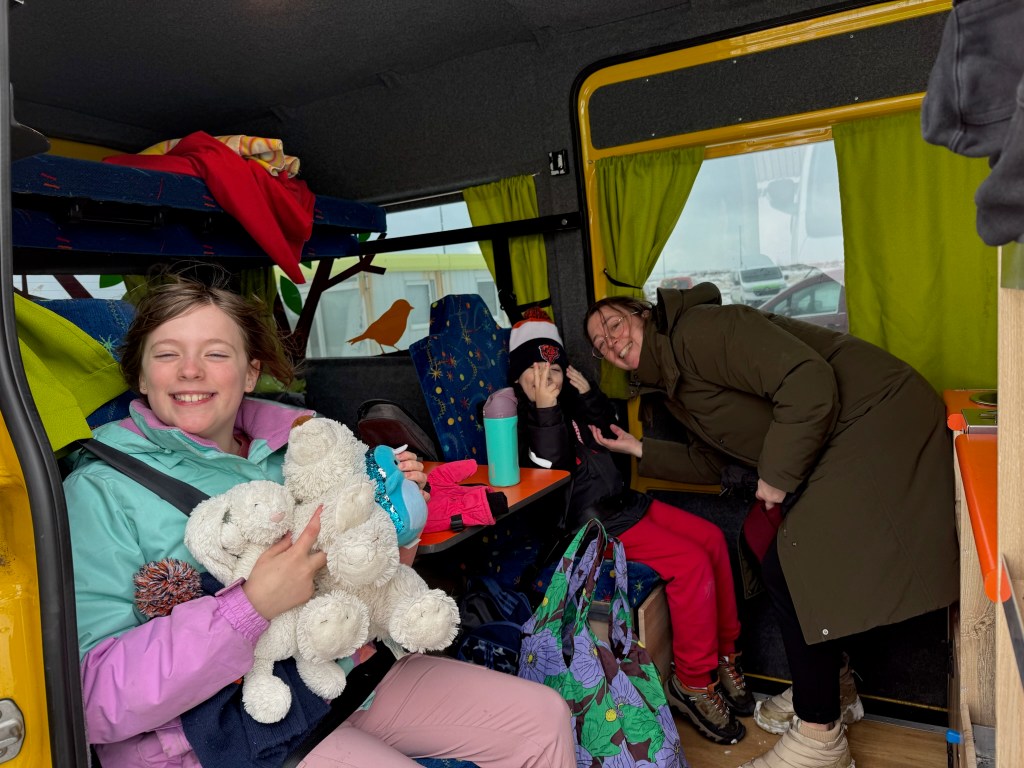
We loaded up our camper van—the “Happy 3,” model, the largest, which supposedly sat and slept 5 (though it wound up being pretty tight sleeping for just the four us, including two children). It was painted a cheery yellow and green, and was massive—maybe 8 feet high, 18 feet long, and 6 feet across. The guy at the Happy Trails walked us through its features, which included many charging outlets (which throughout our trip would be kept busy charging our vast array of electronic gadgets); a fillable water tank that supplied a running faucet of potable water; a large propane tank that would keep the van heated and allow us to cook on a small range top stove; and a refrigerated drawer. All this was powered by a massive battery that was charged by the van’s engine. He also demonstrated how the back section could be switched over from passenger seats, to benches and a small table for meals and recreation, and then to a two-tiered sleeping arrangement. Gwen claimed the “top bunk” for herself and at first, I thought about joining her, but there wound up being maybe four feet of space from the upper sleeping surface to the top of the van, which was just too claustrophobic for me. But it was a perfect space for Gwen, who loved nestling herself up there with her three stuffies and then dangling her hand down for me to hold as she fell asleep.
We loaded our gear into the van and hit the road toward the Blue Lagoon, a luxury hotel and spa built on top of a geothermal vent. Iceland, as we learned, is situated astride two continental plates, the only island to have that distinction and which accounts for all the volcanic and geothermal activity on the island. And the way to Blue Lagoon showed ample evidence of that activity—the landscape was stunning, littered with craggy volcanic rock (which Kaye noted was left over from an eruption that occurred just a few years ago) covered by a thin layer of snow. Beyond the fields of stone were ice-streaked plateaus in the distance. The snowstorm that had pelted us earlier had given way to a grey cloudy sky, the sun a pale distant disk behind the shroud of clouds.
About 45 minutes into the drive, we began to approach the Blue Lagoon, its proximity tipped off by a pungent, sulfuric smell. It was a familiar smell to me from the summer—over 30 years prior—when I worked at Yellowstone National Park, stationed near the geothermic Mammoth Hot Springs, which had an almost identical smell. Gwen, though, had a different explanation for the stench. “I know why it smells like farts back here,” she announced. She waited a beat, then said, “Because I just farted.” Billy made a disgusted groan and I thought to myself there is a good reason Gwen always calls herself “Mini Daddy.”
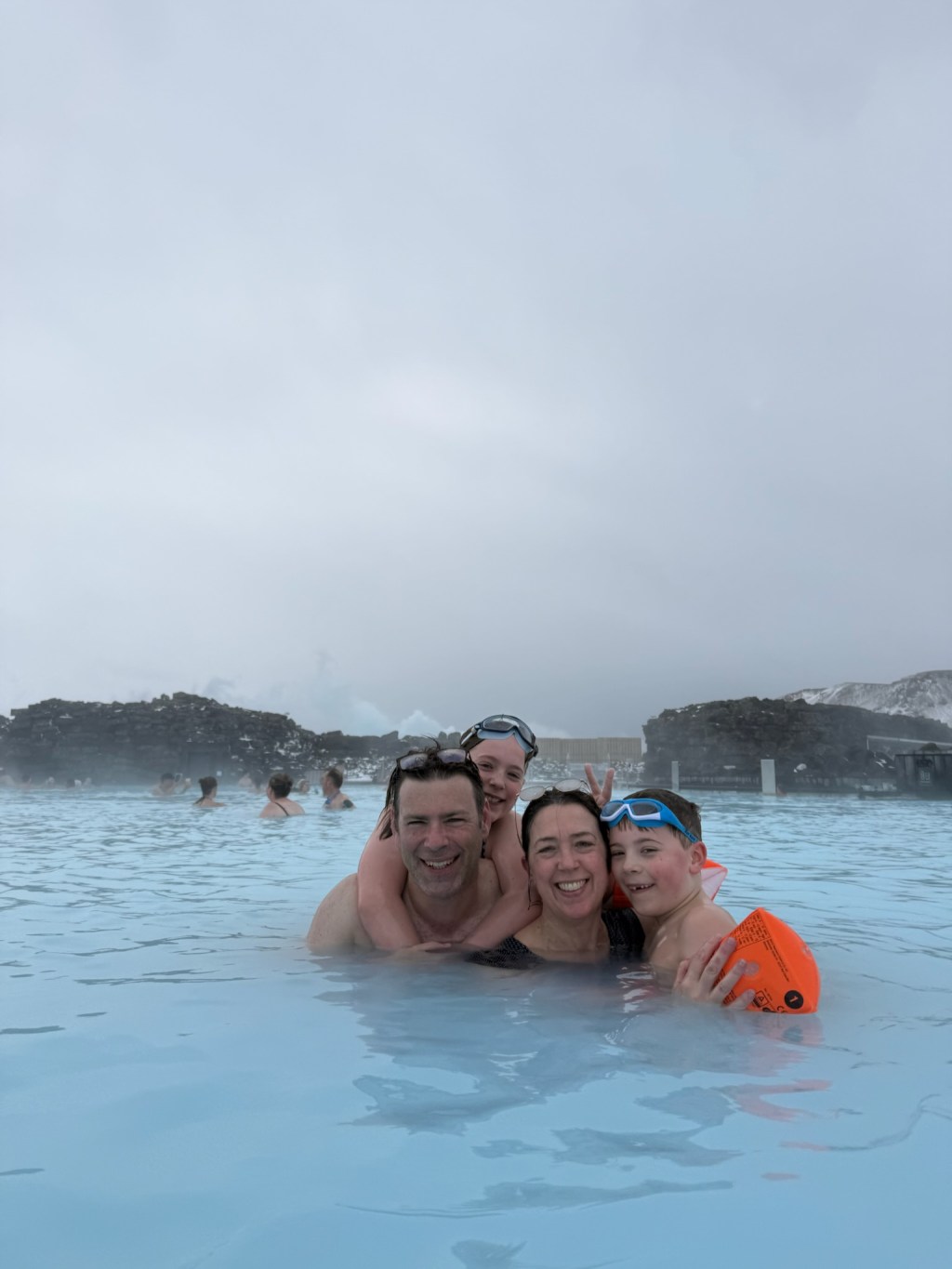
We had bought access to the thermal pools here, so we checked in, donned our bathing suits in separate boys’ and girls’ locker rooms (pretty plush), then headed into the Blue Lagoon. The attendant there had given water wings to Billy as we entered the pool, but he immediately and dismissively peeled them off and threw them to the side of the pool. Not long after that, the attendant tracked us down and told us Billy had to wear them as long as he was in the pool, and he begrudgingly complied for the rest of our time there.
The Blue Lagoon was a hallucinatory experience. It is about 10,000 square meters, cut up into various coves, channels, tunnels, and watery cul de sacs. The water was a vivid, almost unreal deep blue from the silica content in the water. The water’s average temperature was 98-104°F—in jarring contrast to the 30-ish degree air temperature, which was windy and at times carrying biting flakes of precipitation—and wafts of commingled steam and arctic winds slipped over the surface. The same temperature contrast between the hot water and the cold air also fogged up my glasses, giving me the choice of trying to navigate with fogged-over glasses, or my almost equally foggy myopia. Making things even trippier, everyone who paid for admission was given a complimentary mud mask, so masks of garish white bobbed above the surface of the steaming, deep blue water.
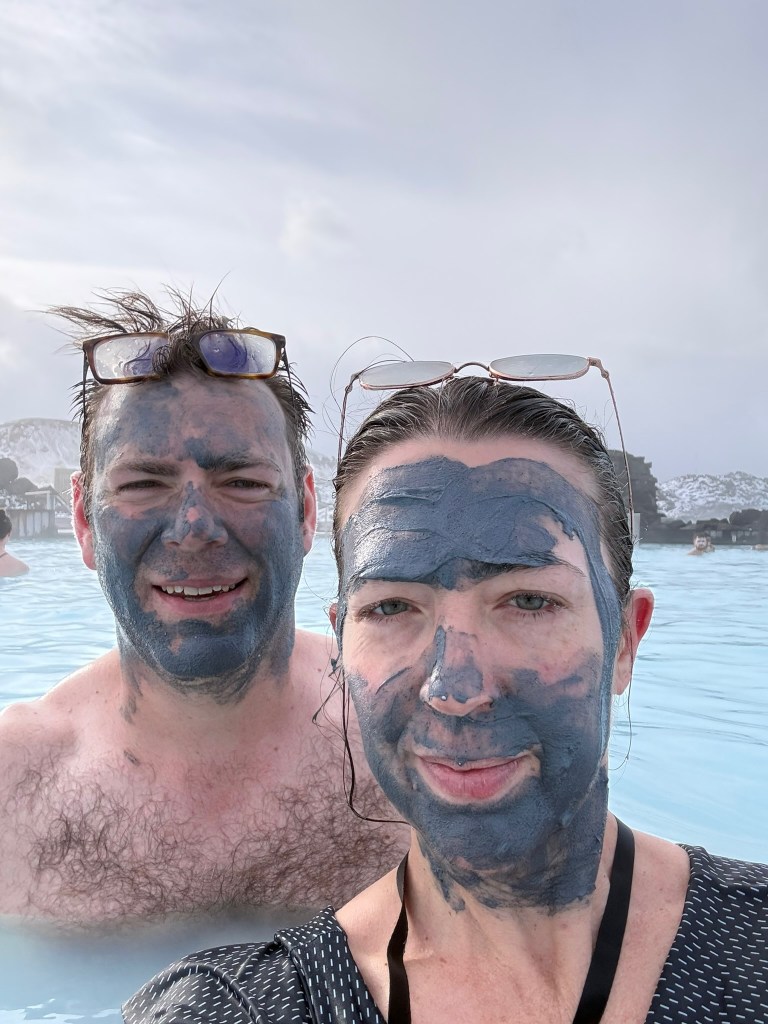
We all floated about, Kaye and I getting our complimentary masks then rinsing off with clean spring water. Billy was a little out of sorts, complaining every time we’d hit a patch of overly hot water and wanting to leave, but we cajoled him into staying until we’d gotten our complimentary beverages (given the cost of entrance, though, the word “complimentary” deserves to be in scare quotes). Then we made our way back to the entrance, went inside, and changed back into our dry clothes.
We had lunch there at the Lava restaurant, a chic, upscale place, with a giant picture window facing the lagoon and an accent wall of made of volcanic rock. The kids both ordered the “lava chicken,” excited due to a quip in “The Minecraft Movie,” where Jack Black’s character is the proprietor of a restaurant serving up chickens cooked in hot lava, and sings a catchy jingle that starts “la-la-la lava, ch-ch-ch chicken!” The kids both happily sang that song as we waited for our food and I noted that we all were in relatively good spirits despite our long flight and lack of sleep.
But again, I was struck by the price of food here – our meal was around $255, for two kids’ meals, a steak and cup of lobster soup for me, and a cod dish and glass of wine for Kaye. Yes, this was a high-end touristy hotel restaurant but still—ye gods. The blow was softened by a bit when Kaye consulted her Rick Steves handbook and saw that tips are neither customary nor expected in Iceland. I quipped, “you mean they pay a living wage here? How barbaric.” On our way out, Kaye took a detour to the bathroom, and I took the kids to a gift shop where again I was struck by the prices here—$100 wool hats and scarves, and wool sweaters I didn’t even look at.
We loaded back into the camper van and did a quick stop at a Kronan supermarket. We would learn over the course of our stay in Iceland that Kronan is a pretty ubiquitous chain of supermarkets. We got cereals, chips, yogurts, etc.—light stuff that could be eaten for breakfasts and snacks on the way. We’d decided against doing any serious cooking inside the van, due to concerns about cleanliness and smells in a space where we would be living and sleeping for a week.
We headed into Reykjavik, on our way to our first campground, when I impulsively looked up “Thor’s Power Gym,” a Reykjavik weightlifting gym owned by Hafthor Bjornson, a world-famous strongman who played a hulking, sociopathic knight known as “The Mountain” on the television show “Game of Thrones.” It just happened that the exit to the gym was coming up as I looked on my Google Maps, and Kaye humored me by going five minutes out of our way so I could take a gander. Billy, who had been complaining of being tired, immediately perked up when he saw the place, and Kaye took pictures of the kids and I posing under the sign to the gym, as well as next to an assortment of ludicrously heavy lifting stones (known as “Atlas Stones”) that were arranged outside the gym, going up to 280 KG (or roughly 600 pounds).
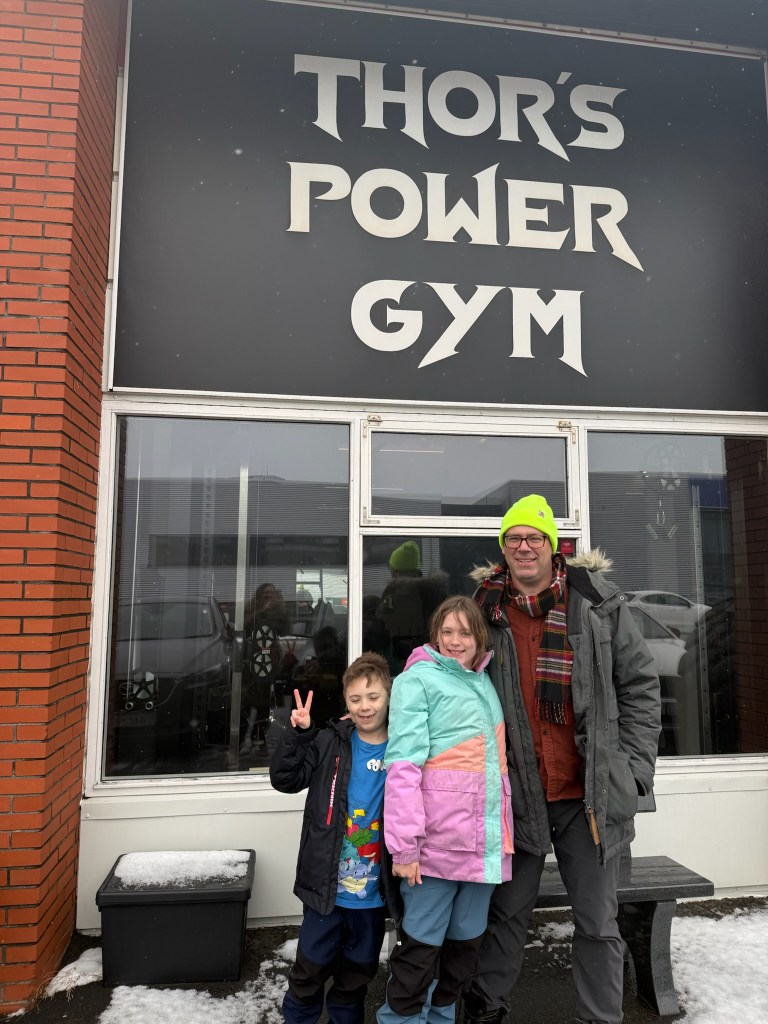
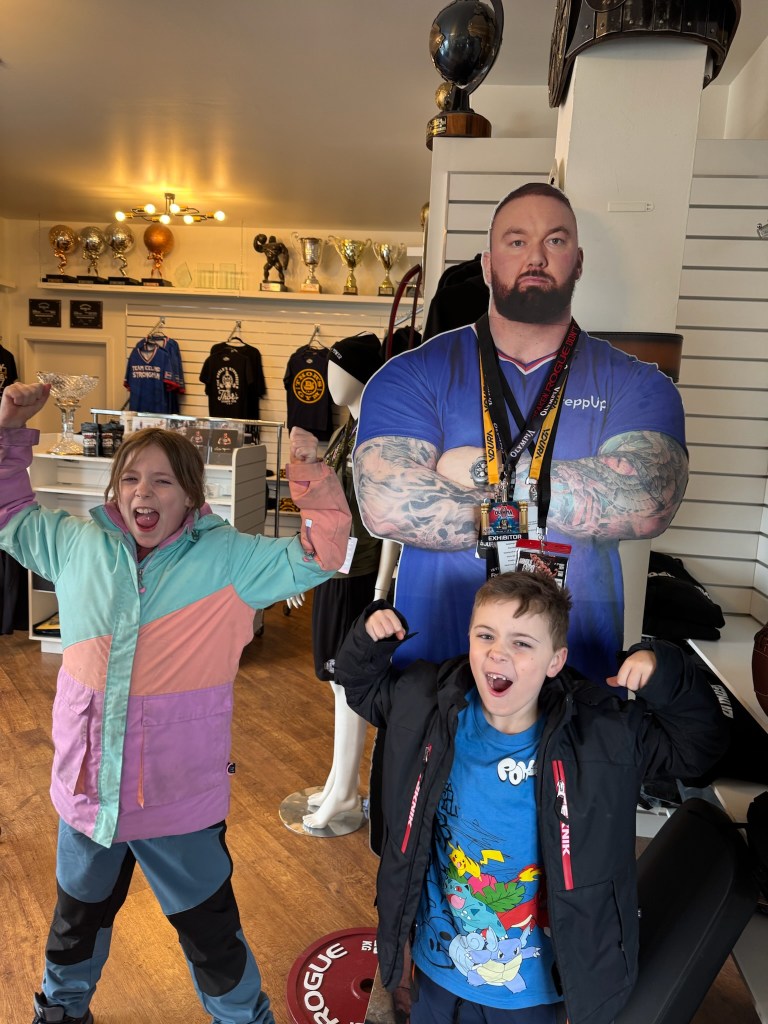
We all went inside and saw a few refrigerator-sized Icelandic guys lifting weights; a small room just off the gym was a combination store and museum devoted to Hafthor’s achievements. I gawked at innumerable medals, trophies, Lucite plaques, etc. on display commemorating his long (and continuing) reign as the world’s strongest man. I bought t-shirts for the kids and I, then excitedly took pictures of all the accolades in the shop before getting a picture of the kids—both hitting double bicep poses and scowling menacingly for the camera—standing next to a life-sized cutout of the 6’8” 400-pound Hafthor.
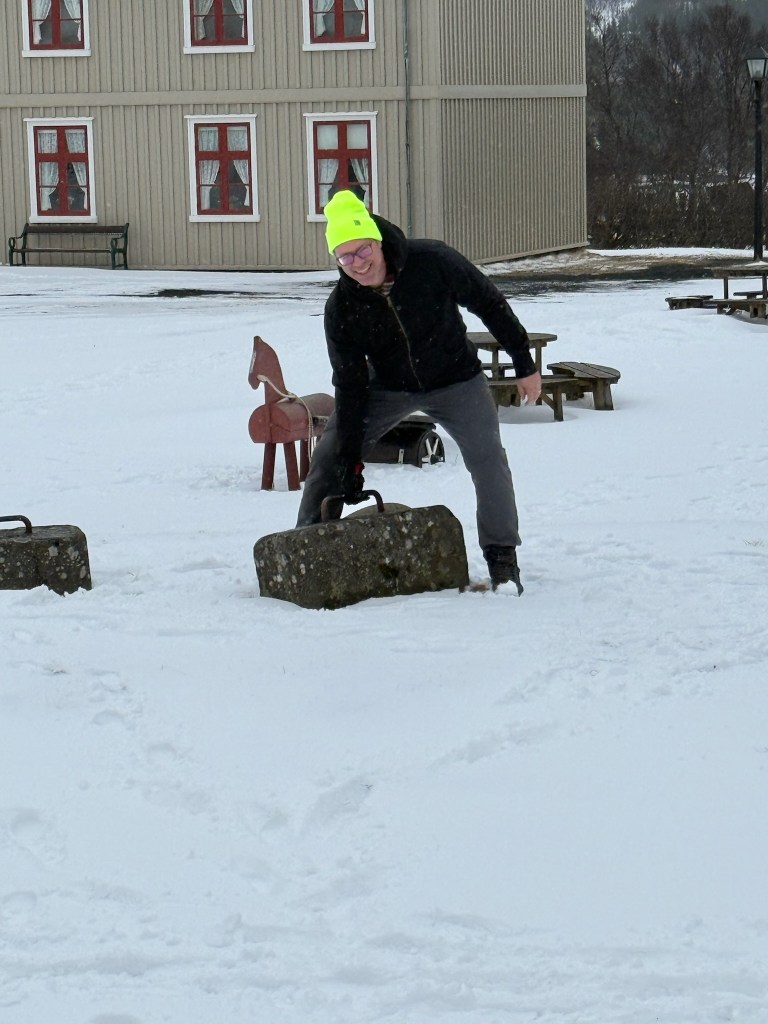
We continued into Reykjavik, through the typical sprawl of 21st Century metropolises: we saw Icelandic franchises of some of America’s worst fast-food restaurants—Subway, Dominos and KFC franchises, which we would see all over Iceland—and Asian car dealerships—Toyota, Honda, Subaru. We came to another destination I’d clamored for, the Árbær Open Air Museum, which reconstructed a turn-of-the century Icelandic town. The real draw for me there were some Atlas stones they had there that ranged from 180 to 600 pounds; according to legend, they would be used to test the strength of prospective sailors to decide what tasks they’d perform on fishing vessels. In anticipation of lifting the Árbær stones, I’d worked on stone lifting with my weightlifting coach in Chicago and had managed to lift 180-, 210-, and 240-pound stones from the ground to a shoulder-level shelf. I’d even brought my weightlifting belt to help me out and avoid injury. But unfortunately, all the smaller stones were frozen into the ground, and only the largest one—600 pounds—was free of ice. I gave the big one a shot and managed to budge it a bit, but I knew that any attempt to actually get it off the ground would almost certainly leave me grievously injured, so I quit while I was ahead.
As I engaged in this fool’s errand, the kids were having a blast on a nearby playground where all the equipment was made of wood. We let them burn off some steam on the playground, then looked inside some of the structures at the open-air museum. One was an old church that later served as a gymnasium and it featured artifacts from both building’s former incarnations: an old stain glass window, as well as a pommel horse, boxing gloves, and other sporting equipment.
Another building recounted the history of consumer activity on Iceland. It was interesting to learn that the barter system existed on Iceland until the beginning of the 20th Century. But despite this rather primitive economy, the country wound up developing along the same lines as the rest of Western Europe, with a large jump in living conditions after WW2, when Iceland formally became an independent republic and also benefitted from the Marshall Plan. One sign noted that Iceland’s strategic location in the North Atlantic motivated the US to spend more money there per capita—$2 per resident (though admittedly the population even now is under half a million)—than any other country.
The snow had picked up again while we were at the museum, so we headed to our campsite at Dalur Hostel, not far from Reykjavik’s city center. By the time we got there, there was a thick layer of snow on the ground. Undaunted, we converted the back of the camper into an eating space and ate crackers and mini donuts for dinner (we were all still pretty full from our expensive lunch at Lava) and played Uno. Then we configured the back of the camper for sleeping; it was a little awkward with all our stuff, but it would get easier with practice. We hit the campground’s communal bathrooms to brush our teeth, then settled in for the night’s sleep. Kaye began reading “A Series of Unfortunate Events” to the kids, but I quickly fell asleep by 8:30. I was awakened at 10, when Billy had to go to the bathroom, so I clambered into my boots and sweatshirt and winter hat and brought him to the foul-smelling communal men’s room then back to the van.
Then Gwen woke up crying the middle of the night. At some point that night she’d lost track of her beloved “monkey blanky” (which she’d had since she was an infant) and was crying disconsolately. Kaye was irritated as Gwen continued to cry for almost an hour; Kaye scolded her that she was far too old to need a blanket to fall asleep. Kaye wasn’t wrong, but I felt a little more sympathy for Gwen, whose body was 6 hours behind the local time and was sleeping for the first time in a van.
Even after Gwen eventually fell back asleep, I slept fitfully the rest of the night, crowded into the lower area (recall, only 6 feet across) with 2 other people. More than once, I woke up with my arm asleep, cut off from blood by my constrained sleeping position, and kept tossing and turning (although the van really did keep warm from the propane heater, and I was covered by multiple warm blankets). But eventually I managed to string together a few hours of sleep.
 RayDorl.com
Leave a comment