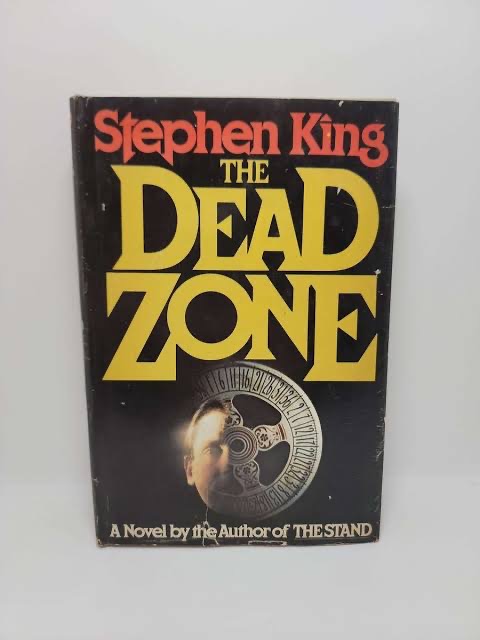
“The Dead Zone”was the first or second Stephen King novel I ever read,[1] and it totally hooked me on King for the next several years of my life. It was published in 1979, the same year as “The Long Walk”(although as I discussed in my previous review, the latter book was the first novel King ever wrote, in 1966 and 1967). 1979 was quite a year for Stephen King, because both books are bangers.
“The Dead Zone” is about a man named John Smith,[2] a schoolteacher in King’s usual stomping grounds of Maine.[3]The novel begins brief prologue showing Johnny (the name he goes by throughout the novel) suffering a head injury while ice skating. When he comes to, Johnny warns a bystander not to jump start his truck. The driver later sprays himself with battery acid when he attempts to jump start his vehicle. This is our introduction to Johnny’s precognitive abilities, which will be the main driver of the plot of the novel.
The book jumps ahead to Johnny as an adult, when his abilities manifest in a dramatic way. He takes his girlfriend Sarah to a carnival and makes a killing on “the Wheel of Fortune,” a roulette-style carny game of chance where he soon wins hundreds of dollars on a series of astronomically improbable bets. But the story doesn’t treat his winnings as a triumph; rather, the scene is a nightmarish tableau that is echoed throughout the novel, particularly a bystander’s repeated, haunting exclamation, “I love to see this guy take a beatin’.”
His “luck” is soon balanced out by tragedy. After dropping Sarah off, Johnny is involved in a horrific car crash, which leaves him in a coma for five years. He wakes up to find that the world had moved on: his job no longer his, his parents five years older, and Sarah having married another man. Much of the “horror” in this book (the novel is more speculative fiction than horror, really) comes from Johnny’s physical and mental recovery – the agony of physical therapy after a five-year coma, the trauma of having lost five years of his life, the existential horror of a world that continued on with scarcely a memory of him.
Johnny also comes out of his coma with his precognitive abilities supercharged—he can sense people’s past and future by touching them skin to skin. As Johnny recovers, his ability (or, as he comes to see it, his curse) repeatedly manifests itself: he rescues a rehab nurse’s home from a fire; he finds that his neurosurgeon’s mother, long thought killed during the Nazi invasion of Poland, survived. Once he is discharged for the hospital, his visions continue: he solves a series of murders on nearby Castle Rock, Maine;[4] and saves a student he’s been tutoring from a grisly fate.
These are all prologues to Johnny’s most powerful vision, when he shakes the hand of Congressional candidate Greg Stillson at a campaign rally. King has checked in on Stillson periodically throughout the book, showing his rise from a small time, crooked Bible salesman to a rising businessman and politician who uses blackmail, intimidation, and violence to further his interests. He is clearly a dangerous dude.
But we don’t know how dangerous he really is until Johnny shakes his hand and is jolted by sensing Stillson’s future, the most powerful vision Johnny has ever had: Stillson will become president and trigger nuclear Armageddon. Johnny is haunted by his revelation:
The only clear image in these dream-replays came near the end: the screams of the dying, the smell of the dead. And a single tiger padding through miles of twisted metal, fused glass, and scorched earth. This tiger was always laughing, and it seemed to be carrying something in its mouth-something blue and yellow and dripping blood.
The rest of the book is Johnny grappling with the truth of this vision, and what he should do about it.
Unfortunately, it’s virtually impossible to talk about this book and the character of Greg Stillson in the year of our Lord 2026 without talking about Stillson’s striking similarities to Donald Trump.[5] Like Trump, Stillson is a lifelong con man: Stillson was a “rainmaker” and bible salesman who is involved in shady land deals; Trump’s cons are too extensive for a full accounting in this blog but he has an extensive history of real estate valuation fraud, as well as consumer fraud, and really his entire second term of office has been one big long looting of the American treasury. Both are right wing populist politicians: Stillson forms the “America Now” party; Trump has his infamous “America First” policy. Both employ paramilitary violence at their rallies: Stillson through a gang of motorcycle thugs he’s enlisted to his cause; Trump with the Proud Boys and other violent ultra right wing groups. And both are curiously impervious to consequences for actions that would sink any other politician. On this last point, Johnny muses:
First, Greg Stillson shouldn’t have been able to get elected. His campaign promises were, by and large, jokes. His background was all wrong….
Second, the press had left him almost completely—and very puzzlingly—alone. . . . His colorful, controversial personality seemed to stir only amused admiration from the national press, and he seemed to make no one-except maybe Johnny Smith—nervous.
There is no doubt that King was prescient in portraying the rise of a fascist politician in this work: the similarities are truly uncanny. But King was tapping into a line of thinking that stretches back to Sinclair Lewis and his 1935 novel, “It Can’t Happen Here,” in which a politician (modeled after Huey Long) claims dictatorial power as a right wing populist.[6] And Lewis himself must have noticed what was happening in Germany and Italy at the time: ultranationalistic populists were the ones who brought fascism to their countries. Whatever you want to say about Trump, you can’t say we weren’t’ warned by generations of American novelists.
It’s also an oddly structured book: the central dilemma of the book, which commences once Johnny meets Stillson, doesn’t arise until about three quarters through the novel. I came to think of this like some sort of dark fairy tale, where the hero goes through three permutations or trials. Here, that would be Johnny solving a murder; saving a student from a deadly party; and then finally having to ward off global apocalypse.
I won’t spoil the novel’s ultimate conclusion, but I love that there is almost an element of Greek tragedy to the novel’s climax: as in Oedipus Rex, Johnny has a vision of his own fate that he can only comprehend when it is too late. This sense of tragic inevitability, and the philosophical implications of whether our fates are predestined or affected by our actions, lends the novel a gravity that much of King’s work lacks.
As with “The Long Walk” and its invocation of the Vietnam War, “The Dead Zone” is clearly influenced by the political violence of the late sixties and early seventies: as Johnny ponders how he should act, given his premonition of Stillson unleashing nuclear horrors upon the world, he morbidly likens himself to Sirhan Sirhan and Lee Harvey Oswald. Perhaps the most radical aspect of King’s novel is how he invites us into the mind of a political assassin and makes him out to be in the right. King makes Johnny a sympathetic figure: a well meaning educator with a goofy sense of humor, who loses almost everything during his five-year coma. And perhaps most perverse is that Johnny’s precognitive is undoubtedly correct. In doing so, King lends credence to the iconic figure of the man in a high place with a rifle, an image that stretches from Charles Whitman through Thomas Matthew Crooks.
The 1983 movie version is a stripped-down adaptation, taking a novel that is over 500 pages and condensing it into a terse 105 minutes. Christopher Walken is an inspired choice for Johnny; Walken’s unplaceable accent and slightly otherworldly appearance emphasizes Johnny’s uncanniness. David Cronenburg directed, and it’s all frosty, chilly New England landscapes, again a fitting choice for a bleak novel. And Martin Sheen is great as Stillson: alternating between oily charm and sudden, frightening outbursts of violence. The movie also inspired one of my all-time favorite Saturday Night Live sketches, which features Walken as a “trivial psychic.”
Next time: King again draws on the political paranoia of the 70s with Firestarter.
[1] It was either this or Pet Sematary, which is also one of King’s best (and scariest, especially revisiting it as a father) .
[2] King is usually very good with names, and I think the generic, “everyman” name is intentional, as I’ll discuss below.
[3] The book I previously reviewed, “The Long Walk”, also started out in Maine and eventually moved its action to New Hampshire, just as this book does.
[4] Also the setting of King’s novels “Cujo,” “Needful Things,” and “The Body” (later made into the movie “Stand By Me”), as well as numerous of his short stories.
[5] This is hardly an original observation.
[6] King himself, through Johnny, pays tribute to Sinclair and invokes Huey Long: “Ever since Sinclair Lewis people had been crying woe and doom and beware of the fascist state in America, and it just didn’t happen. Well, there had been Huey Long down there in Louisiana, but Huey Long had— Had been assassinated.”


Leave a Reply