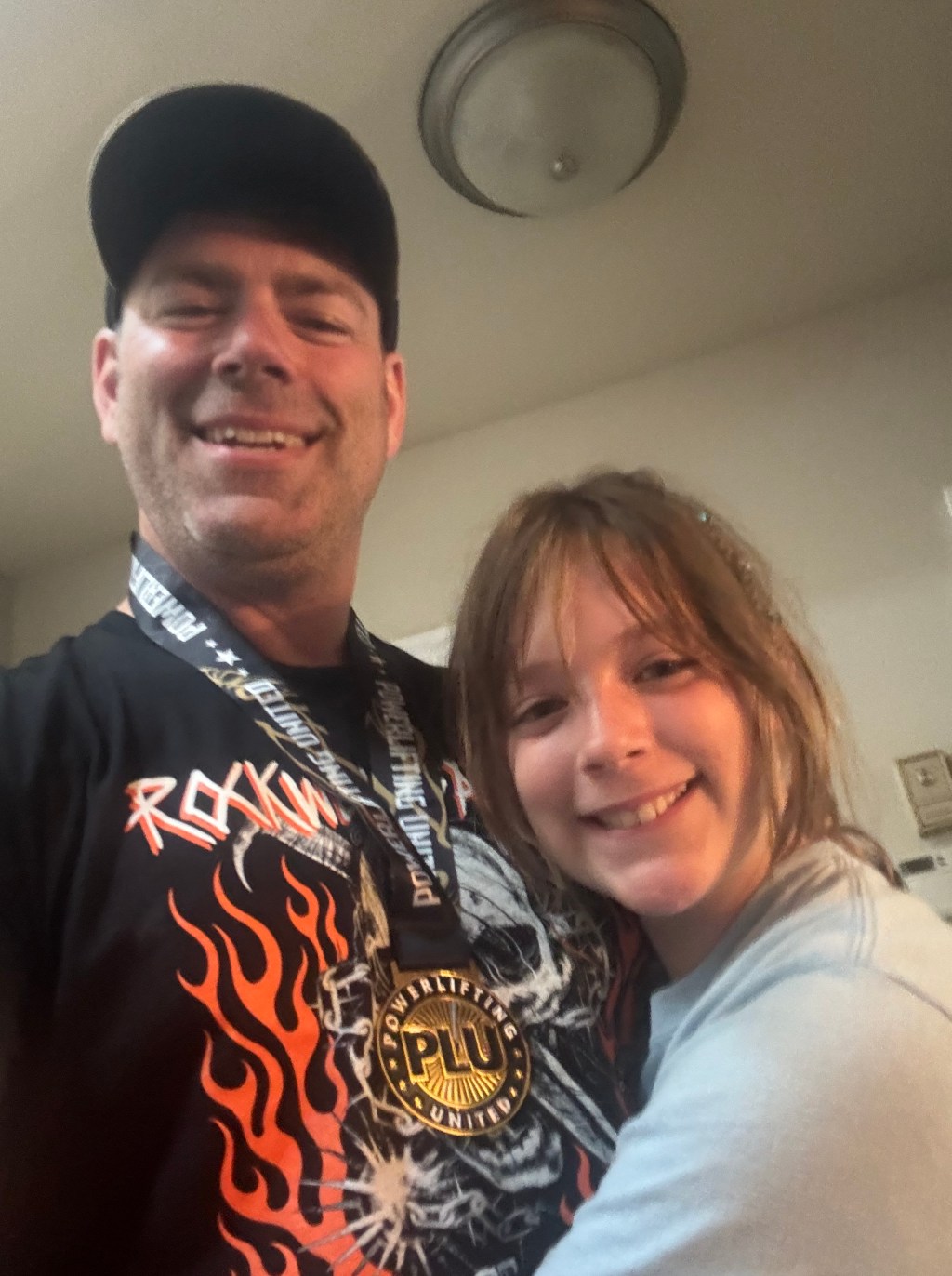
To celebrate my 51st birthday, I signed up for Rockwell Barbell’s annual Midwest Challenge powerlifting meet. TLDR: I had an absolute blast and rediscovered my love of powerlifting as a sport. I was very happy with my meet results as well; I went 9/9 on lifts (the first time I’ve done that in a meet) and my lifts haven’t diminished with age as much as I thought they had–and in fact I set a competition personal record (or PR) at bench press.
What the F@#% is Powerlifting???
For the uninitiated, I will now describe the sport of powerlifting, widely known as “The Sport of Kings.”1 The sport entails competing for who can put up the heaviest squat, bench press, and deadlift–in that order. Each lifter gets three attempts at each of these lifts, and the heaviest of each lift gets added together into what is known as the “total.”2
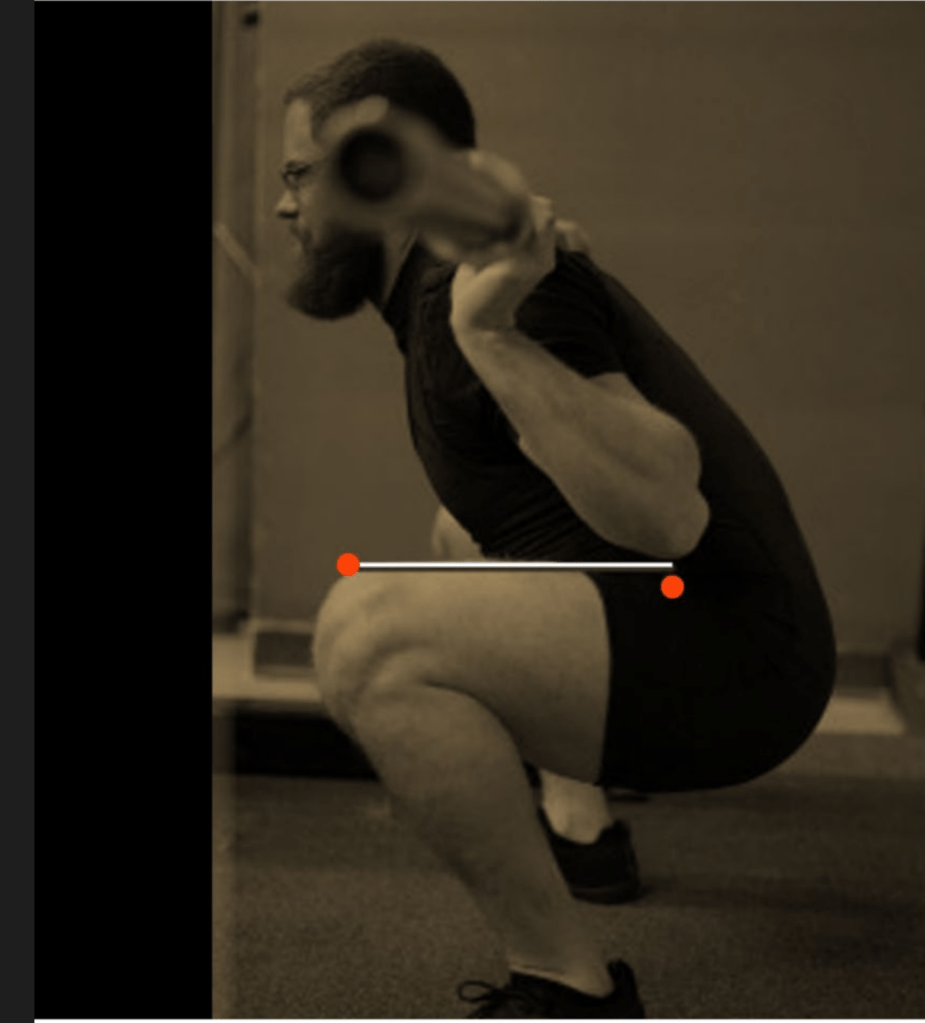
Pretty simple, but a few wrinkles. First of all, the squat has to be “to depth,” which means that the hips have to descend below the knees, like so:3
The bench press is familiar to anyone who has been inside a gym, but again there’s a minor wrinkle in competition: the lifter must bring the bar to his or her chest, and then wait for the referee to give the “press” command. So basically it’s a bench press from a dead stop off the chest; no bouncing the bar off the sternum or cutting it high.
Deadlift is pretty straightforward – the only command is “Down” once you’ve gotten the weight locked out, and you have to keep your hands on the bar as it descends – no dropping the bar.
Lifters are categorized by weight class–I generally compete at 100 KG, or 220 pounds, though in my younger (that is, my mid-40s), fatter, drinking days I competed in the 110 KG, or 242 pound, class.
Also, due to the prevalence of PEDs in strength sports, most powerlifting meets have “drug tested” and “untested” divisions. Competing “drug tested” generally indicates that the lifter is “natty,” or not using PEDs. I’ve never used PEDs and have always competed in the “drug tested” division.4
My History With Powerlifting:
I did my first meet in 2017, had a blast and got a coach soon after that. I wound up doing three meets in 2017, my “total” increasing in each one. I kept doing one to two meets per year in 2018 and 2019. Then came the pandemic, which kept me away form the platform for a couple of years. I did the Rockwell Barbell Midwest Challenge in 2022 and 2023 and had a good time at each of them, but I’d been out of town the past two summers for the meet and wound up not competing at all since July 2023.
Since then I aged into a new age class – “Masters 50-54,” with the word “Masters” being a euphemism for “old.”
Training:
I’ve been training with Matt Blankenburger at Rockwell Barbell for the past seven or so years now. For the past couple of years we’ve been using a “Westside Conjugate” system: two lower body days a week, one focused on maximal strength and the other focused on speed; and two upper body days a week, similarly structured with days devoted to maximum strength and speed work.
I plan on doing an entire post on the conjugate system, but suffice it to say that I’ve found it to be a very good system for an older lifter such as myself – the conjugate system rotates exercises, so you’re not just constantly slamming squat, bench and deadlift until your joints fall apart. It also entails a lot of auto-regulation – in other words, rather than a system with strictly determined loads, you usually work up to what is a good weight for you on that day. So if you had a bad night’s sleep, or are still recovering from a previous workout, and you have to go a little lighter, that’s all part of the system.
I suppose the downside of the conjugate system is the same as its strength: that it rotates through many different exercises, with different implements and resistance stimuli. For example, on a dynamic effort lower day I might be doing a safety squat bar squat to a box against bands. Which is great for developing strength, but in my opinion at a certain point you also need specificity for the squat, bench, and deadlift, so you can best harness that strength into those lifts.
I found that was especially the case with squatting. Over the past few years, I rarely had been doing the competition squat during my workouts, and decided I really needed to dial that in, particularly given the need to “hit depth” on squat. So I switched out squatting variations (like the aforementeiond SSB box squats versus bands) for straight competition weight, and videoed myself so I could neurotically watch my workout squats to make sure I was hititng depth. Note that I’ve never missed a squat due to depth in competition,5 so in some ways this was pointless overkill. But on the ohter hand, maybe my neurotic obsession with hitting depth is the reason I’ve never missed a squat due to depth.
For deadlifts, I mainly switched out deadlift variations for deficit deadlifts, which are great for strengthening the initial pull off the floor. And for bench, I did a lot of Larsen presses–at times, the benches used in competition are slippery, which reduces my ability to get good “leg drive” in the bench. The Larsen press really teaches how to bench without a lot of leg drive, and even though the bench that was used in competition let me get a good amount of leg drive, I think all the Larsen pressing I did really paid off in competition.
Diet:
The Dorl family had a beach vacation in early June. I dieted down to around 215 for that (I was probably up in the mid-220s over the winter and wanted to lean out for the summer and the beach), then got back and had about a month left to prepare for the meet. At that point I just slammed carlories and didn’t pay particular attention to my caloric input–I figured my natural inclination toward overeating and binge eating sweets would get me up closer to my competition weight of 220. There’s an old saying, “Mass moves mass,” so I figured that “filling out” my weight class would set me up for success.
It really worked. I rediscovered something I realized after previous periods of weight loss–when I come off a calorie-restricted diet and go back to eating more, there is genreally a “rebound effect” where my strength rapidly increases along with my food intake. So the final month’s worth of workouts were very productive, and I felt strong and confident going into the meet.
This meet had a 24-hour weigh in, so I weighed in on Friday the 24th for the Saturday meet. I’d cut weight for a lot of previous meets with a gruesome water-loading protocol,6 but this time around I just avoided salt and carbs on Thursday.
I weighed in at 99 KG–or around 218 pounds–and then ate a lot of salt and carbs throughout the day on Friday, culminating in me pigging out on Lou Malnati’s and birthday cupcakes that night.
The morning of the meet, I had a big bowl of steel-cut oatmeal with brown sugar and walnuts, then I was off.
The Meet:
First off, I’ve gotta give a shout out to Rockwell Barbell and my coach, Matt, who was the meet director. The meet was well-run and moved quickly–the meet started at 9 AM and was out by 1 PM, a refreshing change form some of my first powerlifting meets (not run by Matt or Rockwell) that would last 10 hours or so and really be a test of patience as much as strength. There was plenty of equipment in the warm-up room, and the vibes were good and friendly.
Squats came first. I was a little shaky from overcaffeination, which says a lot given my insane tolerance to caffeine: I’d drunk probably 10 ounces of coffee that morning, and then before I started warming up also slammed a scoop of Psychotic Extreme,7 one of the hilariously-named “hardcore” pre-workouts I take.8 On top of this insane amount of caffeine, I had the typical adrenaline dump that comes before lifting something really fucking heavy on a stage while being watched by three judges and a crowd of people. So I was a little wobbly at times on the platform from the combination of nerves and acute caffeine intoxication.
But I did fine. My opener for squats was 160 KG–or 352 pounds–and moved well, like an opener should. My second attempt was 172.5 KG–or 380 pounds–and moved more slowly than I would’ve liked. Going into the meet, I wanted to break 400 pounds on the squat if it was tehre, but given how 380 moved I played it safe and did 180 KG–or 396.75 pounds–as my final attempt. I made it with some pounds to spare, and I was kicking myself a little bit for not going for 182.5 KG–which is 402 pounds–but my conservative game plan was probably the right move given how I hadn’t competed in three years.
Bench wound up being great. I opened with 110 KG–or 242 pounds–and it really flew. Second attempt was 120 KG–or 264 pounds–and again it flew. I probalby would have gone for 125 KG next–or 275 pounds, which would have tied my all-time meet personal record (or PR)9–but Matt put me down for 127.5 KG–or 281 pounds, which I absolutely smoked. That’s now my all-time meet PR, and I really think I could’ve done 285 or 290 that day given how easily 280 moved.
Deadlift also went great. Due to lingering knee tendinitis that made my initial pull on the deadlift slow and painful, I never went above 440 during training (my best ever is 575). But that day I felt great, and went 185 KG, 200 KG, and 212.5 KG–or 407, 440, 468 pounds. Again, my third deadlift felt great and really moved; I feel like I definitely had 10-20 more pounds I could’ve done, but as with my squat I feel that my conservative approach was the right thing to do.
Summing Up The Day:
So my best lifts were 396 on squat, 280 on bench, and 468 on deadlift, or a total of 1,144. I went 9 for 9 for the first time in my powerlifting career (meaning I didn’t’ miss any of my lifts) and hit an all-time competition bench PR. The squat and deadlift were far under my best ever competition lifts–460 and 535, respectively–but I’m fifty-fucking-one years old and have battling knee tendinitis for several years. So overall I’m very happy with my results.
I also set “State Records” in each of these events and in my total, at least in my tiny little subcategory of male lifters, 50-54 years old, drug tested, 100 KG weight class. These records were vacant (probably because I’m the only person in the state who meets those categories who is crazy enough to compete in a powerlifting meet) so really by successfully completing a lift of any weight I would’ve taken those records by default. I had to tell the judges’ table each time I was goign for a state record, and the MC would then announce I was going for a state record, and at times I felt pretty silly. My numbers aren’t particularly impressive by powerlifting standards–for comparison’s sake, the strongest guy at the meet (who was a super nice dude,–he was cheering me on from the sidelines, slapping me on the back between lifts, and calling me “Big Guy”) had a 534 squat, 352 bench, and 644 deadlift.
But at the same time, I worked my ass off to get as strong as I did, and I’m proud of the results of all that work. Besides, someone has to set the standard, and It might as well be me. I have no doubt that those records will fall to someone much stronger than me, but that’s just the way records work, and I’m proud to have put my name in the books when all is said and done.
Also, the kids were in attendance for my final two deadlifts and they went apeshit when they heard I was beating my own state records. Seeing their reaction made it all worthwhile.
What Comes Next:
My goal for the meet was basically to have fun. Mission accomplished–I had a complete blast, enough so that I already signed up for another meet, Rhino’s Revenge on December 5, at Surge to New Levels gym. So on top of having a good time, I seem to have reignited my passion for powerlfiitng. So all-in all, I would call this a very successful meet.
- It isn’t really “widely known” as such, and to my knowledge, only I and my friend Seth, a fellow middle-aged attorney who also competes in powerlifting, would call it “The Sport of Kings.” ↩︎
- A metric known as “Dots” is calculated from a lifter’s total and bodyweight. The Dots score is supposed to be a standardized metric of rating a lifter relative to his or her body weight. I never had a very good Dots score, and after three years away from the sport decided it’s something I don’t need to care about. ↩︎
- Image taken from the official Powerlifting United rulebook. The link is here for your reading pleasure. ↩︎
- My attitude towards PEDs is pretty libertarian–I assume most users are aware of the risks and have made a conscious decision that the benefits outweigh the risks. I’ve never thought PEDs would be worth it for me, though, as “weekend warrior” who competes once every few years for shits and giggles. ↩︎
- Though I’ve certainly failed squats because they were too heavy. ↩︎
- I used something along the lines of this water-loading/cutting protocol. I think the most I ever dropped using that system was around 12 pounds in a week, which I put back on overnight by chugging Gatorade and constantly pigging out. The masochist in me somewhat enjoyed the whole process but I wouldn’t recommend it to anyone. ↩︎
- Manufactured by the esteemed chemists at Insane Labs, Psychotic Xtreme is lauded as their “most powerful preworkout EVER.” ↩︎
- Other preworkouts that are close to my heart include Dark Labs’s Crack, USB Labs’s Jack3d, APS Nutrition’s Mesomorph, and Condemned Labs’s Convict. I really need to do a full post about pre workouts! ↩︎
- My gym PR is 315, “touch and go.” Competition bench presses are usually significantly under a lifter’s gym bench presses, since pausing a bench press and waiting for the “press” command takes a LOT of weight off what a lifter can do. ↩︎


Leave a comment