This is the first in a series of posts about the work of Stephn King. I first started reading King when I awas around 11, which I suppose is a little young given how gruesome some of King’s work is, but just the other night I was out for dinner and another friend mentioned that King was a formative influence on her as a young reader. So it seems like I wasn’t alone in reading King as a pre-adolescent.
I think the first two works I read were tattered paperback copies of “The Dead Zone” and “Pet Sematary,”[1] which were lent to me by my mother’s good friend. Once I’d devoured those two, she gave me other well-worn paperback copies of “The Shining,” “Skeleton Crew,” “Christine,” “Firestarter,” and others. I devoured all of them, some multiple times over, and some passages of those books are still burnt into my memory.
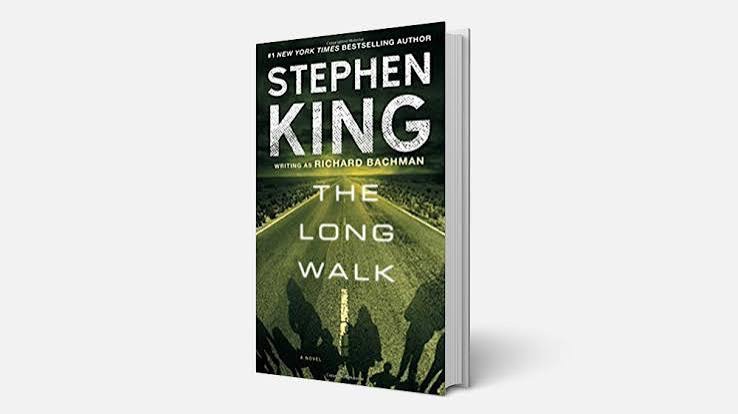
I first read “The Long Walk” as part of “The Bachman Books,” a collection of four books that Stephen King wrote under his relatively short-lived pseudonym, Richard Bachman.[2] “The Long Walk” was always the highlight of “The Bachman Books” in my opinion – it’s a nasty, brutal, unsparing work that has always stuck with me. It also, interestingly, is the very first novel that Stephen King ever wrote, a fact I find astounding. Even at that point, King was brilliant – the novel has a firm grasp on its core of main characters, and he fleshed out maybe two dozen other minor characters into memorable figures even though they have little in the way of dialogue or plot development.
He is also remarkably self-assured in following the brutal logic of its central conceit. For those who are unaware, the book takes place in a dystopian future, in which a military junta has seized control of the country and runs it in a savagely repressive manner. King doesn’t provide a lot of overexplanation-or as it’s known today, “Backstory” of “World Buidling.” He just gives the reader the few key details necessary to understand the plot of the book: the main political figure in this future is a man known only as “The Major,” who seems to exert total control over both the military and the “Squads,” a secret police force that disappears anyone who dissents, including (prior to the events of the novel) the father of the book’s protagonist, Ray Garrity.
Against these backdrop, we are drooped into the plot of the book, the titular “Long Walk,” in which 100 boys teen boys from around the country are picked at random to engage in a savage contest of attrition. The rules are simple: each boy must walk at 4 miles per hour.[3] Anyone who dips below 4 miles per hour gets a “Warning.” If a boy drops under that speed again after he’s been warned three times, the boy is shot to death—or, as it’s termed euphemistically by the boys, “get their ticket.” After 99 boys “get their ticket,” the last boy left standing “wins.”
I put that last word in quotation marks because it soon becomes clear that anyone who survives the Long Walk will be broken, physically and mentally. We learn this when when one of the boys participating in the Long Walk, the enigmatic Stebbins, tells the other boys about witnessing the end of a previous year’s Long Walk:
They walked right past me. One of them was a big blond with his shirt open. One of his shoe soles had come unglued or unstitched or whatever, and it was flapping. The other guy wasn’t even wearing his shoes anymore.
He was in his stocking feet. His socks ended at his ankles. The rest of them… why, he’d just walked them away, hadn’t he? His feet were purple. You could see the broken blood vessels in his feet. I don’t think he really felt it any-more. Maybe they were able to do something with his feet later, I don’t know. Maybe they were.”
It was the big blond that lost. I saw it all. They were just a little past me. He threw both of his arms up, like he was Superman. But instead of flying he just fell flat on his face and they gave him his ticket after thirty seconds because he was walking with three. They were both walking with three.
Then the crowd started to cheer. They cheered and they cheered and then they could see that the kid that won was trying to say something. So they shut up. He had fallen on his knees, you know, like he was going to pray, only he was just crying. And then he crawled over to the other boy and put his face in that big blond kid’s shirt. Then he started to say whatever it was he had to say, but we couldn’t hear it. He was talking into the dead kid’s shirt. He was telling the dead kid. Then the soldiers rushed out and told him he had won the Prize, and asked him how he wanted to start.
Stebbins’s tale proves to be terrifyingly prophetic. I won’t spoil the very end of the novel, but I’ll say that the book’s conclusion remains true to its central premise. There is no miraculous reprieve; the repressive government is not toppled; nobody comes to the boys’ rescue. We just watch them shot to death, one by one, until it’s just a handful of starving, half-mad teenagers walking mindlessly forward like the living dead. And I found the closing paragraph to be utterly devastating, one of the most haunting endings to any book I’ve read.
Anyhow, I hadn’t read the book since I was probably 14 or so. Reading it again, I realized how indebted it is to Shirley Jackson’s iconic short story, “The Lottery.”[4] Both works conceive of a deadly annual ritual. Both take place in a society that believes that this ritual will ensure future prosperity: in “The Lottery,” an old man recalls the saying, “‘Lottery in June, corn be heavy soon,” while in “The Long Walk,” The Major touts the event’s positive effect on the Gross National Product. And both situate the horror amongst symbols of Americana: the pastoral village of “The Lottery,” the home of square dances and Halloween celebrations; while “The Long Walk” unspools against sights familiar to anyone traveling the back roads of Americaa—gas stations, roadside diners, troupes of Boy Scouts.[5]
Also on re-read, appreciated for the first time how the specter of the Vietnam War hangs over this book. King wrote it while he was in college, in 1966 and 1967 or so, and there is a clear connection between the Vietnam-era draft and “The Long Walk,” from the random selection of boys from around the country, to the villainous and militaristic “Major,” to the impassive troops who mercilessly shoot down the boys who violate the rules of the Long Walk.
On my re-read, I also appreciated how King subverted expectations by showing how the boys bond over the course of the Long Walk. In lesser hands, I think we would see the zero-sum game that is the Long Walk cause the boys to be in a dog-eat-dog state of enmity towards one another. But King has the characters bond deeply, in some cases homoerotically, and the general attitude the characters towards one another is one of tenderness and care.
The book was made into a movie earlier this year, and really caught the spirit of the novel. Of course, there were some changes made for the sake of cinematic drama: The Major himself is responsible for the death of Garrity’s father, which seems nonsensical given that he is portrayed as the ultimate head of government. It also changes the ending to include a more crowd-pleasing act of vengeance. But these are minor quibbles: like I said, the novel has a brutal logic to it, and the movie for the most part does not shy away from depicting the horror of its central conceit.
Next time: One of King’s best, “The Dead Zone.”
[1] For my money these are still two of King’s best, though I’m sure that them being the first King books I ever read had something to do with my assessment)
[2] The book also included “The Runing Man” and “rage,” the latter of which King took out of circulation after a spate of school shooters mentioned the work as an inspiration. I think it’s a shame that work is no longer available, because I thought “Rage” had a lot of insight into the mind of alienated teens in general, as well as into the motivations of the antihero, who starts out the book shooting his teacher dead and then spends the remainder of the book holding his classmates hostage, which turns into a sort of gruesome form of group therapy.
[3] It’s 3 MPH in the movie adaptation that came out earlier this year. King himself has said that was an improvement, because 4 MPH is just too fast to be believable.
[4] And King is an avowed fan of Jackson. He devotes a large chunk of his excellent non-fiction book on the horror genre, Danse Macabre, to her novel “The Haunting of Hill House.”
[5] I also realized that the “Hunger Games” has a lot of “The Long Walk’s” DNA. I’d always thought the “Hunger Games” was mostly ripping off “Battle Royale,” but the idea of impoverished teens being given the “opportunity” to compete in a deadly contest is also reminiscent of “The Long Walk.”


Leave a comment