Two brave adventurers waited at the treeline of the goblin-infested Misty Marshes, about a quarter mile from the Ziggurat of Utmost Evil. The Ziggurat had been abandoned for untold centuries, after dark magical rituals had plunged its subterranean levels into a dimension of pure evil. Even from this distance, its dark, jagged outline loomed above the bold heroes, unnerving them with its size and palpable, seething enmity.
Khalsa the Lion, a heavily muscled barbarian clad only in bracers, well-worn leather breeches, and the skin of a massive grizzly he had slain with his bare hands, impatiently fingered his great battle axe, stained with the blood of innumerable slain goblins. “I don’t like it,” Khalsa muttered. “The changeling has been gone too long.”
His companion, the black-clad assassin known only as Mayhem, tried to reassure his comrade. “Wild Woodrow is as good as they come.” He narrowed his shrewd, cruel eyes and scanned the blighted clearing that separated them from the Ziggurat. Then he pointed at a small brown blur that sped a few feet above the blasted heath. “There! I think I see him now!”
As the shape got closer to the treeline, it became discernable – a sparrow. But not just any sparrow; this one had brightly colored ribbons and iridescent flowers embedded in its feathers. It buzzed over Khalsa and Mayhem’s heads, then came to rest on the ground near the two heroes. A burst of mystical energy enveloped the bird, and then it took the human form of the team’s changeling, Wild Woodrow, whose rough-spun robes, flowing hair, and unkempt beard were decorated with the same colorful flourishes they’d seen on his sparrow form.
“Nothing moving within the clearing around the Ziggurat,” Wild Woodrow reported.
Just then, the three of them were interrupted by the fourth of their party, Noble Barfolomew, whose pristine white robes from the Wizard’s Academy looked almost humorously out of place in the chthonic swamplands surrounding them. He steadied his footing over the soggy terrain using a gnarled, six-foot piece of birch branch that he used as a battle staff. Oozing pustules dotted his face, and his crooked wire spectacles slid down the bridge of his nose, which was slippery from the rivulets of sweat that streamed down his face from his lank and choppy dark hair.
Noble Barfolomew eyed the massive Ziggurat before them and uttered an incantation of an old and powerful language, one in which words and mystical destruction were one and the same. Barfolomew’s eyes crackled with eldritch green fire, and he pointed at the crumbling, many-stepped Ziggurat with a shaking finger.
“My mystical sight tells me that great evil lurks there,” Noble Barfolomew intoned.
The three others slowly turned away from the Ziggurat to face him. Khalsa slapped a palm to his forehead and shook his shaggy head in exasperation. Mayhem gave a loud, theatrical sigh, then glared at Barfolomew. “Barf – the place is called the Ziggurat of Utmost Evil. Why the hell would you waste a spell to magically sense for evil when the place has the word ‘evil’ in its name?”
Mayhem made a jerking off motion while pointing a thumb at Barfolomew. Then Wild Woodrow rolled his eyes back in their sockets and summoned waves of arcane power to transform back into his sparrow form. Wild Woodrow then took flight and alit on Barfolomew’s shoulder, where he shit on the wizard’s spotless white robes.
Khalsa and Mayhem laughed hysterically as Barfolomew’s lower lip trembled and he looked almost ready to cry.
Then a voice thundered above them. “Guys, cut the crap. You’re approaching the Ziggurat of Utmost Evil. What do you do next?”
#
Reed shook his head in exasperation. He’d planned this Dungeons and Dragons adventure for months now, getting so caught up in drawing maps, choosing monsters, and setting elaborate traps that he’d fallen hopelessly behind in math class. He was already on thin ice with his father over his grades, and now nobody was appreciating the hard work he’d put into this adventure.
The five boys were at Reed’s house on a dreary Saturday in the middle of the March of their seventh-grade year. They were sitting around an Ikea kitchen table that long ago had been banished from the kitchen and relegated to the basement rec room, along with stacks of archaic CDs and DVDs, his father’s old football trophies, and his mother’s Peloton, now draped with drying athletic wear.
Reed sat at the head of the table, a station he thought befitting his status as the Dungeon Master, or DM: the referee and chief storyteller for their Dungeons and Dragons game. He was separated from his friends by a foldable, four-segmented screen that blocked the players from viewing the materials he’d prepared for the game—maps of the trap-filled Ziggurat of Utmost Evil, and descriptions of the various monsters the characters would encounter: hideous demons, evil necromancers wielding vast and terrible magicks (always with a “k,” Reed thought—it added to the mystique), and the living dead, ready to devour any living being foolish enough to enter the darkened chambers of the Ziggurat.
Reed knew it was up to him to bring to life his fiendishly-trapped temple and the foul creatures within. He was responsible for evoking the smells of long-decayed flesh, putrefied by the lichens and mosses that thrived in the damp and dark of the Ziggurat. The feeling of pushing through dusty spider webs, the loose ends of the broken webs brushing the backs of the players’ necks. The sounds of strange footsteps echoing through the halls of the long-abandoned Ziggurat.
But Reed knew that his imaginative powers were subject to a greater force. A force of impartial chance: of equal opportunity—or catastrophe.
The dice.
The jewel-like dice of different colors and shapes that he kept in the imitation leather bag that he secretly thought of as his own wizard’s pouch. He had dozens of them – not only the familiar six-sided variety, but also dice with 4, 8, 10 and 12 sides.
But one type of die dwarfed the others in importance.
The twenty-sided die.
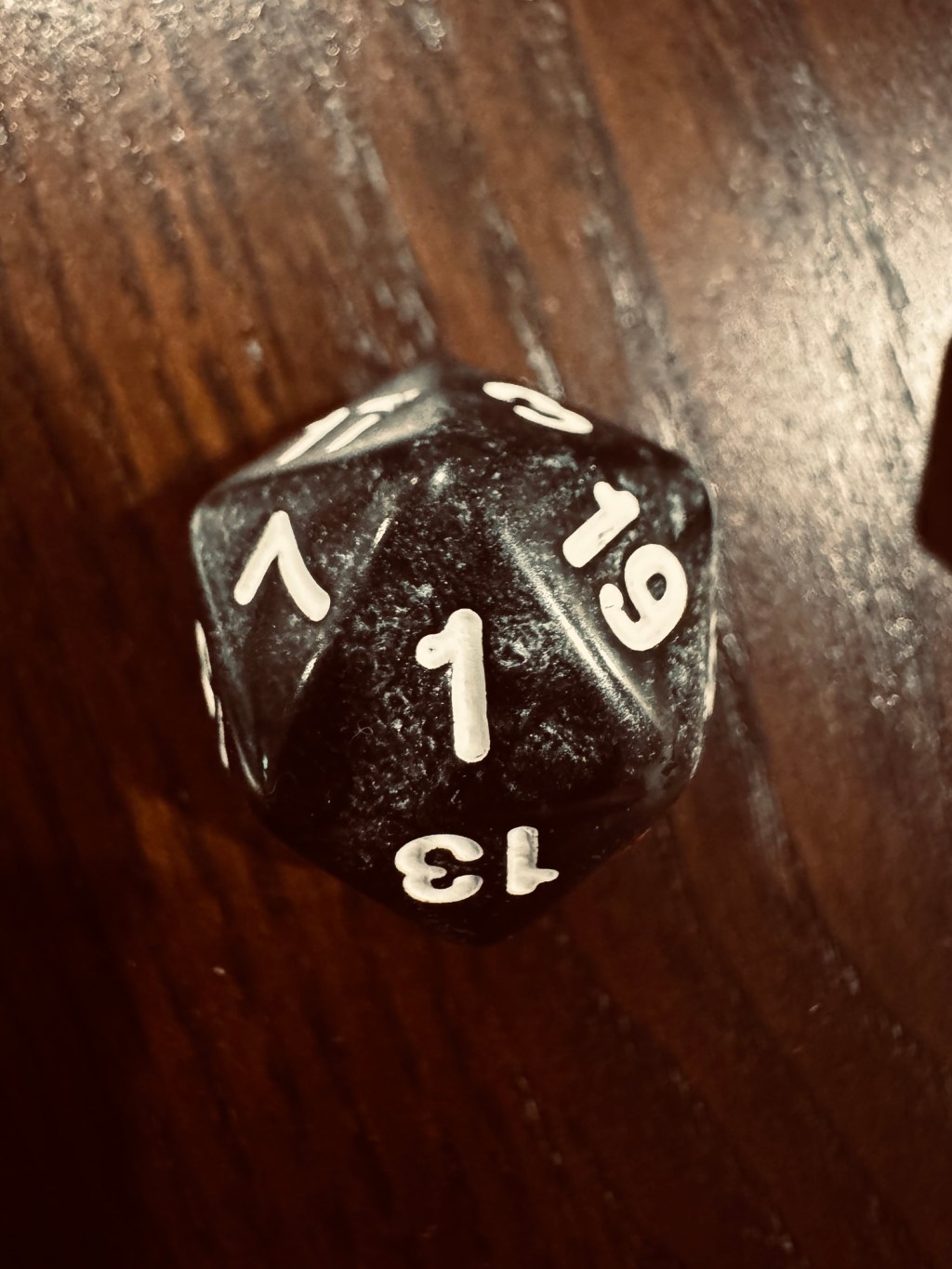
Reed had looked it up and it was technically an icosahedron, made up of tiny equilateral triangles, each stamped with a number from one to twenty. It was used for pretty much everything—for whether a player hit an opponent with his battle axe or halberd or longsword or mace. To see if the players successfully picked a lock or detected and defused a cunningly hidden deathtrap. To determine whether a player escaped the blast of a magickal (again—always with a “k” in Reed’s mind) fireball or lightning bolt or meteor strike, or was felled by the sorcery.
He looked down at his collection of twenty-sided dice: an iridescent green with silver numbers; a gold-flecked and -numbered fireball orange; a cloudy pale yellow; a crystalline blue with its white numbers beginning to rub off from use. And his favorite of the bunch, its body a beautiful, marbled, translucent purple; the numbers inscribed in electric blue.
As his friends continued to bicker, he picked up the purple die and rolled it in between his thumb and forefinger. He mused that although he was in essence a God of sorts—making flesh from word, holding the power of life or death over the characters played by his friends—he was a just and impartial one. He followed the dictates of the blind, chaotic tumble of the dice, which were beholden only to the fundamental laws of the universe. The force of the die—mass times acceleration—as it left the player’s hand. Then the gravitational pull between the mass of the die and the center of the earth, bringing it crashing down to the table with a rattling trill. The complex physics as it tumbled across the tabletop, slowed by air resistance and the friction of the surface until it came to a stop. All of these forces, coming together in a single instant, bearing down upon a small, numbered chunk of plastic, to determine his players’ fates.
Reed snapped out of his reverie as the players ceased their argument and came to an expectant silence, all of them looking to him for what came next. He put the die down and looked around the table. Three of the boys went to Wilson Middle School with him. Immediately to his left was Sonny, who was routinely pummeled at home by his two older brothers and mocked in the cruel arena of Middle School for his turban, as well as his attempt to rebrand himself from his birth name Sundeep, by which he had been known all throughout elementary school. But in the Ziggurat of Utmost Evil, Sonny was the fierce warrior Khalsa the Lion, feared for his prowess with his double-sided battle axe, and deadly accurate with the throwing axes he kept tucked into the waist of his breeches.
Next to Sonny was Jack, a narrow-faced redhead with big ears, which were accentuated by the high-and-tight haircut that his father, a hard-ass and hard-drinking retired Marine, imposed upon him. Jack wore nothing but bargain basement Wal-Mart clothes, and was far behind in school due to his father’s long list of chores to be done every night after school: mopping the floors, scrubbing the baseboards, sweeping out the garage. But in Reed’s basement, Jack was Wild Woodrow, a protean shape changer who could take the form of animals—stealthy and elusive, like a sparrow or skink; or fierce and aggressive, like a dire wolf or wild boar.
The third of his classmates was Harris, the youngest of four adopted children taken in by two Evangelicals, to whom Harris referred exclusively as “the Goody-Goodies.” Under the yoke of the Goody-Goodies, Harris was compelled to pray multiple times a day and attend religious classes every night after dinner. But while playing Dungeons and Dragons, he was the devious and mysterious killer-for-hire known only as Mayhem, master of disguise, poisons, and the well-timed backstab. Like Harris himself, Mayhem served as the group’s id, shit-stirrer, and ringleader.
And then there was Opie, or to the party of adventurers, Noble Barfolomew. The interloper, sitting to Reed’s right.
Reed avoided looking directly at Opie. He was at the height of what Reed’s parents euphemistically called “an awkward phase.” Crooked and twisted wire-rimmed glasses, one bow seemingly attached only by a twist tie covered by scotch tape. Unruly and unwashed hair cut into choppy bangs by his mother. A jutting overbite, full of crooked and discolored teeth. A face full of red, cratered acne. Pilled, faded clothes that gave off waves of a peculiar odor—from what Reed could tell, old, deep-fried foods with an overlay of Febreze.
Harris, Jack, and Sonny had physically distanced themselves from Opie, leaving Reed and Opie on one side of the table, with the other boys crowded together on the other end, as if they were watching the two of them.
Reed knew why.
Because today, Reed thought to himself, would be Opie’s last game with them.
For today, Noble Barfolomew would die.
 RayDorl.com
Leave a comment