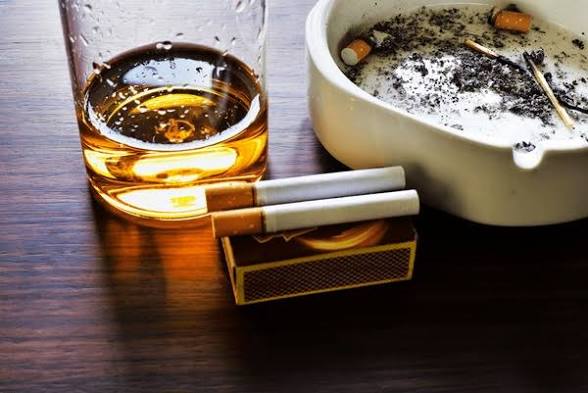
Over the next few days, I tried my best to make the place habitable, enlisting Eli for help. We filled up garbage bag after garbage bag of empty rum bottles and moldy old microwave dinner trays. For the glasses full of cigarette butts, I had Eli hold out a colander, through which I’d dump the yellowish water, then we disposed of the waterlogged butts in trash bags.
As Eli and I got the place in order, I came to realize that my father now needed alcohol on a biological level—he had to drink almost constantly to stave off encroaching withdrawal. He slept irregularly, his sleep cycles determined by this cycle of alcohol intoxication, rather than day and night. Whatever the time of day, he would drink until he passed out, then rouse when his body began to shake from alcohol withdrawal. Often in the dead of night, the empty, cavernous house would echo with the clatter of the icemaker as he made yet another drink.
Alcohol was also virtually his sole means of sustenance, and he had almost completely lost the ability to consume normal food—when I first arrived, I would coax him to eat, even cutting his food into small pieces the way I’d used to do for Eli. But he’d just fidget and take a token nibble, then pronounce himself too full to continue. Now his skeletal visage made sense to me – almost all his caloric intake was from his rum. He was so weak that he could barely rise out of his chair, his legs atrophied and apparently nerve damaged, judging from his tentative, halting gait that he used even when resting his full weight on the walker. He spent almost 24 hours a day in his chair, getting up only to make himself drinks or to relieve himself, which he accomplished by pulling himself up onto his walker, dropping his pants, and dribbling a thin stream of brownish urine into the bucket he kept a few feet from the recliner.
Despite the chaos of our surroundings, we were ready on Eli’s first day of kindergarten. We woke up early, then came downstairs to find my father passed out in his recliner, an empty bottle of Cruzan cradled in his lap. After dropping off Eli, I picked up some groceries and came back to the house. My father was awake now, and staring down at the empty bottle. He was trembling violently and sweating.
When he saw me, he thrust his credit card toward me in a shaky, skeletal hand and demanded, “I need you to go out and buy me another bottle of Cruzan. In fact, just buy a case. It’s cheaper that way. And it will save you a few trips.”
I stared at the credit card and remembered my teenage years, as I helplessly watched Dad drink himself into a divorce from my mother and a euphemistic “buyout” from the family business. Then I recalled my own years in AA and wondered how much my own addiction owed to my father’s. And, I thought to myself, I couldn’t raise Eli in this environment. It was time to stand up to him.
“No. I’m sorry, Dad. This has gone on long enough. We found you almost dead, and this place barely habitable. It’s time to get you some help.”
He scowled, then laughed ruefully. “Help. If you want to help me, you’ll get me my rum, before I die of a seizure.”
“No. I will not help you poison yourself.”
He laughed at that, even through the tremors. “So you won’t help me. Don’t you remember? The times I bailed you out on DUIs and drunk-and-disorderlies? How I paid for you to go through detox? And how I paid for the lawyer for that thing with Eli’s mom, the restraining order or whatever.” He laughed again, a nasty sound.
I turned my back to him to conceal the tears welling in my eyes. Then I headed upstairs, ignoring him as he continued to shout behind me. I went into Eli’s room and picked up his dirty clothes, my father’s taunts still echoing in my ears. He knew all my weak spots, I thought to myself as I filled the laundry basket. He’d created most of them himself.
I walked downstairs to the basement, which had terrified me as a child. It was somehow both cavernous and claustrophobic, with damp, cracked concrete walls, and fragmented into little warrenlike rooms and alcoves. I had to stoop to avoid the piping that ran along the low ceilings, and the few bare lightbulbs cast unnerving shadows as I made my way to the laundry room. Near the washing machine was a little dark alcove that I’d always been afraid of, imagining some monstrous presence back there. It had taken me until the age of 13 to ever go back there and discover it empty, except for a few scuttling centipedes and daddy long legs. Now, even as an adult with a child of my own, I felt a vestigial sense of dread every time I passed it by. But, I reminded myself as I started the laundry machine, I had more important things to worry about.
I came back upstairs and went to the living room to check on Dad. He was shaking violently now, and his anger turned to pleading. “Please. Son. You’ve got to help me.”
“You don’t need any more. You’ve drank plenty enough for your lifetime.”
“Please.” He was shouting now. Beads of sweat dribbled from his forehead, then he began to cry, tears tracing their way down his cheeks into his gnarled beard.
I watched him tremble and writhe in his recliner and recalled my own experience with alcohol withdrawal, just before I’d begun my latest stint in AA. I remembered the sensation of ice-cold razors moving under my skin, along my veins; the feeling of ground glass being driven into my joints by an invisible mortar; of uncontrollable tremors that felt like they would shake the teeth from my gums. Alcohol withdrawal could even kill you, they’d told me in rehab—something that not even withdrawal from heroin or cocaine or crystal meth could do. That’s why they’d shot me up with benzos when I went in to dry out.
I saw no choice. I couldn’t have him die here, this way. So I walked over to him and took the card from his trembling hand, avoiding his eyes. “More of the same?” I asked.
“Get a case,” he said, his voice still shaky—but commanding now, as if he’d brought me to heel. Then he gave me an awful little wink. “And get something for yourself, too.”
So I went to the liquor store. As the cashier went back to the storeroom to get the case of Cruzan, I thought about me and Eli being stuck in this dying town, on a dead river, with my dying father. I felt a rush of grief for my father, for myself. And most of all for Eli.
Then I felt myself walking back to the bourbon section. I watched as my hand reached out and grabbed a fifth of Maker’s Mark, the brand I always used to buy when I was feeling flush.
I held the bottle out for a moment, considering it.
I deserved a drink, dealing with what I was dealing with.
Scratch that, I thought. I needed a drink.
I considered the matter a little more. Then I put the fifth back.
And I picked up the bigger bottle—a handle.
You had to give Dad credit, I thought as the cashier rang me up. Buying the handle made it cheaper per ounce. Plus, this way I wouldn’t have to make a booze run for a few days.
 RayDorl.com
Leave a comment