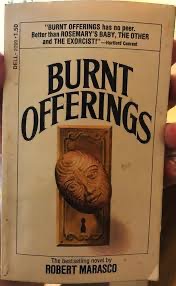
“Burnt Offerings” by Robert Marasco is a 1974 haunted house novel that supposedly influenced Stephen King’s 1977 horror classic “The Shining.” I haven’t seen ay first hand verification by King himself that Marasco was an influence, but for what it’s worth, he lists “Burnt Offerings” in the Appendix to his non-fiction book about the post-World War Two horror genre, “Dance Macabre” (which is a must-read for any horror fan). He even asterisked “Burnt Offerings” in his Appendix, which denotes that he believed it to be “particularly important” to the genre.
Warning: MINOR SPOILERS BELOW
The book begins with the Rolfe family–housewife Marian, husband Ben, who works as a teacher, and eight year old son David–sweltering in a small Queens apartment. Marasco portrays city life as cramped, lacking privacy, and overheated. And I think anybody who has ever lived in a crowded city could relate to a scene in which Ben, coming home after a long day at work, despairs over ever finding a goddamned parking spot, and then promptly forgets where exactly he parked his car.
Marian, in particular, is eager to escape the city for the summer, and manages to convince a skeptical Ben (who is off school for the summer and studying for his Master’s degree) to start looking at summer rental properties. They seem to hit the jackpot when they come across a mansion on the sea upstate. But from the get-go, the place seems pretty ominous:
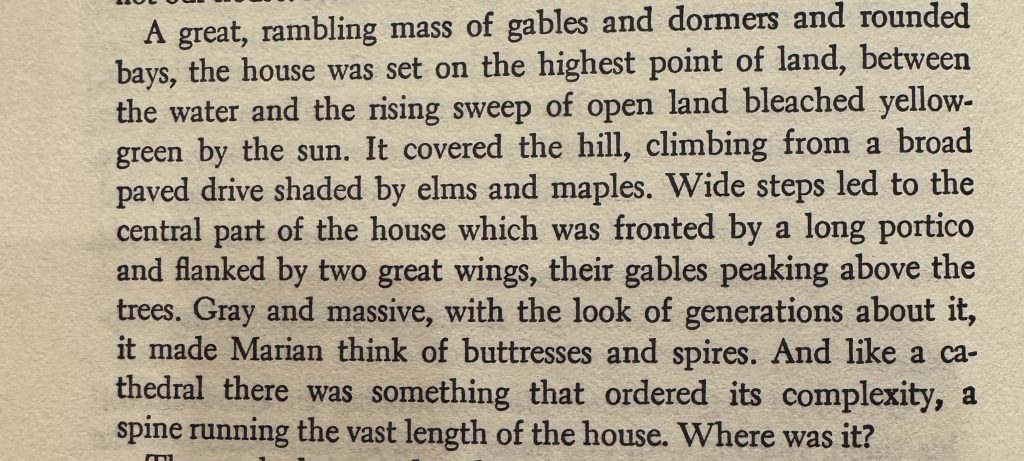
The Rolfes soon meet the occupants of the house: handyman Walker, and the elderly and eccentric owners, the siblings Miss and Brother Allardyce. The Allardyces give the Rolfes a deal that seems too good to be true: they can rent the place for $900 for the entire summer (a steal even in the halcyon days of 1974). But of course there is a catch: the Rolfes are expected to put work into the home, and they are to deliver a tray of food three times per day to the Allardyces’ aging mother, who is a recluse that never leaves her room.
Even by this point, the reader can sense that something is not quite right. But Marasco keeps things on a low boil throughout: the family (accompanied by Ben’s septuagenarian Aunt Elizabeth) doesn’t even move into the house until 77 pages into a 246 page book. By that point, Marian has already developed an unhealthy obsession with the house:

And it’s a slow burn from that point on. There are no ghouls in bathtubs, or living topiaries, or mallet-swinging madmen. The house in “Burnt Offerings” is far more subtle in its evil. Marian becomes obsessed with the house as she burnishes the floors, tends to plants, and polishes the silver. Eight year old David seems bored oout of his mind, retreating into television and junk food. Aunt Elizabeth, a sprightly and vital presence in the City, wanes and ages by the day. Ben spends countless hours in a den, trying to study for his Master’s, but never seems to get anything accomplished–seemingly a precursor to Jack Torrance and his fruitless attempts to write a play in “The Shining.”
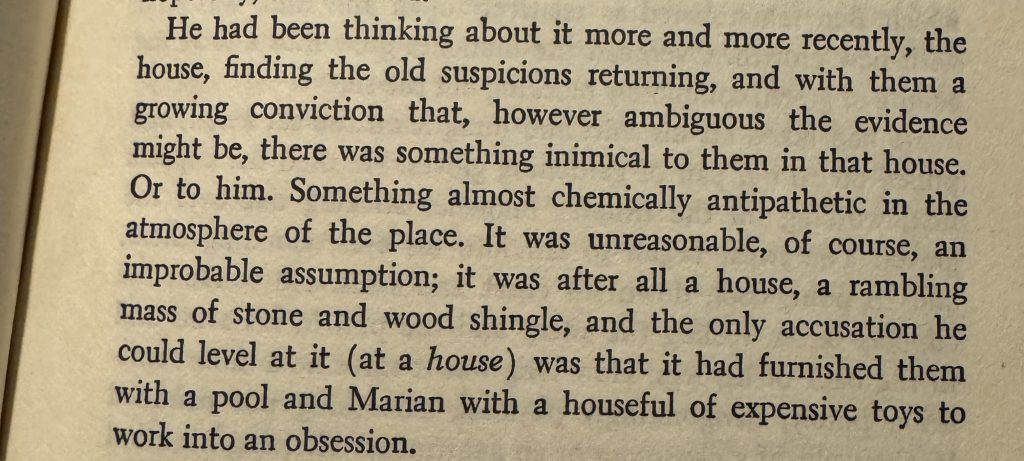
But unlike in “The Shining,” where Jack falls under the Overlook’s thrall, here it’s Ben who becomes alarmed and tries to free his family from the malign influence of the haunted house:
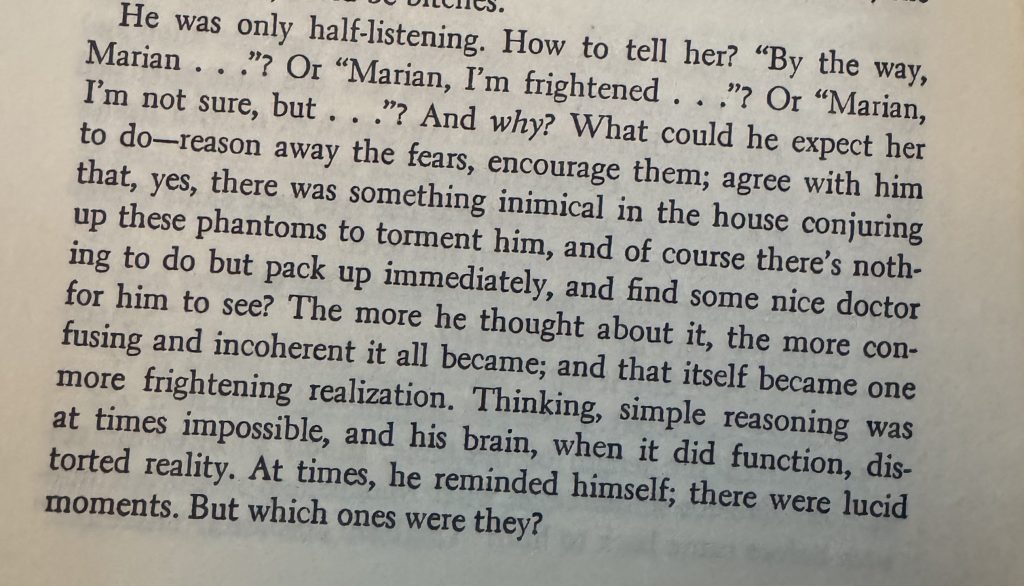
But being a horror novel, Ben continues to doubt his instincts until it’s too late:
By the end of the book, I began to think of the house, and the fate of the Rolfe family, as a sort of a metaphor for the 1970s wave of “white flight,” or families choosing to move out of the city for what seems like the comforts of the suburbs. David, who was active and playful in the city, is devoid of friends or peers in the echoing old house and soon is just mindlessly consuming junk food while staring at the television. Marian falls prey to materialism, becoming obsessed with the beauty of the house and the treasures–fine china and silver–within. Ben becomes intellectually neutered, striving to complete his Master’s degree but stymied. And all of them–but particularly Aunt Elizabeth–begin to age at an accelerated rate, as if the stasis of country life acts as a magnifying force to the ravages of time. All this is of a piece with the countercultural depiction of suburban life as atomized, anti-intellectual, and materialistic.
All in all, this was an interesting and unsettling book–particularly as Marian becomes inured to the fate of the rest of her family and more and more entranced by the house. Like I said, Marasco keeps things on a slow boil, with tension ratcheting up almost imperceptibly until the last 30 pages or so, when the family is irrevocably caught in the house’s/Allardyce’s web. It’s a quick read and I’d recommend it to anybody who’s looking for a creepy haunted house book that’s a little bit off the beaten path.
 RayDorl.com
Leave a comment