
I read and thorougly enjoyed “Paperbacks from Hell” and “My Best Friend’s Exorcism” by Grady Hendrix a few years back, so decided that I’d read his most recent book, 2021’s “The Final Girl Support Group” this Halloween. I was not disappointed.
WARNING: MINOR PLOT SPOILERS
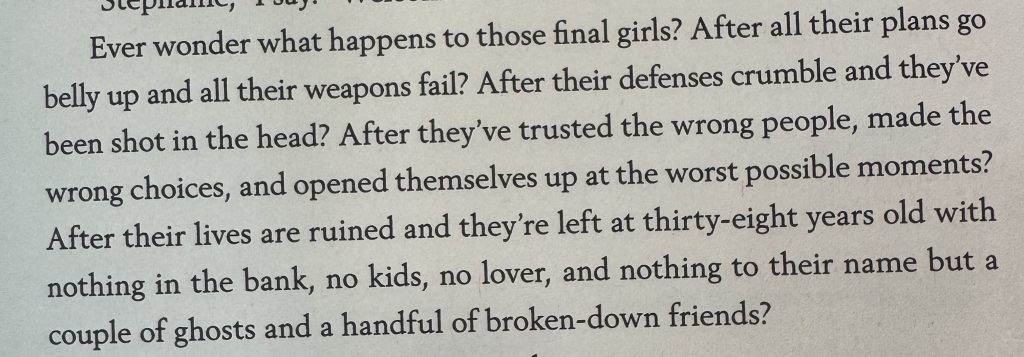
The book starts out with a strong concept: a collection of “final girls” (a term for the trope of the final surviving character in a slasher movie; usually a virginal young woman) are attending a support group. It sounds like a cutesy setup, but Hendrix injects a dose of psychological realism to this fantastical premise. Each of these “final girls” is suffering from serious trauma from the horrible events they witnessed. As our narrator, Lynette, puts it late in the book:
The characters are all thinly veiled versions of characters from well-known slasher movies, each trying–and mostly failing–to live normal lives after the events of those movies. Our narrator, Lynette, is a reclusive shut-in after her family was murdered on Christmas by an axe killer dressed as Santa Claus, a la “Silent Night, Deadly Night.” Heather is a flighty drug addict after surviving a muderous rampage by a pedophiliac school janitor known as the Dream King, akin to “Nightmare on Elm Street.” Dani Shipman is a survivalist on a ranch far from civilization after having to muder her brother after he went on a Halloween killing spree, a la the “Halloween” movies. Marilyn married a filthy rich man and lives in a heavily fortified compound after she and her friends were terrorized by a clan of Texas hillbilly cannibals, as in “The Texas Chainsaw Massacre.” Wheelchair-bound Dani exists in a state of poisonous irony after being stalked by multiple masked killers, as in the “Scream” movies.
Adrienne is doing the best of all of them, psychologically. She is the last survivor of (multiple) massacre(s) at a summer camp, as in the “Friday the 13th” movies, and now runs a summer camp for teenage girls who have been victimized.

The book takes place in 2010, when the characters have been meeting for 16 years. And they all seem sick of one another, backbiting and picking at each other at their support group session. The characters are all coming to the realization that maybe the group has outlived its usefulness:

But soon the plot kicks in–a mere 19 pages into the book–when one of the Final Girls is found dead. This sends Lynette into survival mode, but she soon finds that she and all of the other members of the group are also targets of the killer, who seems to know all of the weak spots of the final girls.
The ensuing action is gripping. The story is told from Lynette’s perspective, and her trauma-induced hyper vigilance is both well-observed and narratively effective: she is constantly scanning her surroundings for danger, which creates at-times unbearable tension for the reader.
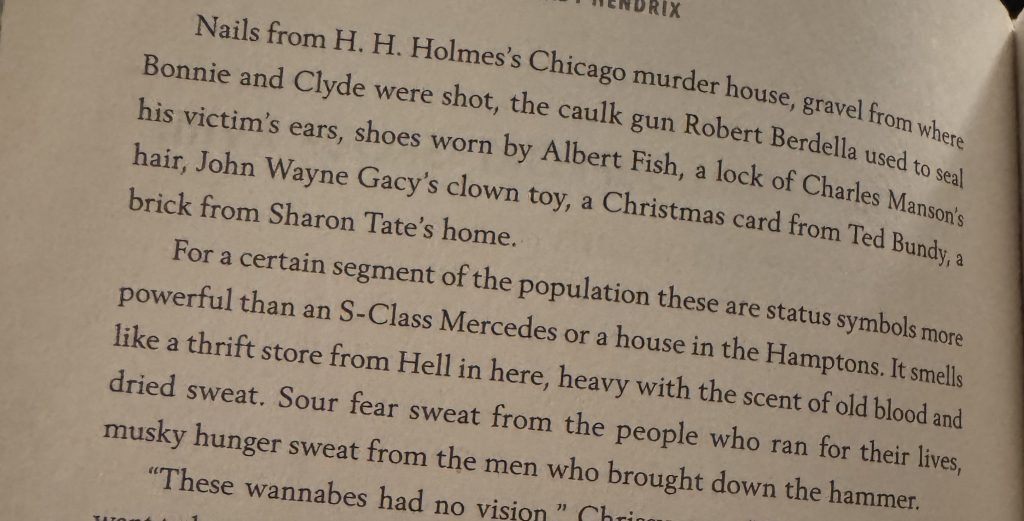
Hendrix also has a knack for making makes things incredibly creepy. I’ve never seen “Silent Night Deadly Night,” and always sort of wrote it off as a stupid slasher, but Hendrix, through Lynette’s memories of the slaughter of her family, transforms the idea of a Santa-themed killer into something truly horrific. Another highlight comes later in the book, when Lynette comes across a sort of serial killer museum:
In short, I loved this book. I devoured it in just a few days, and it was sufficiently creepy that at times the book had me double checking the locks on my doors. It also had me guessing about the identity of the culprit, and I was actually surprised by certain aspects of how it was resolved. This is definitely one of the better horror books I’ve read, at least in recent years.1 Highly recommended if you’re looking for something scary, but also well-observed and insightful, during the Halloween season.
- Stephen King’s best work remains in a class by itself, in my opinion. But as I mentioned in my “Doctor Sleep” review, Stephen King was a formative influence on my developing brain, and thus it’s difficult for me to be objective about his early work. ↩︎
 RayDorl.com
Leave a comment