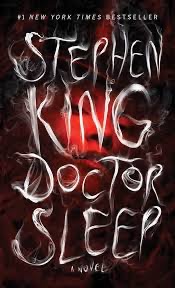
As one of my favorite blogs recently said, the golden age of Stephen King is the age of thirteen. I was a huge fan from the ages of eleven to fourteen, and devoured his early work. I recently re-read a few of his earlier works, including “The Shining,” so when I saw that its belated sequel, “Dr. Sleep” (the latter was published in 2013, or 36 years after the publication of The Shining), was on sale on Kindle, I decided to give it a whirl. I’d say it was a mixed bag.
The protagonist is Dan (formerly known as Danny) Torrence, now grown up and battling substance abuse issues like his dear old dad.1 It was truly dismaying to see the sensitive little boy we knew in “The Shining” turned into a drunken barfly, picking up randos for one night stands, beating up people in barroom brawls, sniffing fat rails of cocaine, and puking up cheap bar snacks. But I suppose that’s the point.2
The subtext is clear: Dan is dealing with his childhood trauma, as so many people do, through substance abuse, random sex, and outbursts of violence. Recall that even before the horrors he experienced at the Overlook Hotel, Dan was a victim of domestic violence–prior to the events of “The Shining,” Jack Torrance broke Dan’s arm in a fit of rage, even before Jack was corrupted by the Overlook Hotel. On top of that, in “The Shining” (book version) Dan was stung by resurrected wasps, almost choked to death by a corpse in a bathtub, stalked by topiary animals come to life, and chased around by his roque-mallet swinging father after Jack was lured into insanity by the Overlook Hotel. And I’m sure I’m forgetting some stuff!3
Dan’s devolution is all very distressing–Danny Torrance was a blameless child in The Shining, and any reader would think that he “earned” a happy ending. But King isn’t just heaping misery on a character for the hell of it. He’s clearly articulating a sad but prevalent phenomenon, in which children who have experienced trauma are at much higher risk of substance use disorders than the general population.
Dan is also abusing alcohol because it dulls his “shining,” the fuzzily-defined mental powers that torment him with images of horrifying violence and death. Adrift, he finds a new home in the small town of Frazier, New Hampshire–a friendly small town akin to many similar small towns in so many other Stephen King novels (albeit not in Maine, King’s usual stomping grounds). Dan finally gets sober with the help of Alcoholics Anonymous and begins working in hospice care, easing the final moments of his patients using his “shining” powers, which have resurfaced due to his sobriety.
Dan is also–coincidentally–living a few hours away from Abra Stone, a young girl with a “shining” far more powerful than Dan’s. The two begin a psychic friendship, and Dan eventually is forced to protect Abra from “The True Knot,” a group of psychic vampires who feed on suffering–and in particular the suffering of children who are strong with “the shining.”
My reaction to this book was mixed. First, it pales in comparison to The Shining. Unlike the terrifying corruption of Jack Torrance and the various ghosts haunting The Overlook Hotel in “The Shining,” I just didn’t find the True Knot particularly compelling or frightening as an antagonist. They’re protrayed as “RV People,” aging Boomers touring the country in high-end RVs, absorbing misery from horrifying public events (they feast on negative emotions at 9/11 and tornado sites, with King likening those “meals” to raccoons eating from dumpsters) and torturing “shining” children to death to absorb their “steam,” or psychic energy. Modern vampires traveling the back roads of the United States has been done before–and done much better–by Katherine Bigelow4 in her excellent 1980s movie “Near Dark.” But here the True Knot–with really unfortunate nicknames like “Barry the Chink,”5 “Heavy Mary,” and their ringleader, “Rose the Hat”–just come off as lame.
Without a compelling villain, I found the main plot of the book to relatively lifeless. As in many King books, including but not limited to “Salem’s Lot,” “It,” and “The Stand,” Dan assembles a group of good-hearted, ordinary people who overcome their skepticism and fear of the supernatural to do battle with evil. In King’s best work (like the aforementioned novels) this can be very affecting–a portrayal of everyday citizens engaging in acts of heroism. But The True Knot are not only lacking as villains; by the time the heroes confront them, they’ve already been weakened by circumstances outside the protagonists’ control, which sort of lessens the agency of the heroes during the climactic battle.6
But I found the emotional beats of the book to be quite affecting. Dan’s struggles are well drawn: as a child of an alcoholic myself, and as someone who has abused various substances for most of my life, I could relate to his pain.7 There is a scene near the end when he reconciles with the spirit of his deceased, violent alcoholic father that left me teary-eyed, and although I never had much use for AA,8 a coda to the novel in which he celebrates fifteen years of sobriety was genuinely affecting.
I also appreciated how King treats the nature of Dan’s heroism. It isn’t ONLY because he helps Abra fight The True Knot. It’s also in his day job, in which he uses his psychic powers to ease the suffering of the dying. I know I mention this in almost every post, but over the past few years I’ve been present for the deaths of far too many people that I care about, and the scenes in which Dan comforts the dying really resonated with me. I also appreciated how King characterized the True Knot to be almost a counterpoint to Dan–while The True Knot feeds on suffering, Dan alleviates it. King has always had a humanistic view of good and evil, and I think the contrast between The True Knot and Dan vividly displays his conception of morality.
So do I recommend this? If you’re a Stephen King fan, I’d give a qualified “yes.” It’s a fairly long book–644 pages, though given King’s page counts I suppose makes this a medium-length book by his standards. But for all my complaints, King remains a propulsive storyteller and I found the book sufficiently gripping that I finished it in less than a week. I suppose if you aren’t expecting a truly scary book, it’s worth reading, particularly if you or someone you love has ever struggled with alcohol abuse.
But if you’re new to King, there are a whole bunch of Stephen King books that I’d clearly recommend before this one.9 Off the top of my head, they’d go loosely in this order:
- Pet Sematary
- The Dead Zone
- Carrie
- The Stand
- It
- The Shining
- Salem’s Lot
- Christine
- Firestarter
The “Dark Tower” series; his short story collections “Skeleton Crew,” “Night Shift,” and “Different Seasons;” his excellent nonfiction works “Danse Macabre” and “On Writing;” and some of the Bachman books (“The Running Man,” “The Long Walk,” and the sadly out of print “Rage”) are also better than this. I haven’t read much of his later stuff, but I’d also recommend “11/22/63” over this, as well.
But all that isn’t to say that this is a bad book. It’s really a testament to King’s work ethic and talent that he’s written so many memorable books. Unfortunately, I’d say that this one is pretty weak as a standalone book (as opposed to its status as a sequel to “The Shining”), and is vastly overshadowed by its predecessors.
- There is a brief section of the book, near the beginning, that takes place in the late 1970s, when Dan is still a child known as Danny. We get a few glimpses of his mother, Wendy, as well as the kindly Dick Halloran (who survived in the book, in contrast with his bloody demise in the movie). This section feels like an outtake or epilogue from the Shining and has little plot relevance to the rest of the novel, which takes place in the late nineties to early 2010s. ↩︎
- I felt much the same in the opening scenes of Cormac McCarthy’s “Cities of the Plain,” where we see Billy Parham–the young protagonist from McCarthy’s “The Crossing”–all grown up and frequenting a brothel. I suppose it’s a testament to both King’s and McCarthy’s powers as novelists that I felt such a sense of loss at the corruption of their young protagnoists. ↩︎
- Note that many of these events differ in the book as opposed to the movie. This excellent article breaks down the differences between the book and movie on a deeper level. ↩︎
- She would later direct classics like the original “Point Break” and “The Hurt Locker.” ↩︎
- The character is white, but still–really Stephen? It’s the goddamned 21st Century, can we cool it with the racial epithets? I suppose to his credit, he has the good sense to have dropped his use of the N-Word, which I recall him using liberally in “The Shining,” “It,” and perhaps others I’ve tried to exorcise from my mind. ↩︎
- SPOILER: They get a fatal case of the measles from consuming the “steam” from a psychic-sensitive young boy. Pretty lame if you ask me, though I suppose it’s thematically significant that they perish from their own cruelty. ↩︎
- King has been very open about his own substance abuse issues, so he knows of what he speaks. ↩︎
- I did a stint in Narcotics Anonymous in my misspent youth but quit alcohol cold turkey 5 years ago without using a 12-step program. ↩︎
- I might write an entire post on this, although I say that enough that I doubt I’ll get to everything I’ve been promising. ↩︎
 RayDorl.com
Leave a comment