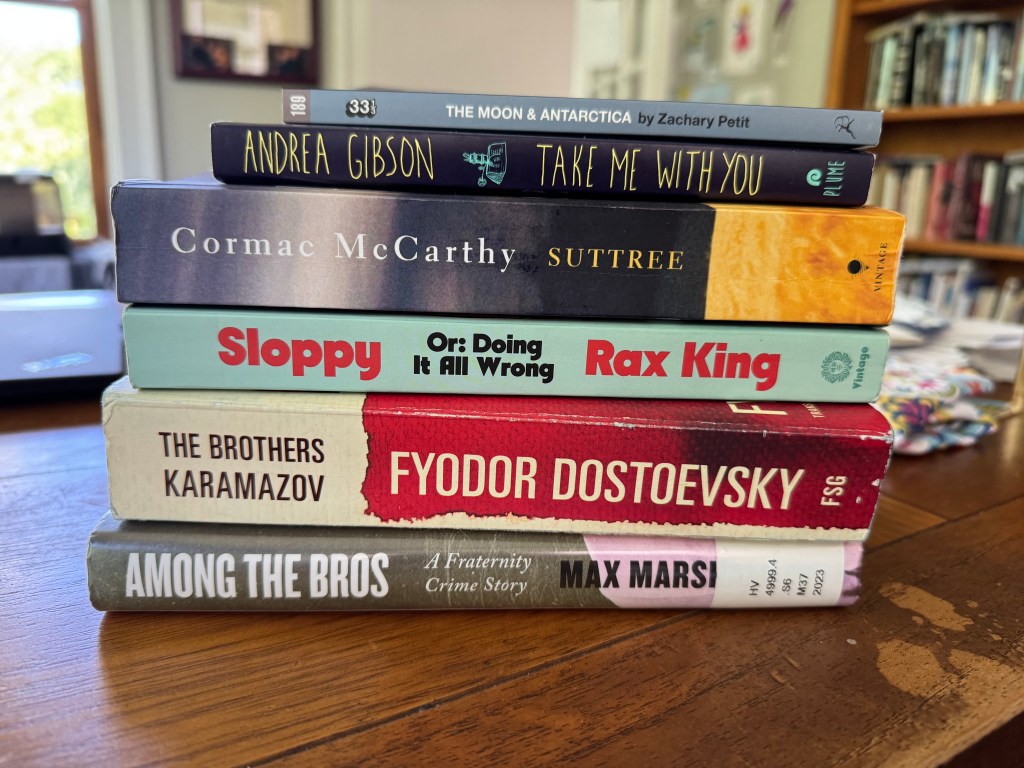
I’m trying to catch up on books I read in July and August, 2025, so here are some capsule reviews. I already covered The Brothers Karamazov and The Violet Hour in separate posts.Books are listed in chronological order by the dates in which I read them.
Suttree, by Cormac McCarthy: A book I’d long meant to read, as all the real Cormac McCarthy heads in my life had told me it’s one of his best books. I’ll admit that at first I was a little underwhelmed; unlike his other best-known books (“Blood Meridian,” “The Border Trilogy,” “No Country for Old Men,” “The Road,” or “The Passenger/Stella Maris”), there isn’t a lot of plot here. In fact, I for the first 100 pages or so I would’ve called it “slow.”
But soon I relalzied that it isn’t “slow.” Rather, it matches the pace of the layabout characters it follows–a bunch of (mostly) lovable layabouts, deadbeats, oddballs, screwups, and drunkards in 1950s Knoxville, Tennessee. The real word for this book is “leisurely,” and after I came to that realization, I read it in that spirit and enjoyed the pure genius of McCarthy’s prose.
As always, his dialogue (delivered in his trademark, quotation-mark-less style) really shines.
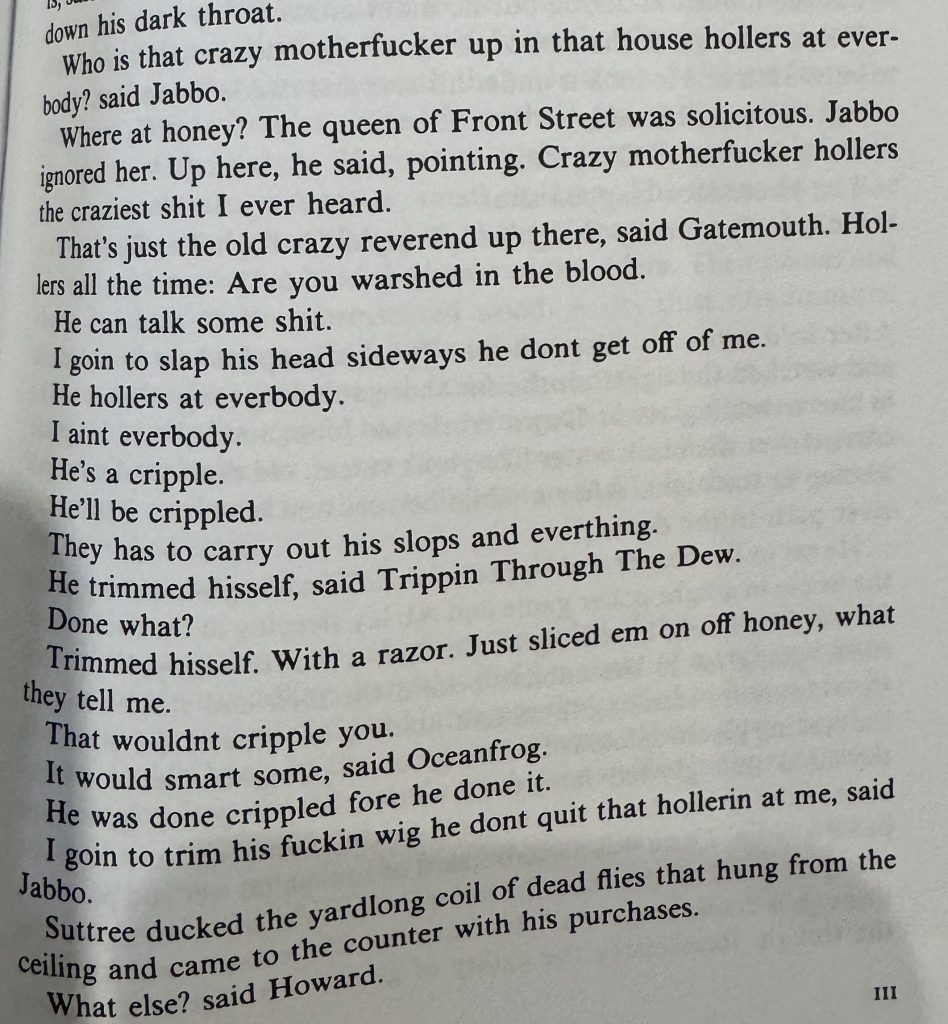
And despite “Suttree”‘s (well-earned) reputation as McCarthy’s “funniest” book, his descriptive language is still used to haunting effect, as in this section where the protagonist–rich kid turned itinerant layabout Cornelius Suttree–wanders, half-starving, through the mountains:


I got chills reading that. This is probably the best book I’ve read in the year 2025. Highly recommended for all the McCarthy-heads out there.
33 1/3: The Moon & Antarctica, by Zachary Petit: This is part of the 33 1/3 book series, each of which does a deep dive into a particular album. This one covers Modest Mouse’s masterpiece,1 The Moon & Antarctica. Modest Mouse is probably my favorite rock band of all time, and The Moon & Antarctica just turned 25, so I picked this one up over the summer.
It was a great read–at least for a Modest Mouse superfan such as myself. Isaac Brock, who is often surly and uncooperative with reporters, seems to have given Petit a lot of time just to hang out with him drinking beers and gives a lot of candid answers to Petit’s inquiries.
It goes into granular detail about the recording of the album in Chicago, and Brock’s infamous assault in Armour Park after the instrumental tracks had been recorded.2 Brock’s jaw was fractured and he had to wait three months until it healed to lay down vocals. The book explains that during his recuperation, Brock obsessively listened to the tracks that had already been recorded and reworked them, and Brock’s enforced silence played heavily into the instrumental tracks that formed the backbone of the resulting album.
The book covers everything from the type of guitar Brock used on such tracks as “The Stars Are Projectors” (which made me briefly obsessed with obtaining a Fernandes Sustainer guitar) to the meaning of the lyrics, which are obsessed with our mortality and our place in the universe. Despite being the writer of what I consider to be some of most profound and thought-provoking lyrics in rock history, Brock remains an appealingly unpretentious subject throughout. He sums up his thoughts on his lyrics in this quote:
. . . [I]t’s not, you know, like Greek philosopher-like focus. It’s that messy shit that is most of our fucking lives . . .And that’s the least cop-out-y way I can explain why I don’t like explaining songs. Why I don’t actually think that it does the songs any justice. And why I think that I’m lying when I give answers to what songs are about. Because they’re not generally about anything except for that fucking moment in time or that feeling you have about something that you can’t yet identify . . . .
Anyhow, highly recommended if you love Modest Mouse. If you don’t–first, what the hell is wrong with you (just joking, I love all my readers); and second, this book probably isn’t for you.
Take Me With You, by Andrea Gibson: Some good friends of mine gave this to me as a 50th birthday gift, and it knocked my socks off. I’d never heard of Andrea Gibson, but they’re3 a poet and visual artist who produces work on love, politics, identity, and trauma. Her work is by turns (and sometimes simultaneously) hilarious, defiant, heartbreaking, and thought provoking. They have the quality of Zen koans–deceptively simple but containing great complexity.
A couple examples (which will not do them justice, since they’re written in Gibson’s own hand, with their hand-drawn illustrations as accents):
Our insanity isn’t that we see
People who aren’t really there
It’s that we ignore the ones
Who are
It’s a myth that
Kids are cruel,
Because we
Don’t grow out
Of it.
These examples don’t really do the book justice, because the poems sort of accrete throughout the book, creating an aesthetic impact that is more than the sum of their parts. That’s why it was so devastating to learn, when I was done with the book, that Andrea passed away from cancer in July, just a month shy of their 50th birthday and ten days before my own 50th. I suppose the only consolation is that they were able to so fully actualize their artistic promise during their lifetime.
Among the Bros: A Fraternity Crime Story, by Max Marshall: The characters in this book could’ve definitely used some Andrea Gibson poetry in their lives. It recounts the (true life!) involvement of members of the College of Charleston chapter of the Sigma Alpha Epsilon fraternity in a wide-ranging drug conspiracy, specializing in selling Xanax but eventually encompassing cocaine as well. It is truly a fascinating story and is well-told by Marshall.
It also illuminates the role that fraternities play in the economic and social elite of this country. Per Marshall (quoting a Cornell University Greek life website):
“While only 2 percent of America’s population is involved in fraternities, 80 percent of Fortune 500 executives, 76 percent of U.S> senators and congressmen, 85 percent of Supreme Court justices, and all but two presidents since 1825 have been fraternity men.”
As a personal note, I went to a Big Ten school with a huge fraternity population and developed a deep-seated loathing of fraternities and their affiliated bros. But this book managed to peel back the layers of privilege and show some of the motivations for why these frat guys engaged in a wide-ranging criminal conspiracy . “Because they could get away with it” was only part of it; another part, Marshall suggests, is class and status insecurity, where even the “well off” bros are surrounded by the mega rich and feel they need to do something to up their status. Marshall also suggests that some of the bros were in it because they’d been handed everything in life on a silver platter, and wanted to prove that they could “make it on their own,” even if that meant engaging in drug dealing.
But still, there is no doubt about it, these bros were privileged. Despite being caught with mind-blowing amounts of Xanax, cocaine, cash, and high powered weaponry (including a Tac-D grenade launcher), all but one (the one who had the actual connection to cartel-affiliated cocaine suppliers and could not “flip” on anyone without being literally decapitated) got slaps on the wrists.
And surprisingly, I was moved almost to tears by one “bro,” from a disgustingly wealthy family, who wound up hopelessly addicted to Xanax and ultimately murdered for his stash. Although his killer (an acquaintance from a Charleston dive bar) was eventually caught and convicted, Marshall insinuates (persuasively) that the victim was set up his own girlfriend and one of the frat “kingpins.”
Marshall does a good job sketching all these characters, and also doesn’t shy away from the misery they spread, going into detail about the spread of “Xanax culture” on college campuses and the horrors of benzodiazepine addiction. This was really a great read, and if you can get over negative feelings about frats and the “bros” Marshall depicts, you’ll be left with some semblance of empathy for them, which is a true testament to Marshall’s abilities as a writer.
Call of the Wild, by Jack London: An absolute banger, and a classic for a reason. Oddly enough I’d never read it before, but I was inspired to finally get around to it by a trip to Denali National Park with my family for my 50th birthday, where we got to see (and pet) the sled dogs there that help maintain the park.
For those who aren’t aware, the book is about a Saint Bernard-Scotch Shepherd named Buck, who lives in “the sun-kissed” Santa Clara Valley, who is kidnapped and shipped to the Klondike and forced to toil as a laboring sled dog on the Yukon Trail. There, the previously spoiled Buck learns “the law of club and fang,” and must survive not only the elements, but the cruelty of his both his fellow dogs and the humans that he serves.
It’s a gripping tale, told with aplomb. London could flat out write, and had a way with a memorable turn of phrase–I’ll never forget the quoted language above, due to London’s evocation of Buck’s fading memories of “the sun-kissed Santa Clara” as he learns the hard lessons of “the law of club and fang.”
I’m not even a dog person, yet I deeply felt the pathos of Buck’s plight, and <SPOILER ALERT FOR A 122-YEAR OLD BOOK> cheered when he ultimately avenged a beloved owner’s fate near the end of the book. I definitely recommend this one to anyone–it’s a timeless tale for a reason.
Caught Stealing, by Charlie Huston: I saw the trailer for a cinematic adaptation of this book, directed by Darren Aronsofsky. It looked intriguing, so when I saw that the Kindle version of the book was on sale for 99 cents, I picked it up.
This is definitely a good read–a terse, propulsive neo-noir thriller about a two-bit loser who gets in over his head through a simple act of kindness. But holy moly this is dark: the trailer for the film adaptation makes it out as a sort of light-hearted action-comedy, but the book is extremely grim, with a lot of likable characters getting unceremoniously killed off in gruesome ways. Highly recommended if you like to read crime novels in the vein of Richard Stark’s “Parker” series, where there is absolutely no honor among thieves and everyone is playing for keeps.
Sloppy, by Rax King: I’ve been a big fan of Rax King since reading her books Tacky and The People’s Elbow a few years back. She fearlessly addresses the most emotionally wrenching of subjects–rape, abusive relationships, substance abuse–with the deftest of touches. Her essay on healing from the aftermath of an abusive relationship through marathon viewing of Guy Fieri’s “Dines, Drive-Ins, and Dives” is an excellent example.
“Sloppy” continues her in this vein. It’s a series of linked, memoir-ish essays that are held together by the common theme of…..well, being sloppy. The chapters cover variations on that theme including her absenteeism from school, pathological lying, working as a stripper, shoplifting, substance abuse, and smoking cigarettes.
That last chapter shows off what I consider her signature writing skill: having the reader nodding and laughing along at her humorous, readable prose and then hitting that one line that just drives home the fact that you’re reading about heart-wrenching emotional trauma. In the chapter “Cough-Cough,” she addresses her beloved father’s smoking habit and her efforts to “bully him into staying alive.” Finally, when the end comes and she visits her father in the hospital for the final time, she writes this devastating passage:
On the wall of his room are written his age, weight, and so on. I read the weight, read it again. Confirm that it’s in pounds, not kilograms. No way that number is right, when he’s the biggest man there ever was.
Having gone through a similar experience, that last line had me publicly burst into tears on the El.
Anyhow, I found this entire book to be extremely relatable, entertaining, insightful, and emotionally affecting. If you haven’t read any of her stuff, I strongly recommend you click on the link I provided above. If that kind of thing is up your alley, I’d definitely recommend “Sloppy,” as well as her previous books.
- As opposed to its best album, which I would contend is 1997’s “The Lonesome Crowded West.” ↩︎
- According to Brock, he was just trying to bum a cigarette and start a conversation. Petit interviewed a lot of people who are close friends with Brock who all agree that Brock was probably fucking with the guys that wound up assaulting him. ↩︎
- Andrea was non-binary. ↩︎
 RayDorl.com
Leave a comment