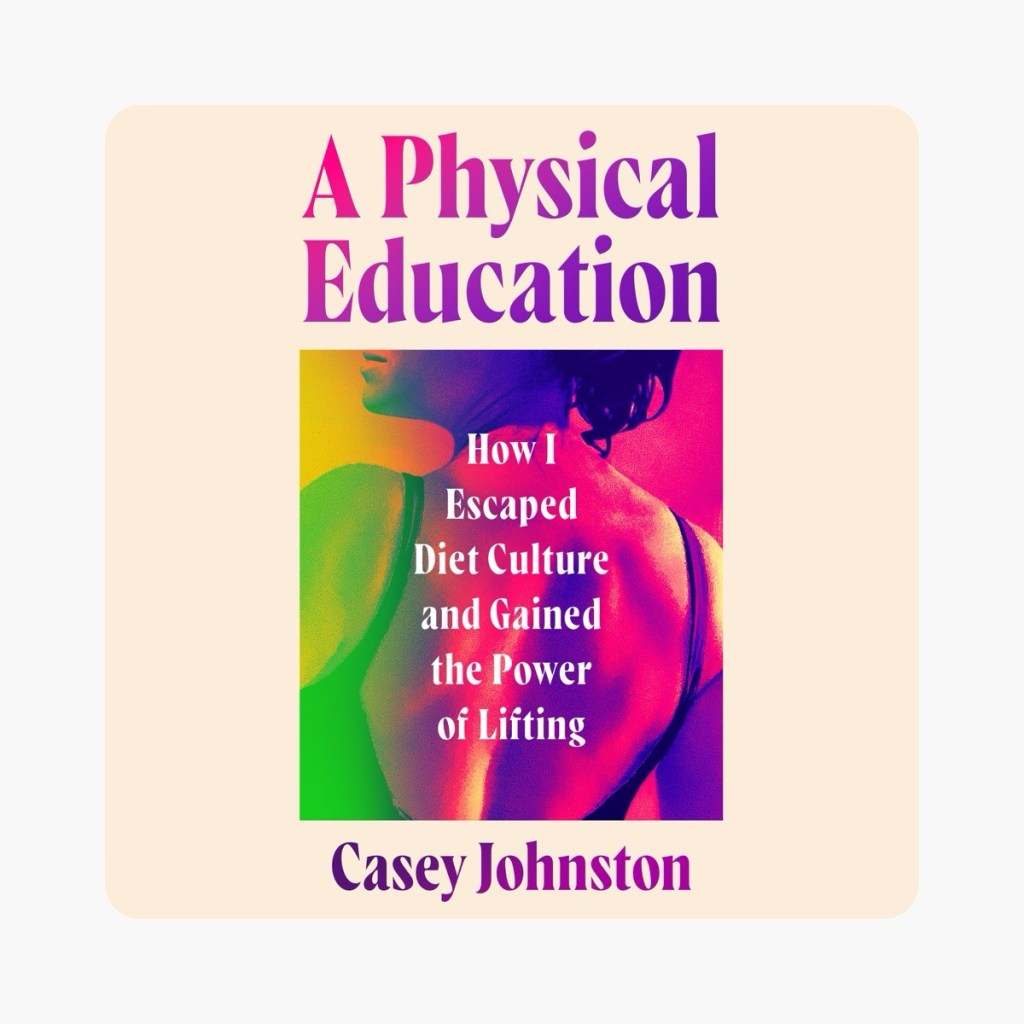
A book about lifting? Talk about combining my two passions….
I used to enjoy Casey Johnston’s column, “Ask A Swole Woman,” which ran on various websites (including The Hairpin, Self, and Vice) before she founded a newsletter and Discord. She always gave good, practical advice about lifting weights, primarily aimed toward newbie lifters who might be a little scared off by some of the more intense corners of Internet lifting. She was always a reliably approachable and positive presence in a sport/community that can definitely fall prey to macho bullshit.
So recently I bought the book for my wife, who, like me, is a retired powerlifter.1 Like any book I give to her, of course, it was destined to be read by me, as well.
I’ll start with the good: Johnston writes an excellent tale of self-discovery and using weights to break out of negative cultural messages she’d been bombarded with her entire life. She ably discusses the toxic diet culture of the 2000s and 2010s,2 and how her efforts to conform to that culture–through relentless starvation diets and endless cardio–left her feeling hollowed out and depleted, both physically and mentally. She writes about rediscovering herself through lifting weights and eating food, looking at her body as a functional system rather as something that needs to be shrunk and minimized. And she writes about how how her physical transformation via healthy caloric intake and lifting weights transformed her mentally as well, helping her to break free from a submissive, “people-pleasing” style in toxic relationships and workplaces. These are all laudable and necessary messages in a patriarchal society that too often treats women as objects to be gazed at or obtained.
I also enjoyed her depiction of the neighborhood gym she first joined while living in Brooklyn–a classic “black iron” gym that had seen better days:

Sounds like my kind of gym!
Similarly, Johnston does a good job depicting her burgeoning friendship with a gym regular named Demetrius–a huge man of indeterminate age, toting a massive suitcase and camping out in a squat rack eating sandwiches between sets of preposterously heavy shrugs ,who is incongruously kind and helpful to newcomers. He’s definitely akin to many lifting “characters” I’ve encountered during my years in the gym.
“A Physical Education” also gives a lot of good, essential information about lifting, tailored for newcomers. Subjects such as bracing, nutrition, calculating one’s protein needs, and progressive overload are described clearly and concisely. So on top of being a well-written book of personal empowerment, the book is a good place to start for someone looking to get into lifting.
But overall I was left a little flat by this book (as was my wife, who described it as “basic”). Johnston portrays lifting weights as something that’s good for you–like eating your vegetables or flossing. She doesn’t really capture the madness and compulsion of the sport/past time, as some of my favorite writers about lifting weights do, such as Mythical Strength3 or Jamie Lewis. After a certain point, pushing the weight becomes an obsession (at times an unhealthy one), and that’s the aspect of the sport I most enjoy reading about. While Johnston gives a few accounts of her pride in mastering certain lifts that had previously been too heavy for her, it never feels like she’s truly passionate about the iron. For example, she talks about using the essential Starting Strength at the beginning of her lifting career. But that program is renowned for stalling out quickly, and we never hear about how she overcame her plateaus, or if she ever developed a personal philosophy of progressing,4 or about adding in assistance lifts to the notroriously low-volume Starting Strength program. And she fails to capture the absolute thrill of putting a heavy weight on your back, one that could crush or permanently injure you, and managing to come out of the lift unscathed and wanting more.
The other issue I have with Johnston’s book is her perfunctory attempt to give an account of the cultural history of weight training in the United States. That would be something that would take a serious sociologist/historian a large book to account for, but here Johnston tries to encapsulate the entirety of physical culture in the United States in a couple of chapters. She essentially reduces that history to the quasi-socialist Turner movement, and then the “Muscular Christianity” phenomenon. She sums up the subsequent history of weight training by stating “once Christian, capitalist, and even fascist propagandists hooked their claws into it, they didn’t let go,” and lumps the subsequent history of physical culture in the United States into two “camps” – the “culture of body building,” citing Arnold Schwarzenegger and Jack LaLanne5 as exemplars, and a “more functionally driven and militaristic” ethos exemplified by the (recently resurrected) Presidential Physical Fitness Test.
I have to take issue with this aspect of Johnston’s book, as I think it’s a gross oversimplification of the modern history of physical culture. Oddly enough, since her book concludes with Johnston competing in a powerlifting competition, she completely ignores the history of powerlifting in the United States.6 In doing so, she ignores havens for brilliant weirdos and outcasts such as the original Culver City Westside Barbell, a powerlifting club with innovative training techniques that drew great minds like neurosurgeon, prolific writer, and 600-pound squatter Oliver Sacks (portrayed by Robin Williams in “Awakenings”) and aeronautical engineers, as well as Olympic athletes and assorted freaks and weirdos. She also ignores the Columbus, Ohio Westside Barbell, also an innovative training center where broken humans congregated, with some lifters escaping abusive homes and living in their cars in order to train there, and a place where a trans lifter like Janae Kroc could find a home.
I guess my point is that lifting weights has always been a haven for people who are perceived as misfits, social rejects, and outcasts7—Henry Rollins has written about how lifting weights allowed him to overcome (physically and mentally) the bullying he suffered as a child. Given that Johnston herself writes so movingly about overcoming various traumatic relationships through lifting weights, I find it curious that she portrays the sport in such a two-dimensional manner.
But these are the gripes of a fanatical meathead. Overall this is a solid book for anyone who is curious about lifting weights, or enjoys books about physical, mental, and societal empowerment. And veteran lifters may still enjoy this as a way to remember their own discovery of the transformative power of lifting.
- I would consider myself “semi-retired” as I still train like a powerflifter and flirt with the idea of entering another meet. ↩︎
- I’m not suggesting that toxic diet culture doesn’t still exist, and in fact I feel like one of the more underreported and pernicious effects of Trump 2.0 is to roll back a lot of the strides toward body positivity that were made in the late 2010s and early 2020s. ↩︎
- The Mythical Strength blog is an absolute treasure. The guy who writes it has been writing an article per week for over twelve years about lifting weights. I’ll probably do a full blog post about his genius/madness. ↩︎
- To be fair, Johnston has put out a book called Liftoff: Couch to Barbell, so I suppose she has her own thoughts on lifting. But that book is directed towards people just starting out, which is very different from the needs of “intermediate” lifters for whom week-by-week progressive overload no longer works. I’ll most likely elaborate on this theme at some point on this blog. ↩︎
- I also feel like she slights LaLanne by reducing him to a “bodybuilder,” the guy was a legitimate badass, as recounted here by the aforementioned Jamie Lewis (warning – as with everything Lewis writes, the language is very, very salty). ↩︎
- She also ignores Olympic Weightlifting, strongman, and Crossfit, which for good or for ill is one of the most influential fitness fads of the 2010s. The lack of discussion of these sports is a little more understandable since she doesn’t compete in any of them, while her competing in a powerlifting meet is the climax of the book. ↩︎
- Definitely including me. ↩︎
 RayDorl.com
Leave a comment