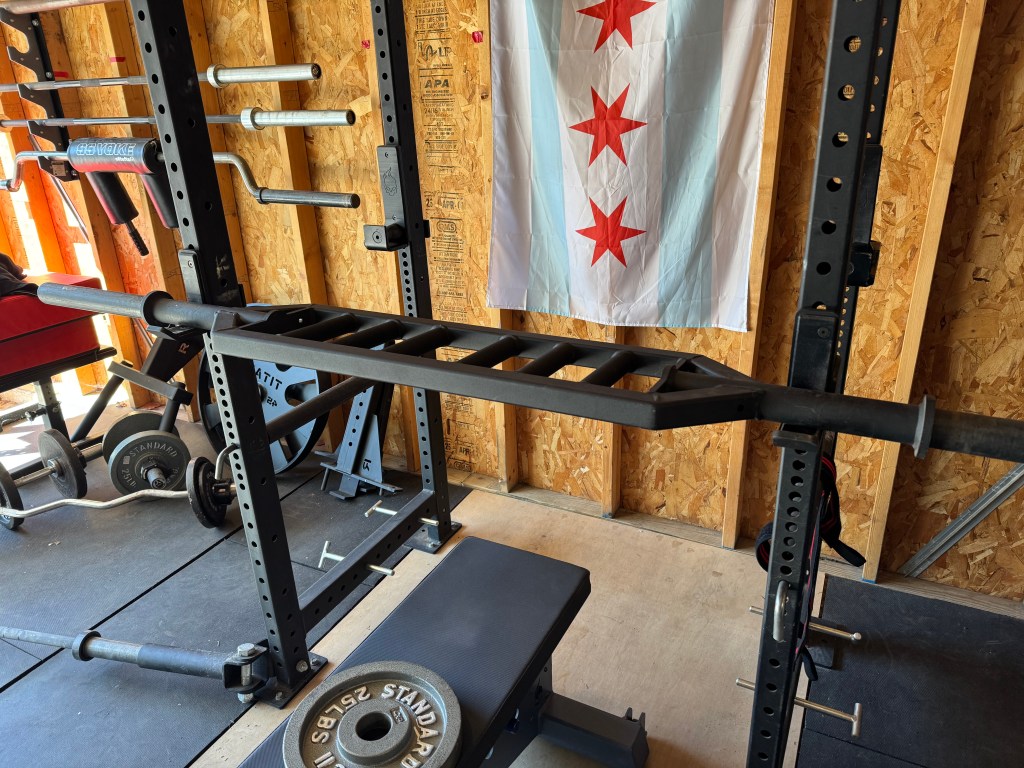
Another “specialty” barbell I love is the multigrip bar, a/k/a the “Swiss” or “football” bar. The multigrip bar is a good barbell to use for shoulder safety while bench pressing, and at the same time poses unique biomechanical challenges that will benefit the bench press–analogous to the Safety Squat Bar with the squat.
True to its name, the multigrip bar features six parallel grips, offering three different widths with which to press it. Here’s an image from another angle, so you can see what I’m talking about:
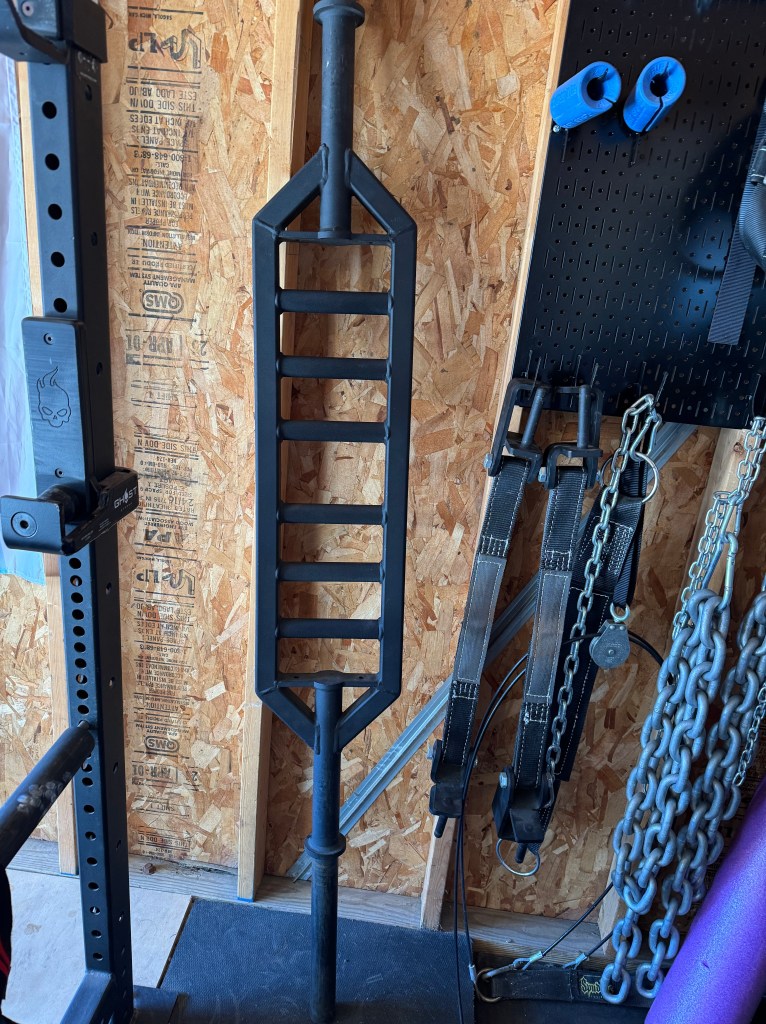
This one is the Rogue MG-1 Multigrip bar,1 the grips for which are perpendicular to the length of the bar. Rogue makes a couple of other multigrip barbells with angled grips–the MG2 and MG3–and I’ve used those at my commercial gym. But frankly I don’t see any advantage to using those, and it can be a pain in the ass figuring out which direction tor rack the angled multigrip bars. It’s worth mentioning that Rogue is not the only manufacturer of this kind of bar–EliteFTS and Titan (and I’m sure many others) also make a variety of multigrip bars. I’m not exactly sure why I got the Rogue version, because Rogue tends to be top-dollar, but it’s a good bar so I have no buyer’s remorse.
The multigrip bar has two unique advantages for bench pressing. First and foremost, the way the grips are situated allows the multigrip bar to be lifted with a “neutral” grip. When benching with a standard barbell, the lifter has to twist his or her hands inwards, which also causes the shoulders to naturally rotate inwards. This slightly rotated grip, and the naturally corresponding rotation of the shoulders, is why the bench press can really chew up your shoulders if you don’t maintain proper form.2 The multigrip bar lets the lifter press the bar with the hands and shoulders in a neutral, ergonomic position and avoid placing his/her shoulders into that compromised position.
The second benefit of the multigrip bar is that it has–true to its name–multiple grip widths. My grips are spaced out at widths of 5.5”, 13.5”, and 21.5”, so you have a few different training stimuli you can use when using this bar. If you’re using it to bench press, the further “inward” you put your hands, the greater the tricep activation. So if you’re looking to build the triceps, you can use the inner handles. If you want to hit your pecs, move the hands to the outer grips. And for the “Goldilocks” method of hitting both muscle groups simultaneously, you can use the intermediate grips.3
But the shape of the bar also creates a training challenge: due to the flat, vertical shape of the bar, it is frighteningly easy to tip toward one edge or the other, which will really fuck up your lift. So when using the multigrip bar, you have to make sure you keep the bar parallel to the ground. That necessitates bringing down the bar–in the eccentric4 phase of the lift–with great care to avoid tipping it one way or another. This tends to limit the amount of weight you can use on the multigrip bar–my max multigrip bar bench press is about 20 pounds or so lighter than what I can do on a standard barbell.
But like so many other things in lifting, this limitation is also a boon. The care with which the multigrip bar must be lowered to the chest builds eccentric strength and also trains the lifter to control the bar on the way down, instead of getting loose and sloppy on the descent. In my experience, that transfers over to bench pressing with a standard barbell by ingraining good form, and it ultimately prevents injuries that can result from loose and sloppy benching.5
I primarily use the multigrip bar for bench pressing, but also use it for hammer curls and skullcrushers. I’ve also seen multigrip bars used for front squats, rows, and overhead pressing, but I personally favor a standard barbell for those exercises (or when I want to overhead press with a neutral grip, I use a log).
I guess what I’m getting at is that the multigrip bar is a versatile barbell that can really help increase your bench press by ingraining good eccentric form while also keeping your shoulders healthy by allowing you to bench with an ergonomically neutral grip. If you have the cash and space to spare and you’re looking to improve your bench press, I heartily recommend this bar.
- RayDorl.com has not been paid by any sponsor, but if anyone’s interested in forking over some cash, hit me up. ↩︎
- Proper bench press form is deceptively tricky. I’ll cover my thoughts on that in a future series on “How to Bench Well.” ↩︎
- For bench “Speed-Strength” training, Louis Simmons of Westside Barbell fame always preached the use of three sets of wide-grip benching, three sets of intermediate-grip, and three sets of narrow grip. What is “Speed Strength” exactly? You’ve got me – like much of Louis Simmons’s teachings, that’s a big time mystery, but I’ll probably try to decipher his training methods in a future blog post. ↩︎
- In this context, “eccentric” means lowering the bar to the chest; not dressing like Tom Wolfe. ↩︎
- To visualize what I’m talking about, think of any teenaged lifter you’ve seen trying to bounce the barbell off his (it’s always a teen boy) chest to eke out a heavier bench press than he’s actually capable of doing. That’s an easy way to injure yourself and something we all should avoid doing when we’re above the age, of, say, seventeen. ↩︎
 RayDorl.com
Leave a comment