WARNING: SPOILER ALERTS FOR A 145 YEAR OLD NOVEL!!!!!
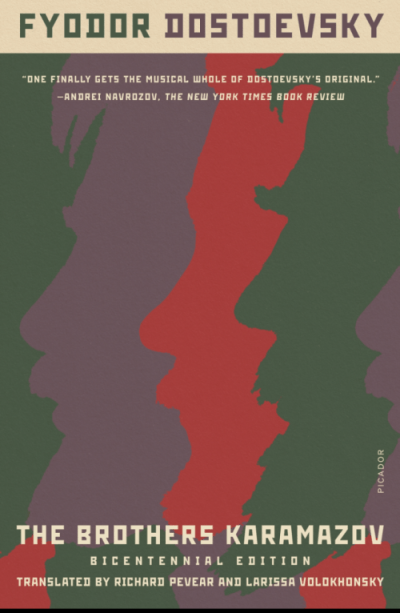
I’d been meaning to read this for 28 years or so. In late July of this year (2025), I returned to Alaska for the first time since working there during the summer of 1997.1 To prepare for the trip, I was perusing a journal from my first trip out there and found a list of books I wanted to read. Brothers Karamazov was the last one on the list I hadn’t completed, so I decided to bring it out to Alaska with me. I didn’t get much reading done on that trip, but I persisted, and finally finished it over Labor Day weekend.
To tell the truth, I found the first 400 pages to be an absolute slog. It was ponderous, wordy, repetitive, and went off on tangents that were at best peripheral to the book’s plot and themes. Reading the first half of the book really demonstrated the difference between a book like Cormac McCarthy’s Suttree2–a long, relatively plotless book that I read recently and eventually realized was “leisurely” and meant to be enjoyed as such–and a poorly-paced book.
The centerpiece of the book, of course, is the murder of the Karamazov patriarch, Fyodor. He’s made out to be a truly loathsome human being–a shockingly neglectful father who drives his wealthy first wife to suicide through his open womanizing, then denies her son (the violent, impulsive Dmitri) his just portion of her inheritance. But Fyodor comes off as the most vibrant and human character, talking shit to venerated holy men and generally reveling in his scumbaggery, in contrast with his tedious sons–the loutish and impetuous Dmitri, the pompous windbag “intellectual” Ivan, and the insipid, religious Alyosha.
The first 400 pages sets up these characters and their fault lines (which are mostly over Fyodor’s money, as well as two overlapping love triangles), punctuated by long passages in which Alyosha’s mentor, the pious Orthodox monk Zosima, articulates a pretty reactionary worldview.3 The whole thing is really a snooze.
But things pick up in the lead-up to Fyodor’s murder, when a sense of dread gathers and permeates the entire narrative: all the characters realized that something horrible is about to happen but seem frozen, as if living in a nightmare. The murder scene itself is vividly rendered and horrifying, while still being ambiguous: the reader questions Dmitri’s guilt until very late in the book, despite the fact that he has the motive and murder weapon, and is caught almost literally “red-handed,” when numerous witnesses see him cavorting about after the murder, blood-stained and freely spending a mysterious amount of cash, when he had been broke just hours before the murder.
The ensuing investigation and interrogation of Dmitri is compelling, as is the disintegration of Ivan (the aforementioned pompous windbag) as his high-minded ideals are turned against him with an (imaginary???) encounter with the Devil. It all winds up in a riveting courtroom drama scene that includes an indelible portrait of the esteemed defense attorney, Fetyukovich, and his rhetorical tricks as he tries to exonerate Dmitri. As an attorney myself, I chortled along at Fetuyukovich’s cross-examinations and closing argument.
In the end, Ivan and Dmitri are essentially destroyed–Ivan in the grips of a “brain fever” and disabused of his previous ideals; the once-proud Dmitri humbled and convicted of a parricide he did not commit. But somehow, both are rendered more sympathetic by their suffering. Ivan, after his encounter with the Devil, is ready to put his own reputation on the line to exonerate Dmitri; Dmitri, on his way to a 20 year sentence in Siberia, is penitent and dedicated to his true love Grushenka.
I suppose that’s the great idea of Dostoyevski’s fiction – that we can be purified and sanctified by great suffering, even if we are simultaneously physically and mentally destroyed, as is the case with Ivan and Dmitri. I don’t know if I agree with that–over the past few years I’ve watched doo many of my loved ones suffer terribly through terminal illnesses. I can personally attest to the fact that much of the suffering in the world is utterly meaningless.
On the other hand,I think of my personal transformation in the wake of the loss of my loved ones after they suffered so terribly. Seeing their end led to me taking stock of my life and values, overcoming the substance abuse that had plagued me my entire adult life, and trying to live more compassionately and meaningfully. So maybe Dostoyevski is onto something.
In any event, Dostoevski seems incapable of understanding an ethical belief system that isn’t rooted in Orthodox Christianity,4 but I give him props for trying to make sense of the unavoidable and horrific pain that is part and parcel of life. A lot of Christians—of that era and ours—seem to simply shrug off the problem of human suffering and ignore the cognitive dissonance of worshipping an ostensibly all-powerful and benevolent God as humanity suffers so much pain.
I’ve talked about the character arcs of Ivan and Dmitri. As for the pious Alyosha, he remains a remarkably static character, and much of his storyline in the last third of the book (and in the epilogue) has to do with his mentoring of some village schoolboys. It all seemed like a waste of space and time to me in an already bloated novel, but then I learned that Dostoyevski actually meant for the whole of Brothers Karamazov to be a prequel to later novels that focused on Alyosha becoming an early Russian revolutionary.
I will say that despite my frustration with the first half of the book, by the second half I was utterly rapt, and when I finished the book I considered immediately reading a different translation from the beginning.5 The book also does legitimately end on a sort of cliffhanger on the ultimate fates of Ivan and Dmitri, and I certainly would’ve read the sequels if Dostoevsky hadn’t died shortly after the publication of Karamazov, before he had a chance to write them.
So is this one of the best novels of all time, as some have suggested? I suppose your mileage may vary. The memorable and psychologically complex characters, the philosophical questions it poses, and the gripping courtroom drama certainly are factors in its favor. But its pacing is simply wretched, and the intent for it to be the first of a series leads to narrative stagnation in all too many sections. But should you read it? If you enjoy long Russian novels that offer insight into the human condition, then I’ll say yes, it’s worth it…
If you can get past those first 400 pages.
- Soon to be blogged about! ↩︎
- Review coming soon! ↩︎
- I get that Doestoevsky’s politics were complicated and that Zosima’s monologues don’t necessarily reflect his worldview, and that I lack the grounding in Russian history and culture to really call them “reactionary” or not, so Dostoevsky-heads, cut me some slack. ↩︎
- The tedious windbag Ivan reduces Enlightenment thinking to “Do as you will,” with horrible consequences, and Dostoyevski often refers to Ivan’s beliefs as “modern” or “European” values. ↩︎
- I read the Paver and Volokhonsky translation, which was considered revelatory at the time but now seems to be maligned in certain, even nerdier corners than this website. The variations in translation are hotly debated and a rabbit hole in their own right, even setting aside the actual narrative. I will say that the issues I have with the book–turgid pacing and extraneous plot lines that seem to go nowhere–don’t seem to be rooted in the particular translation I read. ↩︎
 RayDorl.com
Leave a comment