I recently came across Pitchfork’s “Best Rap Albums of All Time” readers’ poll, and despite my issues with the direction of the website since its acquisition by Condé Nast–and in particular the cancellation of the great Pitchfork Music Festival–I started filling out the poll.
I’ve been a huge rap fan since buying DJ Jazzy Jeff and the Fresh Prince’s “He’s the DJ, I’m the Rapper,” and had the privilege of living through the evolution of the music starting in the late 80s, when I’d furtively buy such classics as NWA’s “Straight Outta Compton” and Public Enemy’s “It Takes A Nation of Millions to Hold Us Back” as they came out, notwithstanding the huge “Parental Advisory” stickers and general media stigma that made them so controversial at the time. I remained an avid rap fan through the so-called “Golden Era” of hip-hop into the mid-nineties, then into the independent or “backpack” rap in the the late nineties and early oughts. Even today (despite the fact that rap is largely a young man’s game–and I am anything but young), I enjoy modern hip-hop artists like Billy Woods, Earl Sweatshirt, JID, Kendrick, and others.
So generally, I’ve listened to rap music through a pretty significant chunk of its history. And when I started to fill out my “Pitchfork Best Rap Albums of All Time” poll, I didn’t try to systematically audit it or anything, but tried to pick some albums I thought were truly great, innovative, and groundbreaking albums that put a stamp on rap cultural and/or creative history.
And then I ran into a problem.
Namely, when you start typing an artist or album name into the spaces to vote, you get a dropdown menu. And a lot of great albums were missing from those menus. Which first came to light when I tried to vote for Mobb Deep’s great, bloody, paranoid high-water mark “Hell On Earth,” only to find…

It wasn’t listed. Admittedly, “The Infamous” is a legitimate candidate for Top 20 rap albums of all time, but listing non-entities like “Blood Money” and “Black Cocaine EP” had me a little chuffed.
But I went on filling out my ballot and tried to vote for my favorite Tupac album, “Me Against The World,” which in my opinion is easily his best album–a portrait of an artist besieged on all sides, recorded right before he sold his soul to the devil1–a/k/a Suge Knight–and signed to Death Row records, where he made increasingly paranoid and violent music until his untimely death. But once again when I tried to vote for that album…..
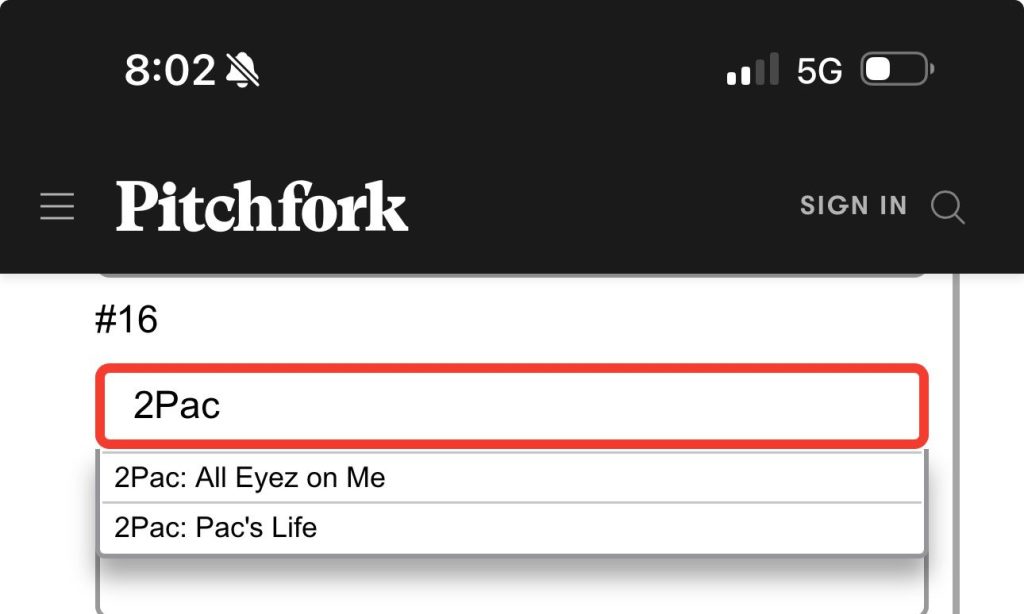
I mean don’t get me wrong, “All Eyez On Me” is an arguable choice for Tupac’s best album, but to only put that and “Pac’s Life”–Tupac’s sixth posthumous album for god’s sake–as the only two Tupac albums contending for “Best Rap Albums of All Time” is just insane.
Likewise, Pitchfork does the great rap group De La Soul dirty, excluding their re-inventive second album De La Soul is Dead, as well as Stakes Is High, their towering indictment of contemporary rap culture, from the choices.
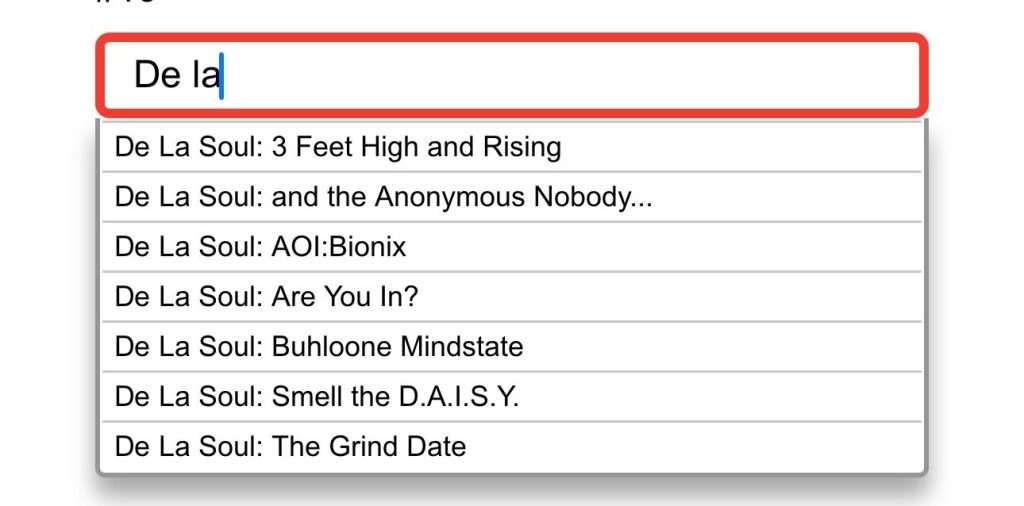
I’ve been a fan of De La Soul’s throughout their existence and I can tell you: except for their whimsical, day-glo debut “3 Feet High and Rising” or the fantastic, jazz-tinged “Buhloone Mind State” . . . NOBODY IN THEIR RIGHT FUCKING MIND WOULD VOTE FOR ANY OF THOSE ALBUMS OVER “DE LA SOUL IS DEAD” OR “STAKES IS HIGH”!!!
Maybe the worst erasure of a historically important album was of Run-DMC – Pitchfork didn’t list “Raising Hell” as an option, despite the fact that it’s a gateway album that popularized rap in the broader culture of popular music. It didn’t list the Geto Boys violent and controversial 1990 self-titled album despite the fact that its lyrical content sparked its distributor to shelve the album, a major cultural watershed in rap history that sparked a debate about rap lyrics that persists to this day. It also didn’t list any Boogie Down Productions albums except for Criminal Minded–which is a great album, but by only offering that as an option, Pitchfork erases the group’s subsequent (and pioneering) turn to non-violent Afrocentrism after the tragic shooting death of founding member Scott LaRock. It only listed Cypress Hill’s (again, admittedly great) self titled debut, but leaves off their second album, Temples of Boom, which put the group on to a whole new audience of alternative rock fans, as well as their third album, which most fully actualizes Cypress Hill’s unique combination of gothic horror and gangsta rap.
Even worse was Pitchfork’s wholesale erasure of entire artists from their selections–and I’m not talking obscure names. I’m talking about LL Cool J, a pioneering rap artist who can credibly lay claim to the GOAT,2 whose braggadocio and charisma helped him carve out a multi-decade career for himself. Or Ice-T, literally the pioneer of West Coast gangsta rap. Or Schooly-D, the creator of gangsta rap as a ge re, period. For better or for worse, rap music as a genre would not be the same today without these artists, and it is truly disrespectful to not even list them as choices to vote for.
Pitchfork tries to create a veneer of plausible deniability by noting, above the polling, that “If you’d like to add an album, please format Artist: Album Title.” I tried submitting some of the albums I reference above, but I checked later and those albums still did not show up on the dropdown menus that appear when you start typing into the polling boxes. So these “selections” are not generated from the responses Pitchfork has received; rather, they are essentially picking and choosing what is worthy of inclusion in the rap canon and what is not.3
It would be one thing if readers weren’t “prompted” with certain albums Pitchfork deemed worthy of inclusion on their eventual list. But by putting some albums and artists on the dropdown lists, and excluding others, Pitchfork and Conde Nast (to the extent there is a difference these days) is in essence trying to re-write the history of rap music without the historical context in which to do so.
So to sum up, paraphrasing the great philosopher Tupac Shakur: Fuck Condé Nast as a Staff, Publishing House, and as a Motherfuckin’ Crew…..
 RayDorl.com
Leave a comment