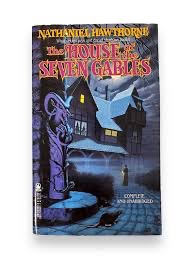
To be honest, I didn’t know much about this book and chose to review it during my “Spooktacular October” on the basis of the cover,1 which depicts a rather creepy and gothic scene, as well as my admiration for Hawthorne’s short stories “The Minister’s Black Veil” and “Young Goodman Brown,” both of which I think are effective horror stories. “The House of the Seven Gables” wound up not being so much of a horror novel; in fact Hawthorne himself referred to it as a “Romance” in his foreword to the book. But he meant that in the classical definition of a “Romance,” and notwithstanding that label, the book really does use (and pioneer) a lot of horror conventions.
WARNING: Minor spoilers for a 175-year-old book to follow
To start out with, although this book does include a romantic relationship (that is only realized in the book’s closing pages), the term “Romance” is used in the classic sense. To quote author Christopher Patton:
Like comedy, romance includes a love-intrigue and culminates in a happy ending. Like tragedy, romance has a serious plot-line (betrayals, tyrants, usurpers of thrones) and treats serious themes; it is darker in tone (more serious) than comedy. While tragedy emphasizes evil, and comedy minimizes it, romance acknowledges evil – the reality of human suffering.
That definition definitely fits the bill for “The House of the Seven Gables”–in particular, betrayals, usurpation, and human suffering are all critical to the plot.
The book begins with a Puritan of Salem, Colonel Pyncheon, accusing Matthew Maule of wizardry. The book is clear that Colonel Pyncheon’s motives, however, are material, not spiritual: Pyncheon’s true aim is to get Maule out of the way so he can annex a choice plot of land owned by Maule. Maule is dispatched, but in his dying breath, the reputed Wizard curses Pyncheon with the epithet, “God will give him blood to drink!”
Pretty hardcore, I’m sure you will agree. And soon thereafter, Colonel Pyncheon dies under mysterious circumstances, just as he is throwing a gigantic party to celebrate the building of the titular “House of the Seven Gables” on the plot of land that formerly belonged to Maule.
This is all backstory, by the way, and takes up the first eleven pages of the book. I suppose one can’t accuse Hawthorne of not using a compelling inciting incident. But soon the book slows down, and the bulk of the action takes place some 200 years later, in the mid 1800s (or around the time Hawthorne was writing). By this point, the house has fallen into disrepair and is described, by one of the characters, as such:
There is a certain house within my familiar recollection, one of those peaked-gable (there are seven of them), projecting-storied edifices, such as you occasionally see in our older towns–a rusty, crazy, creaky, dry-rotted, damp-rotted, dingy, dark and miserable old dungeon, with an arched window over the porch, and a little shop on one side, and a great, melancholy elm before it!
Sounds like a great place, right? And the once-proud Pyncheon family isn’t doing so hot, either. The aforementioned “miserable old dungeon” is inhabited by a miserable old pair of siblings–Hepzibah, a scowling old crone, and her brother Clifford, who is emotionally and intellectually destroyed after having served a long prison sentence for the crime of (supposedly) murdering his uncle. These two have a life estate in the House, and seem to be playing out the string, with their cousin Jaffrey–the son of the murdered uncle and a prominent judge–set to inherit the estate after they are gone.
Hawthorne spends a great deal of time setting up how miserable and drab the lives of Clifford and Hepzibah are in the House of the Seven Gables, with a lot of gothic imagery essentially portraying these two as ghostly presences, figments of a worn out bloodline that are essentially haunting the mansion. At one point, Clifford even vocalizes this idea:
“It is too late,” said Clifford, with deep sadness. “We are ghosts! We have no right among human beings–no right anywhere but in this old house, which as a curse on it, and which therefore, we are doomed to haunt.”
Things take a turn for the better, though, when a distant cousin, Phoebe, moves into the House. Phoebe is the daughter of a minor branch of the Pyncheon family that has come to help Hepzibah with a “cent store”–basically a little shop selling sundries such as gingerbread men, ginger beer, yeast, and other necessities of 1800s life–that she opened for some much-needed income. The young and pretty Phoebe immediately brightens the spirits of both Hepzibah and Clifford, and she also befriends Holgrave, an artist who is renting one of the many rooms at the House of the Seven Gables.
Things are starting to look up, but soon Cousin Jaffrey begins plotting nefariously, in search of document that would establish his right to some valuable land in Maine. Hawthorne really shines in his characterization of Jaffrey–in earlier chapters, Hepzibah shuns him much to Phoebe’s (and the reader’s) confusion, as Jaffrey doesn’t come across as particularly bad in these encounters. But later, even before his perfidy comes to light, Hawthorne describes Jaffrey as such:
Hidden from mankind–forgotten by himself, or buried so deeply under a sculptured and ornamented pile of ostentatious deeds that his daily life could take no note of it–there may have lurked some evil and unsightly thing. Nay, we could almost venture to say, further, that a daily guilt might have been aced by him, continually renewed, and reddening forth afresh, like the miraculous bloodstain of a murder, without his necessarily and at every moment being aware of it.
I love how Jeffrey is characterized–shades of Arthur Dimmesdale and Roger Chillingsworth from “The Scarlet Letter,” and also of the famous quote from that novel: “No man can wear one face to himself and another to the multitude without finally getting bewildered as to which may be true.”2
Being a romance in the classical sense, the book ultimately resorts to a deus ex machina to resolve things in a happy ending–or rather, four or five deus ex machinas. Suffice it to say that in the final ten pages or so, there are many happy coincidences that are barely hinted at in the previous 300 or so pages (though a reader who is familiar with the conventions of a classic romance will probably hazard a guess as to these events). I found this pretty unsatisfying, and thought that Hawthorne could have done a better job plotting out these turns of event, but again, he’s working in a classical, pre-modern genre and employs the well-worn tropes of that genre.
So overall I enjoyed this book. Its language3 and plot points are rather archaic, but it successfully evokes a gloomy, gothic atmosphere–I read somewhere that H.P. Lovecraft was a big fan–and explores interesting themes of multi-generational guilt, exhaustion of bloodlines, and the hypocrisy of the powerful.
- My copy is the Tor Classic printing, a publisher mainly known for its fantasy and science fiction works. I’m pretty sure I grabbed my copy out of a Little Free Library in my neighborhood. ↩︎
- I’m not gonna lie: the only reason I remember that quote is because it was used in the classic episode of “The Sopranos,” “College.” ↩︎
- The language took a little getting used to. Hawthorne’s prose is highly ornamented and tends to “tell not show,” but that was the style of the time, and I couldn’t help but think that in a generation or two people will be dumbed down to the level of only using emojis and three letter abbreviations for their writing, and the language used in this very blog will seem overly ornamented and pretentious. ↩︎
 RayDorl.com
Leave a comment