
How the fuck did we get here? I’m sure I’m not the only one who has thought this as masked fascist goons terrorize my city, tear gassing Halloween parades and schoolyards, crashing their cars into civilians then dragging them out of their cars to take them God knows where, and literally “disappearing” people from their families and lawyers. And that’s just the tip of the iceberg, as an unaccountable executive arrogates more and more power from supposedly coequal branches of government, bombs or intimidates more or less every other country in the Americas, sinks our economy with misguided notions of autarky, and corruptly pockets bribes, all while a steady 37% of the country continues to accept that he will “Make America Great Again.”
In hopes of understanding how exactly in the fuck we got here, I turned to Robert Paxton’s “The Anatomy of Fascism.” Before publishing this book in 2004, Paxton wrote a well-regarded history of Vichy France that bucked the conventional wisdom that it was a reluctant hostage and instead portrayed it as an enthusiastic supporter of Nazi Germany.
I first came across Paxton’s name on my favorite political blog, Lawyers Guns and Money, which often cites Paxton’s definition of fascism in various posts about the Trump administration’s latest depredations. The definition is a mouthful, but is also extremely useful:
Fascism may be defined as a form of political behavior marked by obsessive preoccupation with community decline, humiliation, or victimhood, and by compensatory cults of unity, energy, and purity, in which a mass-based party of committed nationalist militants, working in uneasy but effective collaboration with traditional elites, abandones democratic liberties and pursues with redemptive violence and without ethical or legal restorations goals of internal cleansing and external expansion.
I’m too lazy to link to news articles that demonstrate, in my opinion, that Trumpism checks all of those boxes, but the aforementioned Lawyers Guns and Money does a good job of that.
Paxton really “shows his work” in “The Anatomy of Fascism,” coming to this definition only at the very end of the book, after his exhaustive breakdown of fascism into different phases: “Creating Fascist Movements,” “Taking Root,” “Getting Power,” “Exercising Power,” and the long term prospects of fascist states, which are overwhelmingly negative.
Not surprisingly, Paxton mostly focuses on Fascist Italy and Nazi Germany in his history. Paxton points out that the ravages of the First World War and its aftermath of runaway inflation were what created the “political space” for fascism to take root. The existing “liberal” (in the classical sense) democracies in those countries were simply incapable of dealing with the almost unimaginable aftermath of World War I. In addition, Italy and Germany were both “young” democracies at this point, and Hitler and Mussolini were able to harness the disappointment and resentment of the dispossessed in a way that more traditional “conservatives” of that era–who were mostly from the aristocratic classes–were unable to do.
Paxton emphasizes over and over that it was the particular sociopolitical conditions of post World War I Europe that created the conditions for fascism: mass impoverishment, devastation that is almost unimaginable to modern Americans, the absolute decimation of an entire generation of young men, and an inability to absorb the survivors into the workforce.
At this point in the book, I found myself wondering; how did the American polity fall prey to a nakedly authoritarian con-man rapist like Trump? I’ve seen many on the left blame the Great Recession and the debacles of war in Iraq and Afghanistan; but those explanations just don’t seem to explain what is happening in our country. As bad as the Great Recession was, the American political system didn’t “fail;” in fact the recovery was fairly quick In comparison with the Great Depression, and the labor markets were never anywhere near as disrupted as in the 20s and 30s (particularly in a Germany that was also paying reparations under the Treaty of Versailles). I thought the same about the so-called “Global War on Terror;” sure, it was heinous, and sure, we were led into the war in Iraq by mendacious lies by the Bush Administration and an overly-credulous mass media. But the number of Americans whose lives were destroyed by the Global War on Terror is nothing–and I mean NOTHING–like the wholesale slaughter of World War I.1
But near the end of the book, Paxton turns to more modern European and American fascist movements, which at the time of publication (the relatively halcyon days of 2004) were only in their nascent forms and hadn’t gained any appreciable power. Paxton cooly assesses the socioeconomic changes that led the way to a resurgence of the European ultranationalist far right in the early 2000s:
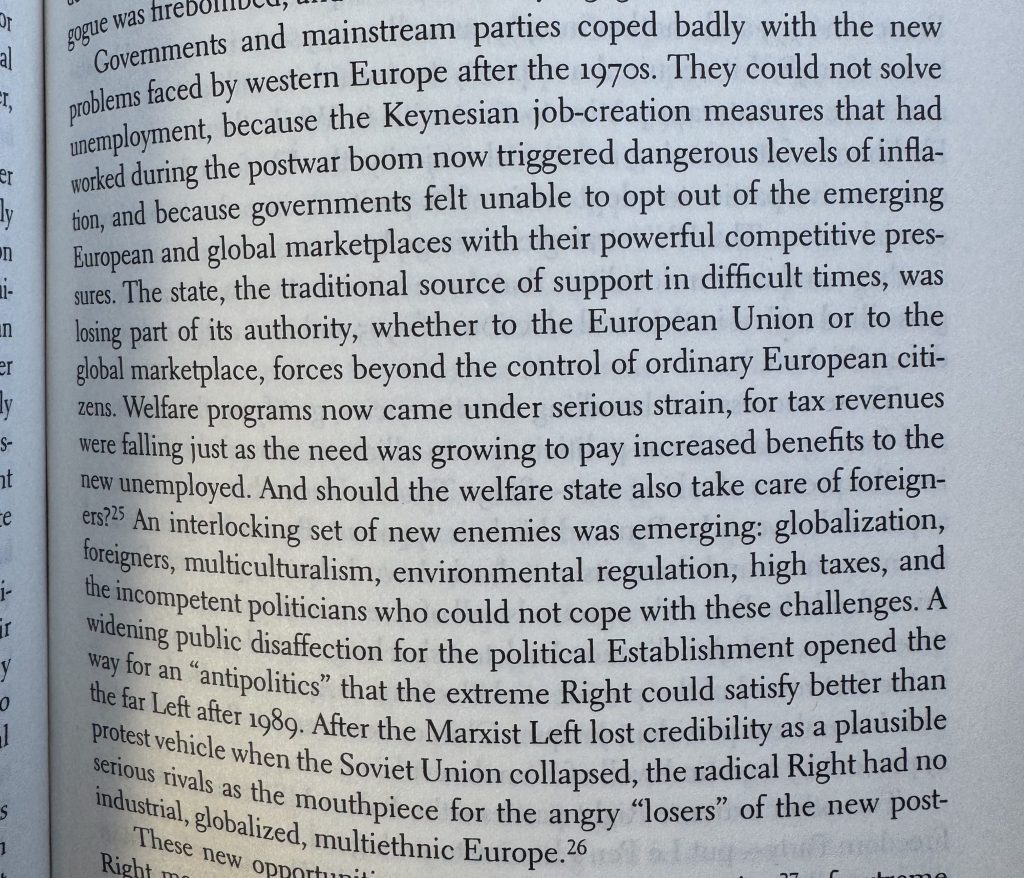
I don’t know about you, but that laundry list of post-World War II socioeconomic factors sounds awfully familiar to what has happened to the American political economy in the past 20 or 30 years.
Early on in the book, Paxton emphasizes the fact that Fascism is a mass-based movement that harnesses popular energy, and in doing so takes on the symbols of whatever culture it is taking root in. So, he notes, resurgent fascism isn’t necessarily going to look like what we’re familiar with through popular culture: black shirts, armbands with swastikas, goose stepping, and the like. Paxton–again, writing in 2004–notes the following regarding a then-hypothetical American fascism:
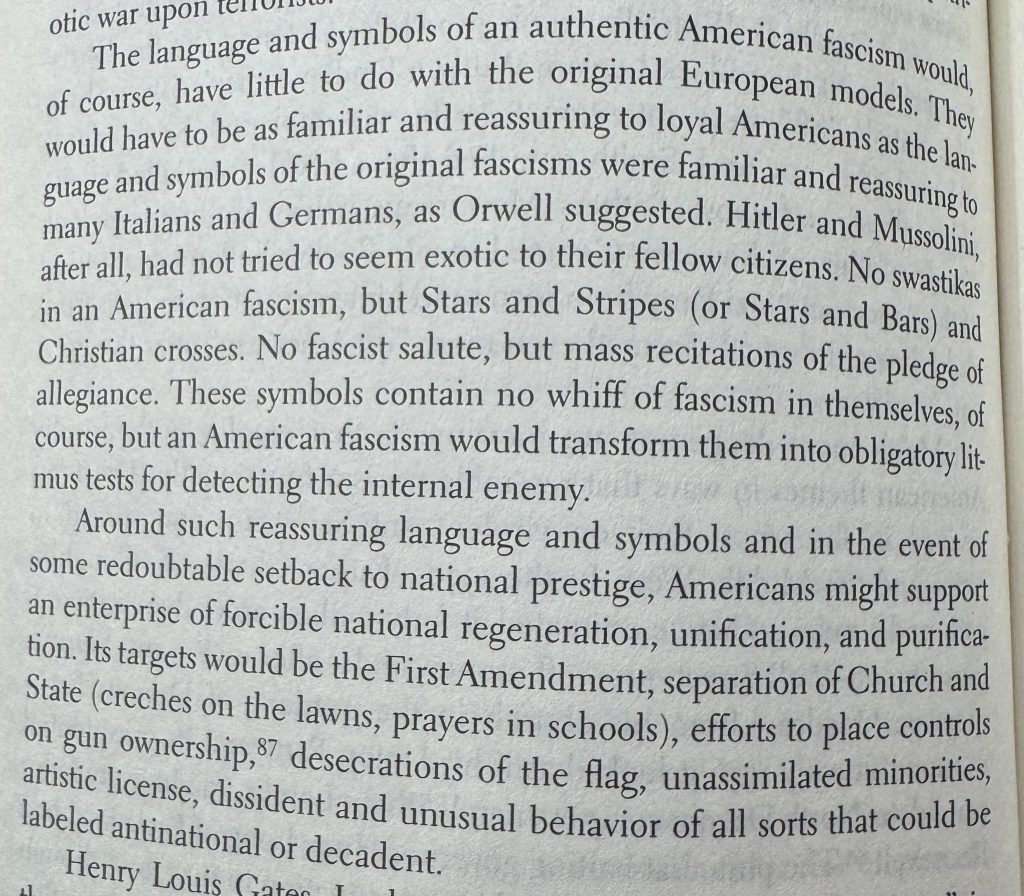
Again, I don’t know about you, but this seems awfully prescient.
Another thing that struck me about Trump’s rise to power as I read this book is the fact that while Hitler and Mussolini came to power in parliamentary systems, Trump attained power through a vastly different political system. I came to believe that Trump actually had an easier time assuming authoritarian power over the country due to the fact that the United States has a “winner take all” electoral system that essentially guarantees that there will be a two-party system. Once Trump gained a large enough mass following, the elites of the Republican Party began to accede to his demands– recall that Paxton identifes fasicsm as entailing “uneasy but effective collaboration with traditional elites”–to the point where even the Senators whose lives were threatened during Trump’s January 6 attempted coup2 would not move to convict him in his second impeachment trial.
Another factor of the American political system that differs from 1930s Germany and Italy and that seems to have really empowered Trump is that the United States has a presidential system, with the Constitution granting a great deal of power to an executive. Our presidential system can, in the euphemistic terms of an intro to political science workshop, “present[] challenges to democracy.” I’ll fucking say.
The book doesn’t give much of a silver lining for nations that are taken over by fascist movements. Paxton argues persuasively that fascist dictators such as Mussolini and Hitler, far from being omnipotent autocrats, relied on mass-based energies to come to power, and continued to rely on the enthusiasm of their base to maintain that power. This, Paxton argues, led to constant escalations of both internal repression and outward expansion, which only ceased once those nations collapsed.
Unfortunately, this feels in line with our current dilemma, as Trump has continued to up the ante since he began his second administration–increasingly militant and violent State actions via the National Guard, ICE, and Customs and Border Protection in “Blue” cities, coupled with plans for a hot war in South America, along with bluster about annexing Canada and Greenland. I hazard to guess that Trump’s violence and unhinged rhetoric will only increase as his prospects in the next midterm elections continue to sink. He’s already (illegally) attempting to outlaw mail-in voting, preparing a “rapid reaction” military force, and vowing to deploy “observers” to blue-state elections while threatening military action in South America and Nigeria.
Given the bleak outlook of this book, I found myself often asking myself–in my characteristic way of denying obvious facts that are right in front of my face–Is this REALLY fascism? But whatever denial I had was pretty much wiped away when I did a little research for this blog post and found that Robert Paxton–you know, the foremost researcher and theorist of fascist movements and the guy who wrote this book–has himself labeled Trump a “fascist.” QED I suppose. And maybe RIP.
Anyhow, by the end of the book I found myself simultaneously depressed and alarmed. Alarmed by the fact that I’m convinced that using the word “fascist” for the current administration is not an overstatement, and that a study of previous fascist states gives us a pretty good indication that things are going to get way fucking worse. Depressed by the fact that Trump could have been stopped at many points, but the political elites of this country found it too expedient to cover their eyes and pretend that a fascist takeover of our country was not happening. As I mentioned above, I think the primary culprit is a mendacious and power-hungry Republican Party, which wouldn’t even denounce Trump even after he tried to get some of its leading political actors fucking lynched on January 6. But another major “sliding doors” moment in my estimation was the Biden Administration’s–and more particularly former Attorney General Merrick Garland’s–slow-walking the prosecution of Trump for January 6. But in this case failure has many fathers (and mothers–I’m looking at you Marjorie Taylor Greene, Katie Miller, Usha Vance, etc., etc., etc.).
So why read this at all? Paxton gives us a sort of raison d’être for the book near the end:
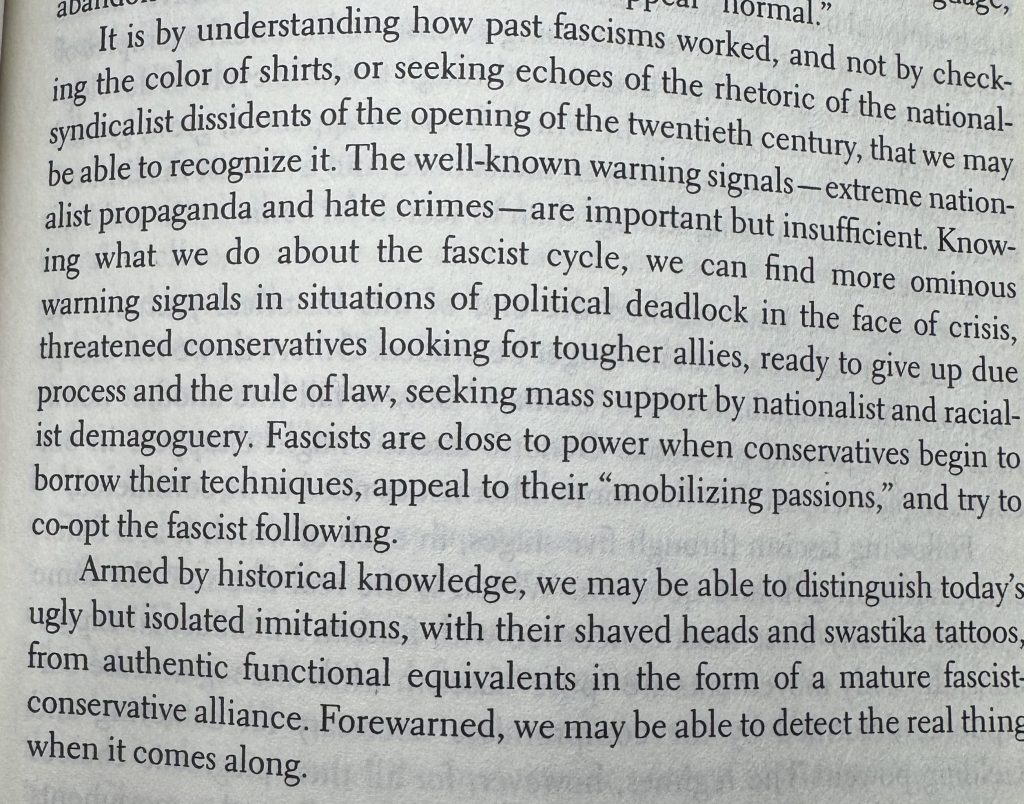
Welp, we were warned. And the people who mattered didn’t take heed. And now we all will face the consequences.
To paraphrase the late, great Hunter S. Thompson, who had a few thoughts about fascism, “Buy the ticket, take the ride.” If Paxton is right, we’d all better buckle up.
- I certainly don’t mean to dismiss the suffering of the Afghanistanis, Iraqis, or Americans who died or were physically and/or mentally maimed in those wars. But in terms of societal disruption, total U.S. casualties in both the Iraq and Afghanistan wars combined, over the course of a decade, totaled around 50,000 killed or wounded, according to Wikipedia. Compare that to the over TWO MILLION German soldiers killed (I’m not even counting the number that were wounded) in World War I, with a far lower population. The two wars just aren’t comparable. ↩︎
- Technically January 6 wasn’t a coup, it was an attempted autogolpe, but same idea. ↩︎



 RayDorl.com